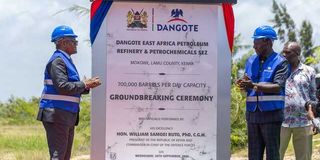
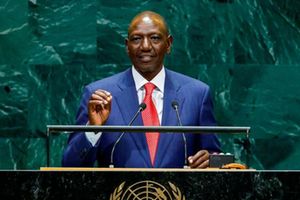
The Dangote East Africa Petroleum Refinery in Lamu broke ground on September 30, 2026, witnessed by President William Ruto and Nigerian industrialist, Aliko Dangote, amid political noise, court cases and uncertainty.
The project is a key petroleum refining and petrochemical complex, budgeted to cost between $15 billion and $17 billion (approximately Sh2.2 trillion at current exchange rates).
The facility is designed to process about 700,000 barrels of crude oil per day, alongside a 1,000MW power plant, fertiliser making plant and infrastructure for industrial materials like polypropylene.
Kenya needs a massive Foreign Direct Investment and capital injections of this magnitude to offset its huge public debt, and advance fiscal consolidation without relying solely on tax raising measures.
The project is meant to inject unprecedented private capital into the economy, easing pressure on the national budget, while targeting the country’s heavy foreign currency outflows used to underwrite fuel imports.
It is financed through 70 per cent debt and 30 per cent equity. Dangote Group and partners form the primary equity holder. The Dangote Group has offered a combined 30 per cent equity stake to governments in East Africa. Kenya is investing $500 million (about Sh64.7 billion) through the National Infrastructure Fund (NIF), to acquire a 10 percent stake in the project, allaying fears of undisclosed private ownership by political bigwigs and influence-peddlers.
The group has disclosed that plans are on to eventually float shares through an Initial Public Offer on the Nairobi Securities Exchange and give ordinary Kenyans an ownership stake.
Regarding concerns from some quarters that the Dangote Group may lack capacity to deliver the project, it is noteworthy that this company has developed and commissioned the Dangote Petroleum Refinery in Lagos, Nigeria.
The facility reached its commercial operability in 2024, at 650,000 barrels per day, providing a direct operational blueprint for the Lamu refinery.
The Lamu project will be located on 7,000-acre government-owned tract in the Mokowe/Hindi Manda Magogoni area, falling within the demarcated Lapsset corridor Special Economic Zone.
Some reports indicate that the land belongs to the Kenya Ports Authority, which is said to have compensated the legitimate landowners.
Nonetheless, some 133 residents of Chandavai have filed suits against the project, arguing that the site encompasses ancestral land their kin have occupied for centuries.
Kenyans are awaiting the outcomes of these lawsuits with bated breath. As locals and opposition politicians raise their concerns over the project, it must not be lost on Kenyans that the country relies entirely on costly imported petroleum products since the closure of the refinery in Changamwe, Mombasa, years ago.
Last year alone, for instance, the country spent Sh528.8 billion on fuel imports, gobbling up approximately 12.5 per cent of the national budget.
Undertaking the refining locally, therefore, protects the country against international supply chain shipping shocks and retains massive value within the borders.
It also provides a structural anchor for the underutilised Lamu port. It is forecast that the complex, once fully operational, will create up to 60,000 direct and downstream jobs.
With a 4,000-kilometre regional pipeline networks, the project positions Kenya as the definitive energy hub for East and Central Africa – supplying Uganda, South Sudan, Ethiopia, Rwanda, Burundi and the DR Congo.
The inclusion of a 1,000MW power plant – adding 500MW directly to the national grid – introduces a “plug-and-play” industrial hub to spur localised manufacturing.
The project will ensure fuel availability by securing local supply, significantly shielding the region from unpredictable international market scarcities. Furthermore, it will remove the hefty global shipping and landing freight costs, thus rationalising prices.
Massive reduction in fuel prices is, however, not entirely guaranteed as retail pump prices will still be subject to global crude oil market prices and local taxes.
However, the government will ensure huge revenue gains from corporate taxes, port usage fees, export tariffs and dividends via the NIF equity stake.
Some critics have noted that the country’s Lokichar oil fields cannot yield enough volumes to sustain operations of the refinery, which will necessitate importation of crude.
Be that as it may, the country will still make substantial savings by locally refining a significant proportion of fuel for domestic use.
Rights groups are concerned about the fate of the 133 households which are likely to be displaced by the project. For the sake of harmony and community support, no effort should be spared to ensure the sticking issues are resolved amicably.
At the same time, the requisite mitigation should be instituted to address the issues being raised by the environmental activists who are concerned about placing a massive facility next to a fragile Unesco-recognised marine and coastal ecosystem.
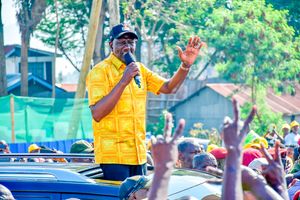
Finally, there is a huge concern that the some leaders are weaponising the project for political capital ahead of the 2027 General Election.
The opposition is evidently apprehensive that should the project succeed, President Ruto stands to reap huge political dividends as it will vindicate the investment policies of his administration.
They will, therefore, stop at nothing in their quest to portray the project as a case of corporate capture of public resources.
One thing our politicians must never forget is that elections come and go, but Kenya remains. Let us protect the integrity of our nation by promoting its objective interests above politicians’ personal preferences.
Kenya cannot afford to think twice about an opportunity of this magnitude, to inject private capital into the economy.
This project presents a huge opportunity to expand the country’s industrial base, and boost tax revenues. The Dangote East Africa Petroleum Refinery is Godsend. We must embrace it with open hands.
Prof Ongore is a Public Finance and Corporate Governance Scholar based at the Technical University of Kenya. [email protected]