By-elections have in the past served as a political barometer, offering insights into regional political shifts and voter sentiment ahead of a general election.
Although mini-polls are also influenced by local political dynamics, they point to an emerging balance of power and changes in public opinion.
Political tension, deployment of government machineries, alleged voter bribery and chaos have characterised most of the polls due to attendant implications.
Analysis of mini-polls since 2017 shows how such contests have somehow predicted future electoral prospects by testing the popularity of political parties, voter sentiment and changing political alliances.
In the Ol Kalou poll, Democracy for the Citizens Party (DCP) candidate Sammy Kamau Ngotho won after securing 35,440 votes. President William Ruto’s United Democratic Alliance (UDA) candidate, Samuel Muchina Nyaga, came a distant second after polling 5,450 votes.
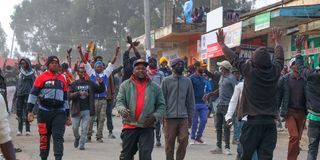
A man brandishes a button as residents of Ol Kalou chase away vehicles carrying hooded gunmen who attempted to force their way into at AC Primary School polling station during the Ol Kalou by-election on July 16, 2026.
Photo credit: Boniface Mwangi | Nation Media Group
Former Deputy President Rigathi Gachagua’s DCP on Friday said the win confirmed the party’s dominance in the region ahead of the 2027 General Election.
UDA exploited mini-polls before the 2022 elections to make a triumphed entry into Mt Kenya following a bitter fallout between Dr Ruto and his then boss, President Kenyatta.
UDA clinched its first elective seat in the Rurii ward by-election. Rurii is in Ol Kalou constituency. In the May 18, 2021 by-election, UDA candidate Francis Muraya polled 4,178 votes against then ruling Jubilee Party, whose candidate, Peter Thinji, garnered 3,051.
UDA again won in the July 15, 2021, Kiambaa by-election. Njuguna Wanjiku of UDA bagged a narrow win against Kariri Njama of Jubilee.
Dr Ruto secured yet another victory in Juja when he backed George Koimburi, who contested on the People’s Empowerment Party in the May 19, 2021, by-election. Mr Koimburi won by polling 12, 159 votes against Jubilee candidate Susan Njeri, who came second by polling 5,764 votes.
UDA would later, in August 2022, ride on the victories in the region against Jubilee to sweep the majority seats in the region. In the presidential race, Dr Ruto secured close to three million votes to ascend to power, beating the late Raila Odinga , who had the backing of Mr Kenyatta.
In the period preceding the 2022 polls, the Bonchari by-election also offered major political trends. Despite the 2018 handshake between Mr Kenyatta and Raila, Jubilee and Orange Democratic Movement (ODM) clashed for the seat occasioned by the death of John Oroo Oyioka, who died on February 15, 2021. In the polls, ODM’s Pavel Oimeke won after polling 8,049 votes against Jubilee’s Zebedeo Opore, who garnered 7,279 votes.
The poll was characterised by claims of deployment of police and State machinery to influence the outcome. Jubilee deputy party leader Fred Matiang’i, who was then Interior Cabinet Secretary, was accused by ODM of being behind the deployment.
“An election process is an opportunity for the voters to express their will at the ballot and not an avenue to pursue imaginary and short-legged political interests,” Mr Odinga said.
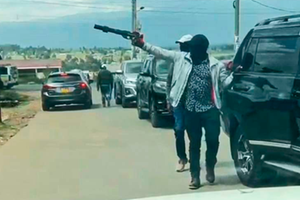
A screengrab of a video shows hooded men brandishing guns and hurling tear gas canisters at residents and journalists during the Ol Kalou by-elections on July 16, 2026.
Photo credit: Pool
He added, “What we have witnessed in the by-elections in Bonchari and Juja is an abuse of police powers and an arrogant display of impunity by a few overzealous and bellicose government functionaries.” In 2022, ODM emerged as the most dominant party in the Gusii region.
Other by-elections that offered major political insights in the run up to the 2022 included Kabuchai, Matungu and Msambweni.
Heavy deployment of police, alleged bribery and chaos characterised the elections in Kabuchai and Matungu that were held on March 4, 2021. In Kabuchai, the battle was seen as a contest between Ford Kenya of Moses Wetang’ula and UDA of the then Deputy President, Ruto. Mr Wetang’ula and Dr Ruto were on opposing sides.
Dr Ruto accused the police of siding with Ford Kenya in the polls. When IEBC declared the results, Ford Kenya’s Majimbo Kalasinga won by polling 19,274 votes, with his closest rival, Evans Kakai of UDA coming a distant second after garnering 6,445 votes. The now-defunct Amani National Congress (ANC) won Matungu through Oscar Nabulindo.
In Msambweni, independent candidate Feisal Badar won the December 15, 2020, hotly contested by-election by beating ODM’s Omar Boga. Mr Badar was backed by Dr Ruto.
The loss by UDA in Ol Kalou is interpreted as a rejection of Dr Ruto’s administration in Mt Kenya that voted him to a man in 2022. The outcome is also likely to see more elected leaders defect and align with the DCP for political survival.
For DCP, the win buttresses the perception that UDA has lost ground in the region. It also validates Mr Gachagua’s claims that DCP is the dominant outfit in the region ahead of 2027.
UDA Secretary-General Hassan Omar said President Ruto is not giving up yet on the region despite the discouraging outcome. He said UDA still considers Mt Kenya as its political stronghold.
“We will participate in elections everywhere. The President is not giving up and will compete in every corner of this world. We will participate with the same audacity. We were selling development while others were selling emotions,” said Mr Hassan, adding that “UDA invested heavily because this is our stronghold”
DCP candidate Sammy Waweru Ngotho casts his vote at AC Ol Kalou Primary School on July 16, 2026.
Photo credit: Boniface Mwangi | Nation Media Group
But Prof David Monda – a US-based university lecturer and political analyst – said the outcome is an indication that Mt Kenya has left UDA. He said the vote shows the contempt the region has for President Ruto.
In his observation, he said, the President needs to invest scarce election resources in regions where he has a chance of winning, not in lost causes like Ol Kalou, and Mt Kenya as a whole.
“UDA should anticipate an avalanche of defections, especially from the Mountain, as the elections draw near, as politicians begin testing where the wind blows. UDA is a non-starter on the Mountain,” noted Prof Monda.
He said the outcome is a pointer that the use of money, armed goons, and State resources to influence elections does not always win.
UDA and its broad-based partner ODM have, however, maintained a winning streak in the recent mini-polls.
The team won Mbeere North, Ugunja, Banisa, Kasipul, Magarini and Malaba parliamentary seats. It also captured the Baringo senatorial seat in the November 28, 2028 mini-polls. UDA secured another win in Emurua Dikkir after its candidate Peter Keter polled 18,266 votes against DCP’s Vincent Rotich, who polled 10,760.
The latest survey by Infotrak released on Monday shows UDA has lost backing in some of its traditional bases, especially Mt Kenya. The shift is linked to the impeachment of Mr Gachagua.
According to the poll, UDA enjoys a paltry nine per cent backing in Mt Kenya, in a sharp contrast to the overwhelming support in the run up to the last general election.
The 10 Mt Kenya counties and the seven from the North Rift collectively handed him 4.5 million votes, which translated to 63 per cent of his total votes. Laikipia, Tharaka-Nithi, Murang’a, Kiambu, Nyeri, Kirinyaga, Nyandarua, Embu, Meru and Nakuru collectively gave Dr Ruto nearly three million votes.
But this has since shifted as DCP now emerges as the most popular party in the region at 33 per cent. About 36 per cent are undecided.
UDA’s largest support comes from North Eastern at 45 per cent, Rift Valley (39) and the Coast (29). In Western, UDA boasts 18 per cent approval, Eastern (16), Nyanza (13) and Nairobi at eight per cent.
ODM, on the other hand, has had its popularity drop from 38 per cent in September 2024 to the current 21 per cent approval rating. The broad–based government has been a major point of political differences within the party.
The late Raila entered the deal with President Ruto following the June 2024 Gen Z protests. Emergence of Linda Mwanachi, led by Nairobi Senator Edwin Sifuna, Siaya Governor James Orengo and Vihiga Senator Godfrey Osotsi, is largely linked to the political deal. The Linda Mwananchi camp is opposed to Dr Ruto’s re-election.
ODM remains strong in Nyanza at 50 per cent, Coast (46), Western (32), North Eastern (23), Nairobi (16), Rift Valley (11), Eastern (7) and Central (6).