Ruto: Our economy is expanding despite global uncertainty
Kenya is already in the 2027 election cycle. Public debt is one of the sticking campaigning points for both opposition and government-leaning candidates.
According to the opposition, the government is over-borrowing to finance its largesse and insatiable appetite for funds. On the other hand, the government has maintained that Kenya is pursuing a strict austerity regime in line with its stated fiscal consolidation objectives.
However, one nagging question remains unanswered: what is the state of Kenya’s public debt? The latest verified reports by the National Treasury, and Central Bank of Kenya (CBK) place the country’s total public debt at approximately Sh13.53 trillion (September 2026), out of which Sh7.73 trillion is domestic, while Sh5.80 trillion is from offshore sources.
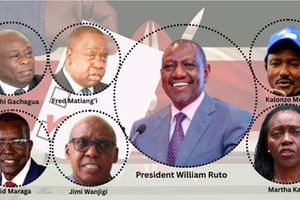
The elephant in the room is: how did Kenya find itself in this debilitating debt situation? In March 2013, the Mwai Kibaki/Raila Odinga “Grand Coalition” government bequeathed to Uhuru Kenyatta’s administration a total public debt of Sh1.79 trillion. Within 10 years (2013-2022), the Uhuru administration accumulated additional Sh8.51 trillion in loans, driving public debt to Sh10.3 trillion, an increase of more than 475 percent, or 47.5 percent per annum. The key drivers of this accelerated debt accumulation were mega-infrastructure projects such as the SGR (Mombasa-Nairobi-Naivasha Phase 2A), costing over Sh500 billion, and Nairobi Expressway. Others were expansion of the Mombasa and Lamu ports, major road networks, and expansion of geothermal/power transmission.
Audits by the Office of the Auditor General (OAG), and parliamentary inquiries have highlighted major governance and value-for-money concerns during the 2013-2022 borrowing boom. A special audit by OAG on the 2014 $2 billion Eurobond found that the proceeds could not be traced to specific development projects.
Subsequent OAG audit reports flagged Sh1.13 trillion in borrowed funds between 2010 and 2021 that lacked clear project linkages. In addition, there were concerns regarding exaggerated land compensation costs along the SGR corridor. Further audits revealed that dozens of project loans were executed with neither the mandatory legal opinions from the Attorney General nor parliamentary approvals.
Official National Treasury records indicate that between September 2022 and November 2026, the Ruto administration borrowed between Sh3.23 trillion and Sh3.6 trillion. In the same period, government spent Sh5.8 trillion on total debt servicing, much of which went toward retiring and refinancing expensive short-term Uhuru-era commercial debts
In February 2024, for instance, the government used $1.5 billion Eurobond to buy back the maturing June 2024 $2 billion Uhuru-era Eurobond. Additionally, the February 2026 $2.25 dual-tranche Eurobond was used to buy back $415 million of 2028/2032 notes, and refinanced near-term maturities.
These strategic decisions were made to save the country from relapsing back to the junk territory, which would have worsened its credit rating, denying it access to concessional loans.
It is therefore, clear that under President William Ruto, the country’s debt appetite has been contained to the level of necessity. Kenya is not completely out of the woods yet as far as debt distress is concerned. The Uhuru legacy debts are driving the government crazy. Were it not for these debts, the current administration would probably have managed its fiscal consolidation much better with very little external debt. It is estimated that save for the debt rollovers relating to Uhuru-era, Ruto administration has acquired not more than Sh2.0 trillion in offshore loans.
The projected FY 2026/2027 ordinary revenue (VAT, customs duty, income tax and excise duty) is about Sh2.99 trillion. On the other hand, the projected total public debt servicing for the year ending 30 June 2027 is Sh2.301 trillion (interest Sh1.295 trillion; principal redemption Sh1.006 trillion). This translates to about 76.95 percent of all tax revenue collected by the Kenya Revenue Authority (KRA) being used for debt repayments.
Put differently, Sh4 out of every Sh5 collected by KRA goes towards debt repayments. Further still, what this means in practice is that for every Sh1.25 that the KRA collects in ordinary revenue, Sh1.00 is required to recover maturing debt (principal and interest), leaving only Sh0.25 (roughly Sh583 billion) to fund development and cost of governance (including transfers to counties, and salaries). The public debt -to-Gross Domestic Product (GDP) ratio stands at 72.3 per cent (World Bank’s November 2026 estimates). On its part, the IMF World Economic Outlook projects a figure of 72.9 percent.
Using the Present Value figures rather than nominal face value, the National Treasury estimates the ratio at a slightly lower figure of 66.9 percent to 70.2 percent. Even if one uses the National Treasury figures, debt service-to-revenue is still high, hovering around 65 per cent to 69 percent of GDP. This is way above Kenya’s own self-imposed debt anchor of 55 per cent of GDP. In FY 2025/2026, interest payments alone (Sh1.07 trillion) outstripped the entire development budget of the country (Sh531 billion).
In the FY 2025/2026, fiscal deficit widened to 6.8 per cent of GDP (Sh905 billion) against a target of 4.7 per cent (about Sh630 billion) due to supplementary budgets and revenue shortfalls. Heavy domestic borrowing (over Sh1 trillion planned for FY 2026/2027) keeps treasury bills yields high, exposing commercial banks to sovereign risks (crowding out), and undermines credit access for private enterprises. This curtails capital formation, slowing down tax base expansion and tax collection.
With revenue shortfalls, there is more demand for debt financing to support the budget, hence exacerbating the fiscal deficit situation, and throwing fiscal consolidation efforts off balance. As the country is forced to borrow more for budget support, the risk of debt distress surges, and the country’s credit rating remains deep in speculative (junk) territory.
Efforts to improve the country’s credit rating have been grossly undermined by maturity of Uhuru-era loans in quick succession, forcing the country to remain constantly vigilant against any possibility
of default. Consequently, in 2024, the major credit rating agencies (Moody’s, S&P Global, and Fitch) moved Kenya’s rating out of Caa1 where it was consigned due to pressure of repayments of Uhuru-era loans to B3, B, and B-, respectively, with positive outlook. In conclusion, the Ruto administration has so far demonstrated low debt appetite, while at the same time rolling over expensive Uhuru -era legacy debts that are really undermining fiscal consolidation efforts.
Nonetheless, there’s a positive outlook as Kenya streamlines its debt management to prevent any default. This view has been confirmed by major global credit rating agencies. The country must however, jealously protect these gains by not allowing injection of excess election-related liquidity into the economy in the next nine months.
Professor Ongore is a Public Finance and Corporate Governance Scholar based at the Technical University of Kenya. [email protected]