At 60 years plus, Kenya is still quite young as a modern nation-state. However, looked at differently, this is an age when human beings are not only called ‘old’ or ‘aged’ but can also be grandparents, whether one has children who now have children or not. In many cultures it is an honor to be called ‘grandpa’ or ‘grandma’ or even just Mzee - remember why Jomo Kenyatta was called Mzee! The title speaks of experience because one has lived for six decades plus; that life experience symbolizes wisdom, which stands for collective investment that other members of the society may seek to imbibe and use. One doesn’t just become a grandparent though?
One must be productive. One must nurture life and build their family and community. Is this what Kenyans have done for the past 60 plus years? Does Kenya qualify as a land of growth, experience and wisdom that can serve all its citizens equitably?
This is not just a rhetorical question. It is a question that takes one back to the arrival, departure and the aftermath of the country’s colonizers. The British arrived on the shores of this land as adventurers and prospectors. They settled as exploiters of the land, farming, mining and extracting other resources that would make most of them prosperous but also support the growth of their empire.
When they established a government, it was only to serve their interests - economic, political, cultural, legal, and in other ways. It was only natural that the women and men who they dominated would be excluded from their colonizers’ ways. For, the colonialists served her majesty’s government, in far away England.
Kenyan freedom fighter, the late Achieng’ Oneko.
Photo credit: File | Nation Media Group
Thus, when non-European Kenyans agitated to be included in the affairs of the government; when the people at the Coast of Kenya, in Central Kenya, Rift Valley or Nyanza petitioned to be treated fairly, to be allowed opportunities to trade or cultivate some crops or keep some livestock like the European settlers, did they do so because they had accepted to be ruled by the European strangers in their land? Did those who protested against the discrimination by the oppressive colonial government do so in the name and service of their brothers and sisters in their respective communities?
Granted, Jomo Kenyatta may have been sent to England to present a petition by his community, which was largely aggrieved about land appropriation by the settlers. But, when he ‘overstayed’ in England, was he still representing his people? Can we say that Kenyatta’s petition represented the interests of other, non-Kikuyu, Kenyans? When Ramogi Achieng' Oneko travelled to England, also to deliver a petition, was he representing the interests of all ‘African’ Kenyans at the time?
These questions are directly related the story of the men and women who Kenyans call ‘freedom fighters,’ a story that remains deliberately partially told since independence. This story, which is also the story of the making of Kenya as a nation-state, always seems unable to rise from under the rubble of the country’s troubled history.
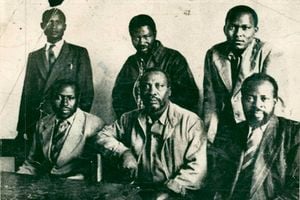
Why did men such as Ramogi Achieng' Oneko, Bildad Kaggia, Kungu Karumba, Paul Ngei, Jomo Kenyatta and Fred Kubai have to be imprisoned in the name of contesting the authority of the colonial government only for some of them to suffer a similar fate after independence? Did these men, if we take them as representative of the larger anticolonial struggle, ever share a dream of what Kenya should or could become at the end of colonialism?
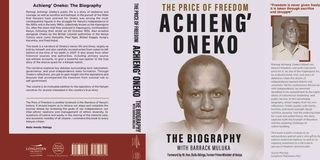
Reading the biography of Ochieng' Oneko, The Price of Freedom (Mvule African Global Profiles & Biographies and Longhorn Publishers, 2026), one is confronted by what appears to have been different struggles or pursuits within the team that Kenyan historians associate with anticolonial struggles.
Achieng' Oneko’s case is an intriguing one. The Luo boy from Uyoma, Bondo sub-county, Siaya County, born in 1920, like many young people of his time, desired to go to school, partially driven by his father’s commitment to take all his children to school. School represented something new. Oneko noted that by the time he was in second year at Chianda Sector School, his own “people had begun to recognise the importance of school. Children who attended school began to be treated with some degree of respect in the village, even by older people.”
The cover of Achieng Oneko’s biography ‘The Price of Freedom’ written by Barrack Muluka.
Photo credit: Pool
He recorded that his teachers identified him as a “pupil to watch because of my performance in class.” Oneko as a self-driven pupil who would walk 16 kilometers to and from school, a determination that takes him to the prestigious Maseno School in 1936. That desire for new things would propel Oneko to leave Maseno and the village behind in search of a future in Nairobi.
At Maseno, Oneko would go on to become not just an excellent scholar but also a very competitive athlete. Oneko schooled with several men who later became significant public figures in the country including, David Wasawo, first Luo professor; John Ouya, Medical Officer of Health; Senator James Machio; Nathan Munoko, Cabinet Minister; Wycliffe Works Wasya Awori (WWW), member of parliament and journalist, among others.
After Maseno, Oneko was employed by the government in the East African Meteorological Services in 1941, through the intervention of his Maseno School headmaster, Carey Francis. The Maseno experience, the progress of his schoolmates in life and his employment combined to create an acute sense of awareness about his identity as an black person in Kenya, even though as he noted, he “was doing very well” in his job by 1944, when he was 24 years old. He would marry his fiancee, Jedida the same year.
But what would drive a man who was employed by the government in a job that placed him way above those of his age and race, and had just been married, into the tumultuous world of politics at the time? What made Oneko resign his job to try his hand at managing a newspaper, Ramogi? Was it stories of “gallant Kikuyu people who were questioning the colonial order in our country” or the effect of tales by soldiers coming back from the 2nd World War or his own contact with public figures such as James Beauttah or the spirit of his father, who had been a soldier?
Or, could it have been the dream of ‘enlightening’ his own Luo community through a newspaper, in the manner of Baraza for Kenyans who could read Kiswahili and the Kikuyu newspaper, Mwigwithania? When he surprisingly resigned from his government job, Oneko had already established Ramogi. He was already involved in the activities of the Luo East African Union, which sought to bring together Luo-speaking people in East Africa, where he “quickly rose to the position of Secretary” in 1943.
The Kapenguria Six. Seated: Kung’u Karumba, Jomo Kenyatta and Bildad Kaggia. Standing: Achieng Oneko, Fred Kubai and Paul Ngei.
Photo credit: File | Nation Media Group
Leaving government service enabled Oneko to focus on managing Ramogi as well as freed him to be involved in politics. At the time, Oneko notes that he was undergoing a serious identity reawakening. He dropped his Christian name, Richard and adopted the moniker, Ramogi. He also thought more about the abduction of his great grandmother by European slave traders long before he was born.
However, it is his journalism that would propel him onto the national political stage. Joining KAU and getting closer to the emerging political elite in Nairobi placed Oneko within the larger Kenyan political scene much earlier than even Jaramogi Oginga Odinga, who would become more prominent later. Oneko was among the lot of politicians who organized the first KAU meeting in Nairobi in 1946.
It is Oneko who introduced Odinga to Kenyatta in Maseno. These were no mean achievement for someone so young, and one who was hardly settled in Nairobi, the hotbed of national politics. Oneko’s political journey would lead him to prison for nine years but it would pay off with a Cabinet appointment when independence was attained. However, by 1969 the KANU government was in a disarray and Oneko resigned from government to join Odinga in the Kenya People’s Union (KPU).
So, how did things fall apart between Oneko and Kenyatta after independence? How could Kenyatta detain Oneko, the man who took Kenyatta to Nyanza, and even named a bedroom in his house ‘the Kenyatta room’ after the president spent a night there? What forces pushed Oneko to leave his beloved KANU and resign as the Member of Parliament for Nakuru Town? Was it the ideological differences that would be cited by commentators as separating the supposed capitalist vision of Jomo Kenyatta and his team from that of Oginga Odinga and his followers?
As the biographer notes, even towards the end, when the relationship between Kenyatta and those who were opposed to the direction that the governing party and the government were taking, Oneko still imagined that he could talk to his co-detainee of nine years. But he couldn’t reach Jomo “…as the solid iron curtain around him had now become impossible to penetrate.”
Maybe, one can conclude, that by the time the Kenya gains independence, the likes of Oneko were too idealistic, dreaming of an inclusive nation-state when some of their colleagues dreamt of a ‘colonial-era’ type of political arrangement. This mismatch in dreams can aptly be described as the ‘price of freedom’ that Oneko paid and other progressive Kenyans continue to pay to date.