Charles Gathara arrived at the Jomo Kenyatta International Airport (JKIA) early last Monday, ready to board a flight to Accra.
He was leading a technical team to Ghana for a mission that most — not even many of his colleagues at City Hall — knew about: a due diligence exercise which involved getting a feel of the controversial Zoomlion Ghana Ltd’s waste management operations.
Mr Gathara and his team were to depart at 5.05am and land in Accra five hours later, where Zoomlion’s protocol team was expected to put on a show dazzling enough to remove any doubts the visitors still had.
First, aviation workers downed their tools, delaying all flights from JKIA.
Then Mr Gathara, who had served for over a decade as deputy director for Water and Sanitation at City Hall, collapsed and died while waiting for the chaos from the workers’ strike to end.
While the sudden death dampened the spirits of the travelling party, the other members of the due diligence team still departed for Accra aboard a Kenya Airways flight.
The Boeing 737-86N, flying the call sign KQ508, eventually took off at 8.53pm and landed in Accra slightly over five hours later. A protocol team from Zoomlion in Accra endured the over 15-hour delay and received the due diligence team, ready to prove that the Ghanaian firm was fit for the multibillion-shilling deal, which will run for two-and-a-half decades.
The due diligence team spent the next three days in Ghana, visiting various sites at the heart of Zoomlion’s operations.
Governor Johnson Sakaja is angling to award Zoomlion a contract for waste management in Nairobi County, a move that could edge out several local firms — some owned by powerful politicians — that have aggressively controlled that space.
While the paperwork may exclusively read City Hall, President William Ruto has in the past seven months left the national government’s fingerprints at the scene, with hints that his administration was on the brink of solving Nairobi’s garbage problem once and for all.
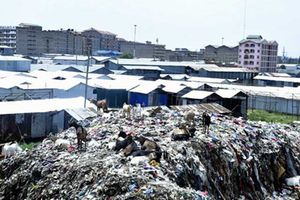
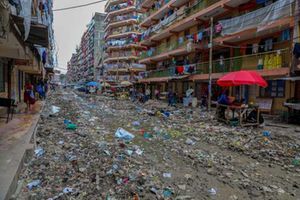
A woman walks on a heap of uncollected garbage at Muthurwa Market in Nairobi on December 16, 2025.
Photo credit: Dennis Onsongo | Nation Media Group
President Ruto, in his statements, confirmed that his administration has been part of the procurement process that has birthed the Zoomlion deal, albeit from the sidelines.
“Nimesema kwamba shida ya takataka Nairobi (I have said that the waste management problem in Nairobi), the national government is going to support the county government to deal with the menace of waste and garbage in Nairobi. Kuna (there is) procurement county wanafanya (are doing), we are supporting them so that we provide a lasting solution to that challenge,” President Ruto said in a January 20, 2026 address in Nairobi.
Much like forbidden love, Kenya’s dalliance with Zoomlion was kept secret throughout the procurement and contracting stages, with only a few at State House and City Hall aware of the goings-on.
From garbage collection to the generation of electricity from solid waste, President Ruto and Mr Sakaja have pitched Zoomlion as the only solution to an itch that Nairobi has been unable to scratch for decades.
On August 13, 2025, at the Devolution Conference in Homa Bay, the Jospong Group of Companies was allocated a stand, which President Ruto visited on the opening day. Zoomlion Ghana Ltd is a subsidiary of the Jospong Group of Companies. President Ruto then hailed the firm for its work in Ghana and would, over the next few months, tell Nairobians that his administration was working with Mr Sakaja to solve the waste management problem.
On August 23, 2025, Zoomlion Waste Services Ltd was incorporated in Kenya. Zoomlion Ghana Ltd was listed as the sole shareholder. Ghanaians Said Haidar and Joseph Kwame Siaw Agyepong were listed as directors.
Mombasa lawyer Heeral Vishal Soni is the sole Kenyan in the new company’s top hierarchy, listed as a director without shares. In October, civil rights group Centre for Litigation Trust (CLT) sued Mombasa County, seeking details of a waste management contract that Governor Abdulswamad Nassir’s administration had entered into.
It emerged that Mombasa County had signed a contract with Zoomlion for waste management services for a period of 35 years, with the contract sum cited as Sh17 billion. CLT has asked the High Court to declare the contract illegal, holding that the procurement was done in secrecy and without public participation.
Barely four months later, Nairobi is walking the same path as her coastal sister.
On December 18, Nairobi County advertised a waste management tender, with the winning bidder to execute the agreed functions for up to 25 years.
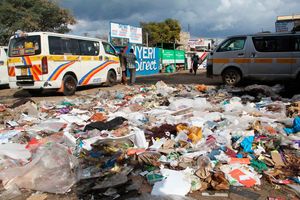
People walk past a heap of uncollected garbage at Muthurwa Market in Nairobi on November 2, 2025.
Photo credit: Dennis Onsongo | Nation Media Group
Last Saturday, in an interview with Nation, Governor Johnson Sakaja publicly admitted for the first time that the firm had been contracted. He followed the admission with multiple denials of potential expensive legal exposure to City Hall and, by extension, taxpayers on account of the Zoomlion deal.
Mr Sakaja further denied allegations that Green Nairobi Company Ltd — the firm incorporated to handle waste management in the county — is set to become dormant just months after he touted it as the city’s waste management solution.
Instead, he said Green Nairobi Company Ltd is the contracting party in the Zoomlion deal, comparing it to the Nairobi Water and Sewerage Company.
While it does City Hall’s bidding, the firm executes functions such as procurement in its own name. This means that for Green Nairobi Company Ltd to be the contracting entity in the Zoomlion arrangement, the advertisement, evaluation and declaration of a winning bidder in the procurement process would have been done by the company itself, not City Hall.
The tender documents uploaded by City Hall on its website and the PPIP also state that the contracting authority in the tender now awarded to Zoomlion is the Nairobi City County Government.
“The new partner coming in will do three things. One, under the Green Nairobi Company, they will deal with the first point of collection together with our staff. Then they will do transfer stations, then recycling. So that there’s a profit element that comes out of the garbage. You see, the problem has been it’s been a zero-sum game,” Mr Sakaja said in the interview.
“If you pick up these things today, there’s no money they give you, there’s nothing to fund that activity. But the fertilisers that come out of it — remember we’ve been discussing waste-to-energy, which is another step — then create an incentive for somebody to invest in that process with a long-term concession,” he added.
Last Tuesday, Prime Cabinet Secretary Musalia Mudavadi, Attorney-General Dorcas Oduor, Nairobi County Attorney Christine Ireri and Mr Sakaja signed a co-operation agreement which they said will see the national and county governments work together on some functions, including waste management.
Nairobi County Governor Johnson Sakaja (centre left) and Prime Cabinet Secretary Musalia Mudavadi (centre right) during the signing of a cooperation agreement between the National Government and the Nairobi City County Government at State House, Nairobi.
Photo credit: Wilfred Nyangaresi | Nation Media Group
“In furtherance of this objective, the parties shall collaborate in the following areas… refuse collection, management of refuse dumps and solid waste disposal to improve public health within the capital city through enhanced and integrated waste management systems,” the agreement reads in part.
Mr Mudavadi and Mr Sakaja presented the agreement to Kenyans as a 50-50 partnership. However, the national government will have significantly more representation on the committee, in addition to holding the powerful seat of chairperson. County Attorney Ms Ireri will represent City Hall, alongside two other individuals nominated by Mr Sakaja.
Mr Mudavadi will chair the steering committee, with Mr Sakaja as vice-chairperson.
Attorney-General Ms Oduor and the six Cabinet Secretaries for Interior, Treasury, Lands, Environment, Water and Energy will represent the national government on the steering committee.
None of the county executive committee members in charge of the relevant functions under the co-operation agreement has been co-opted onto the steering committee.
But as a storm looms over the co-operation agreement and the procurement process that led to Zoomlion being contracted, the Ghanaian firm’s operations in Ghana could trigger another round of controversy.
In the Ghana Auditor-General’s report for 2024, it was noted that in several zones where Zoomlion is contracted to operate, it did not repair damaged vehicles and equipment. It also supplied fewer vehicles and items of equipment than paid for.
In 2024 alone, the firm failed to supply 32 skip trucks — vehicles fitted with containers that carry and ferry collected solid waste — and 173 containers. It also failed to repair 38 broken skip trucks and 164 damaged containers.
In municipalities like Ahanta West, trucks that broke down in 2019 had neither been repaired nor replaced, as per the audit report. Zoomlion received Sh4 million (345,718 cedis) for no work done for the Korle Klottey Municipal Assembly in Accra. That trend was repeated in other municipalities.
“This situation affected the haulage of waste, which adversely affected sanitation conditions in the respective communities. We recommended that the management of the Assemblies engage Zoomlion to provide the remaining skip trucks and solid waste containers as per the contract. We also urged management to exercise strong oversight on the activities of Zoomlion,” Auditor-General Johnson Akuamoah Asiedu said in his report. The same issues were raised in past audit reports.
Zoomlion Ghana Ltd served a two-year ban from World Bank projects between 2013 and 2015, following findings that its officers paid bribes to Liberian bureaucrats. The bribes were paid to secure contracts and fast-track payments under a World Bank-funded project in Liberia.
Garbage on a street in Nairobi's Pipeline estate on November 16, 2025.
Photo credit: Dennis Onsongo | Nation Media Group
The firm’s chief strategy officer at the time, Mokhles Bustami, said the debarment was a wake-up call to do better and strengthened Jospong’s resolve to grow into one of the leading groups of companies in Africa.
Multiple stories published in Ghanaian outlets over several years have alleged that Zoomlion overcharged the government for equipment and services. The firm has also been accused of paying workers less than what it billed the government for salaries.
In Nairobi, Mr Sakaja said existing contractors will not be released, but will work under the firm that will take over.
“No, they can still be contracted by Green Nairobi. Because today, if we start, you need trucks in different parts of the city. So, it’s always a hybrid solution. That’s why I’ve given the example of DSNY in New York — you have the city, but the other companies you see are contracted again by DSNY,” Mr Sakaja said.
He also suggested that the shake-up has already driven out firms that previously relied on inflated or fictitious billing.
“Today, there are fewer than 20 such companies operating day-to-day,” he said. “They’ve run away because the system has changed.”