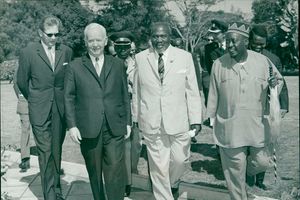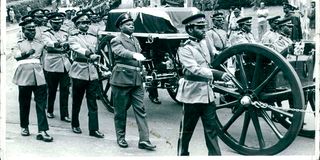
August 31, 1978: A gun carriage with Mzee Jomo Kenyatta's flag-draped coffin is drawn through the streets of Nairobi for the funeral.

On August 22, 1978 President Jomo Kenyatta died in Mombasa after 15 years in office. Though the official government statement was that he died peacefully in his sleep due to age-related complications, claims of neglect by those around him continue to swirl.
Fuelling this speculation is the fact that only one nurse was present when Mzee suffered a medical emergency, the oxygen cylinder at State House was empty and his cousin Njoroge Mungai, who also doubled up as his physician, was in Nairobi at a time the president appeared visibly unwell in Mombasa.
Perhaps if contingency measures contained in a previously highly restricted document recently seen by the Weekly Review had been adhered to, things could have turned out differently. The document marked “Top Secret” and titled “Presidential Medical facilities”, was drafted by a closely-knit team of government officials, supported by British special forces military officers and diplomats. It was meant to prolong Mzee’s life and stay in power.
The plans began after Mzee Kenyatta suffered a heart attack and slipped into a coma for days. Though he recovered, the experience made British officials in London and power barons in Kenya come to the realisation that the removal of the president from power due to incapacitation or death from natural causes was a possibility they needed to start preparing for.
The West and the cabal around Mzee had their interests, some of them political, which they felt could be safeguarded by the right person at the top after the founding president. The only problem was that Mzee had no definite successor, a situation they feared could lead to a power struggle and probably result in a leader who was not acceptable to them.
“The removal of Kenyatta’ control over the Kenya government poses dangers to the British and the Western position. There may be a reduction of British influence, accompanied by a reduction in the British expatriate element in the civil service, the forces, trade and farming,” wrote a top Western official.
It was decided that Mzee Kenyatta be provided with adequate, high quality medicare to prolong his stay in power so that political manoeuvring and constitutional amendments could take place to position his definite successor acceptable to the West and to the cabal around him.
This set in motion a series of security measures that did not only seek to influence the succession but also to ensure smooth transition in case Mzee died. The initiator of this plan was Agriculture Minister Bruce McKenzie, working closely with British security and diplomatic officials. McKenzie would rope in Vice-President Daniel arap Moi and Attorney General Charles Njonjo, the document reveals.
However, the plans were almost impeded by the conflict of political ambitions and suspicion among government officials. It was felt that because of his role as Minister for Defence, Dr Mungai be included in this tight-knit circle.
However, Moi was opposed to Mungai participating in such discussions, owing to their conflict of ambitions. Mungai was among an entitled Kiambu cabal that sought to retain power by blocking Moi from the race to succeed Mzee, resulting in frosty relations between the two.
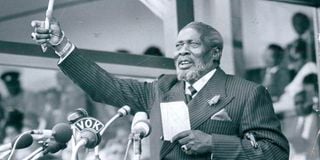
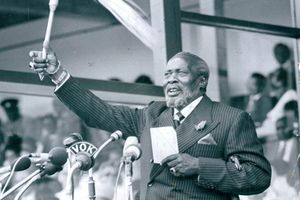
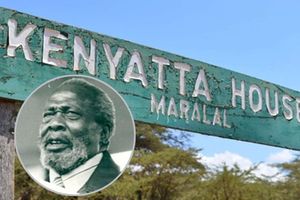
Former President Mzee Jomo Kenyatta.
Due to the weightiness of the matter, a way had to be found to reconcile them, a role entrusted to Njonjo. On June 19, 1968, just before McKenzie, Moi and British officials met for another round of secret discussions on the contingency measures, Njonjo convinced Moi to allow Mungai to attend.
“The two got on well... and Moi authorised Mungai and McKenzie to work further on the security, military and police aspects of the planning and report to him in due course. Moi also agreed that Mungai should become a member of the National Security Executive on which he, McKenzie and Njonjo sit to assess intelligence and watch over internal security,” wrote one British official who attended the talks.
“The omission of Mungai has always been a weakness in the system and this reconciliation is a valuable achievement. It remains to be seen whether Mungai will again get too big for his boots.”
There was still another hurdle to overcome. As the force tasked with maintaining order, Kenya Police was to be at the centre of the formulation of such plans. However, it turned out that Police Commissioner Bernard Hinga had fallen out of favour with most government officials, especially Mungai, who was hesitant to share with him sensitive information.
“One of the main anxieties is the position of police. For reasons which we do not understand, Bernard Hinga, the Kikuyu Commissioner of police since January 1965, seems to have lost much of the confidence which he enjoyed from Kenyatta and ministers. Mungai, in particular, refuses... to confide in him about any of this security planning,” the then-British High Commissioner to Kenya wrote.
Even as McKenzie, Mungai and Moi continued with the plan, they sidelined Hinga and instead dealt with a European official known as Davis, who was the staffing officer at Vigilance House.
The introduction of the draft on the provision of medical care to Mzee produced by the team read: “Any Head of State of the importance and age of Mzee Kenyatta should have available, in addition to his personal physician, a panel of about six eminent doctors, one of whom by turns is always on call.”
The document went on to list six doctors whose names have been redacted in the documents seen by the Weekly Review. In addition to the six, there was to be a specialist in London who was to fly to Kenya at short notice. This British specialist was to be selected, based on the recommendation of the six African doctors.
To ensure medical emergencies could be dealt with immediately, Mzee was to be accompanied throughout his trips in Kenya by a well-equipped motorised medical unit staffed by nurses and a senior doctor.
“A government light aircraft should be available at short notice whenever the president is away from Nairobi to transport the doctor on call from the panel mentioned in the first paragraph to wherever the president may be,” the document says.
For fear that the constant presence of a medical team in the president’s entourage could attract theories and whispers, it was decided that the public should be sensitised on the reason such measures were necessary.
“We should educate the public that it is the duty of the government and people of Kenya to protect and preserve their president by all modern medical means available,” it said.
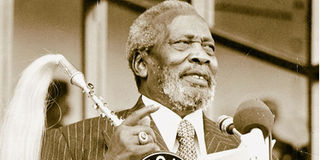
The first President of the Republic of Kenya, the late Mzee Jomo Kenyatta.
One way of achieving this, according to the draft, was by influencing suitable questions in Parliament “so that everyone knows what is being done.”
Another was by providing confidential briefing to the editors of newspapers so that they could write editorials, “getting people used to the idea of our head of state being cared for”.
Despite the measures, rumours about Mzee being neglected during his last days have continued to swirl, perhaps signalling that the plan was swept under the carpet as those around him focused on their political ambitions and interests.
In an interview not too long ago, Lee Njiru who worked as press officer under Mzee and later headed President Moi’s communication team, said the founding president was abandoned by his aides and advisers who were jostling for power and property.
“Kenyatta was more in the company of wolves than his own family,” he said.
According to events of that fateful day, Mzee attended a public function in Mswambweni while visibly weak and collapsed in a washroom where he was rescued after staying unusually long inside. Instead of requesting medical assistance, the officials guided him back to the dais to maintain an illusion that the president was in good health. Mzee’s health deteriorated that night, forcing the State House nurse to phone Coast General Hospital, which dispatched Dr Joab Bossman Wasuna to conduct resuscitation.
According to a posthumously published book by former Coast Province Commissioner Eliud Mahihu, after he received a call from Dr Wasuna informing him of the medical emergency at State House, he quickly phoned his personal doctor called Pinto to join Dr Wasuna even as he also made his way to State House, Mombasa.
“On entering the room, we found Dr Pinto asking for an oxygen cylinder. I was shocked out of my wits when I heard the nurse telling Dr Pinto that the cylinder was empty,” Mahihu wrote.
A decision was made to rush to Aga Khan Hospital, Nairobi, to borrow an oxygen cylinder as Dr Wasuna continued with resuscitation on the carpet. Mzee died in the process.
It was not the first time such a level of disorganisation was witnessed during Mzee’s medical emergency. When he descended in a long coma after suffering a heart attack in 1968, no attempts were made to inform those in positions of authority.
According to previously restricted files, even though he collapsed on Saturday May 4 at lunch time, Moi, Njonjo and Hinga were informed the following day at noon, while the Director of Intelligence was told two days later.
Fortunately, Mzee regained his consciousness after two days and ruled for another 10 years.
Follow our WhatsApp channel for breaking news updates and more stories like this.