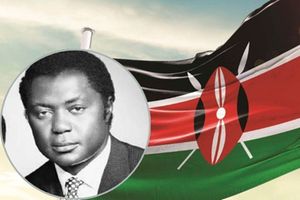
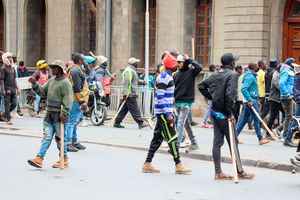
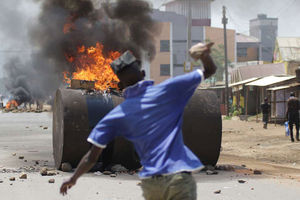
On Rusinga Island stands the mausoleum of Tom Mboya, one of Kenya’s most gifted political organisers. Not far away, Homa Bay has just offered the country a dark reminder of one of the institutions that arose during his years at the centre of Kanu; the partisan youth wing.
Armed goons dare the police. The youths blocked roads in Homa Bay ahead of Linda Mwananchi rally.
Photo credit: George Odiwuor | Nation
The aim of the violence was larger than the destruction. It was to draw a political border around Homa Bay and declare that some leaders could enter only with permission of those who claimed ownership of the county.
That is an old Kenyan script. To understand its origins, we should return to November 5, 1960, when Kanu acting president James Gichuru travelled to Ngong for the party’s first rally in Maasailand. The incident that followed would confront Kanu secretary-general Tom Mboya with a genuine security problem. His answer helped open the door to a much more dangerous political institution: the party vigilante.
Kanu had been formed only months before the Ngong incident and presented itself as the national movement. Kadu, led by Ronald Ngala, argued that smaller communities required protection from domination by the larger ethnic blocs within Kanu. In Maasailand, John Keen and the Maasai United Front were building a powerful Kadu base.
Ronald Ngala.
Photo credit: File | Nation Media Group
Gichuru’s rally was, therefore, more than a public meeting. It was a test of whether Kanu could organise inside a region its rivals treated as their political preserve, the same way Edwin Sifuna and his Linda Mwananchi were doing in Homa Bay.
Trouble had been anticipated in the Ngong rally, the same way it was in the Homa Bay incident. When Gichuru collected the rally permit, he warned the police that the meeting might be disrupted by Kadu. Dr Njoroge Mungai (who later became a Cabinet minister) had reportedly received an anonymous telephone call warning him not to attend. Kanu nevertheless went ahead.
According to accounts later given about the clash, Kadu hecklers shouted down Gichuru. He said the disruption had been led by a “foolish” former teacher called Gachingu. Other witnesses alleged that Gichuru had described the Maasai as “backward and uneducated”, an accusation he denied.
As Gichuru invited a Maasai elder, ole Ndeka, to address the meeting, some men withdrew from the arena and ran towards concealed weapons. They returned armed and before police intervened, a certain Chege Kibe, a Kanu supporter, was fatally speared. Gichuru had to be whisked away as the rally collapsed into chaos.
Dr Njoroge Mungai.
Photo credit: File | Nation Media Group
The violence did not end at Ngong. That evening, two women arrived at Kadu headquarters claiming that they wanted to defect to the party. The executive officer, D. Odinga, became suspicious since he knew the two Kanu activists. About 15 minutes later, the women returned with a larger group. The intruders restrained Odinga as he reached for the telephone and smashed typewriters, telephones, a duplicating machine and other equipment.
Thus, in a single day, Kenya saw the emerging nature of party violence. One group broke up a rival rally; another attacked a party office. Both incidents were presented through the language of defence, revenge and political entitlement.
As Kanu blamed Kadu for the Ngong death, and Mboya declared that Ngala and his supporters had to accept full responsibility, politician John Keen replied with an equally ominous warning: although Kadu and the Maasai were peace-loving, “if Mboya wants war we shall give it to him”.
But the most consequential statement came from Mboya. He announced that Kanu would register volunteers and form a force to maintain order at its future meetings. The argument appeared reasonable: if the police could not protect Kanu, the party would protect itself.
That announcement did not immediately create the uniformed and violent Kanu Youth Wingers remembered from the Moi years. Nor did Mboya invent political coercion. Colonial rule had already normalised violence through chiefs, loyalist Home Guards, informers and emergency forces. Both Kanu and Kadu had militant supporters, and the attack on Kadu headquarters demonstrated that retaliation was already part of the political culture.
Ngong nevertheless marked an important turn. A national party had formally embraced the idea that it required its own force. The volunteer was supposedly a steward who would protect the speaker and keep order. Yet, as we now know, the distance between a steward and a political enforcer is dangerously short when the party decides whom the steward should regard as an enemy.
Mboya understood organisation better than almost any politician of his generation. He had built power through the trade-union movement and the Nairobi People’s Convention Party, which was fighting to control Nairobi politics then challenged by C.M.G Argwings-Kodhek’s Nairobi District African Congress. Mboya knew the value of disciplined cadres, branch networks, choirs, women’s groups and youth mobilisation. Kanu’s volunteers fitted that organisational imagination in the battle for space.
After independence, Kadu dissolved in 1964 and was absorbed into Kanu, leaving the ruling party without a serious national rival. The youth wing was no longer useful until 1966, when the struggle with Vice-President Oginga Odinga reached a climax. At the Limuru conference, Kanu reorganised its leadership and replaced Odinga’s single post of national vice-president with eight provincial vice-presidencies, forcing Odinga to resign and form the Kenya People’s Union.
The Kanu Youth Wing resurfaced and attacked opposition organisers and offices. Provincial administrators, licensing rules, the police and party activists worked within the same field of power.
The force justified at Ngong as a shield for a vulnerable party had become part of the machinery used by a ruling party to constrict its opponents. Mboya did not personally direct every attack, and it would be historically careless to attribute every act of a youth winger to him. Yet as Kanu secretary-general and Kenyatta’s leading political strategist, he helped construct and command the party machine within which the Youth Wing acquired its coercive function.
That is the uncomfortable side of Mboya’s organisational genius. Kenya rightly remembers the airlifts, the trade unions, the constitutional negotiations and the development plans. But institutions must also be judged by the powers they normalise. Mboya’s response to Ngong legitimised the proposition that a political party could maintain its own force. His later battle with KPU demonstrated how easily a party force could be joined to state power.
After Mboya’s assassination in 1969 , the institution outlived its organiser. Under Daniel arap Moi, especially after Kenya became a de jure one-party state in 1982, the Kanu Youth Wing developed quasi-policing authority. Its members, recognisable in party uniforms, monitored meetings, silenced dissent and sometimes behaved as if they possessed powers of arrest.
They moved into markets, bus stations and matatu termini, collected money and fought hawkers and touts. They worked alongside local authorities and security officers while remaining outside the normal restraints placed upon the police. The fusion was now complete: party loyalty had become a licence to police the citizen.
A poster for the launch of Youth for Kanu ’92.
Photo credit: File | Nation Media Group
When multiparty politics returned, the uniforms faded, but the method survived. Youth for Kanu ’92 combined campaign mobilisation with intimidation. Later politicians recruited or courted groups such as Jeshi la Mzee, Baghdad Boys and Taliban. Other organisations, including Mungiki and Chinkororo, had their own social and historical origins, but politicians learned that existing vigilante networks could be financed and temporarily converted into campaign armies.
The lesson was absorbed across party lines. Once Kanu lost power in 2002, its rivals did not dismantle the political market for violence. They inherited it. The youth winger became the “hired goon”: available to guard rallies, attack journalists, block roads, extort traders or prevent an opponent from entering a supposed stronghold.
Homa Bay belongs to this lineage. The young men on the road were not defending the county. They were enforcing the fiction that a county, constituency or ethnic community is the private estate of a political patron. Their roadblocks reproduced the principle contested at Ngong in 1960: that one party owns the territory, and another enters as an invader.
The historical irony is difficult to miss. Homa Bay preserves the memory of Mboya, the nationalist who tried to transcend ethnic enclosure. Yet it has now witnessed the sort of territorial politics that Kanu’s early volunteers helped institutionalise. A force created in the language of protection has returned in the language of protecting a political “bedroom”.
The police response is therefore crucial. Selective inaction is not neutrality. It is assistance to the aggressor. Arresting a few weapon-carriers after the event will mean little unless investigators trace the organisation behind them. Who recruited the youths? Who paid for their transport and food? Who supplied the weapons? Who identified the vehicles? Who assured them that they could erect barricades and attack a convoy without immediate intervention?
It appears that while Ngong gave Kenya an early warning, Homa Bay has repeated it 66 years later. Between the two incidents lies the history of how the party volunteer became the Youth Winger, how the Youth Winger fused with the state, and how the state-backed enforcer became today’s political contractor.
There is something we have to accept as a nation. That political violence survives not because every generation spontaneously discovers it, but because each generation inherits an institution, a vocabulary and an assurance of impunity from the one before it. Until the organiser and financier are punished as firmly as the young man holding the weapon, the names and uniforms will change, but the Youth Winger, or goons, will remain with us.
John Kamau is a PhD candidate in History, University of Toronto. Email: [email protected] ; X: @johnkamau1