On April 5, 1965, Attorney-General Charles Njonjo carried a secret message from President Jomo Kenyatta to Malcolm MacDonald, the British High Commissioner in Nairobi. The message was explosive: Vice-President Jaramogi Oginga Odinga and his associates were suspected of preparing to seize power.
Mzee Kenyatta wanted Britain to be ready.
Njonjo told MacDonald that the President hoped a British warship, preferably an aircraft carrier, could conveniently appear in the waters near Kenya, ostensibly on a routine exercise. If the government found itself in serious difficulty, Kenyatta would formally request British troops to restore order.
Kenya had been independent for barely 16 months, yet its first President was privately asking the former colonial power to prepare to defend his government against his own Vice-President. It was the age of military coups in Africa as cold-war machinations took centre stage.
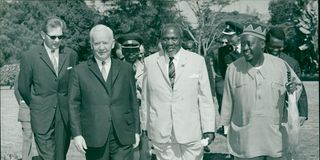
Jomo Kenyatta is sworn in as Kenya’s Prime Minister on June 1, 1963 in Nairobi. Kenyatta wanted Jaramogi Oginga Odinga as his number two.
Photo credit: File | Nation Media Group
Njonjo, according to archival records, stressed that this was not yet an official request, though MacDonald noted it down. Politically, it would have been disastrous for Kenyatta to admit that his government depended upon British soldiers. But if the anticipated crisis erupted, the President would call London, just as he had done during the Kenya Army mutiny at Lanet Barracks in January 1964.
Thus began Operation Binnacle, the secret British plan to prevent the overthrow of the Kenyatta government. Within four days of Njonjo’s approach, British military planners had prepared to fly troops from Aden into Nairobi. Warships were directed towards Mombasa, soldiers were placed on alert and plans were drawn up to guard Kenyatta, his ministers, government buildings and Nairobi airport. Historian Poppy Cullen’s archival reconstruction shows that this was an operational military plan, not diplomatic theatre.
Whether Jaramogi was actually organising a coup remains doubtful since we now know that London had started a secret campaign against Jaramogi. What is beyond doubt is that the fear of one helped preserve Britain’s influence over Kenya’s military, intelligence and foreign policy long after the Union Jack had been lowered.
The roots of the panic lay in the poisonous politics of early independence. The Kenya African Democratic Union had dissolved in 1964, leaving Kanu as the dominant party. But Kanu was itself divided with one faction coalescing around Jaramogi, who cultivated relations with the Soviet Union, China and other socialist states. The other was conservative faction that included Economic Planning minister Tom Mboya, Foreign Affairs minister Joseph Murumbi, Health minister Dr Njoroge Mungai, Attorney-General Charles Njonjo and Agriculture minister Bruce McKenzie.
Kenyatta had initially relied upon Jaramogi, particularly during the campaign for his release from detention. But through political manipulation, he had by 1965 increasingly viewed Jaramogi as a rival. Jaramogi’s access to money, scholarships and diplomatic support from the Eastern bloc made him especially threatening to the pro-Western politicians surrounding Kenyatta.
It was within the frame of Cold War politics that Jaramogi was labelled a communist or a Soviet agent, although his attraction to Moscow and Beijing was often more strategic than ideological. The British nevertheless believed that a Jaramogi victory would remove Kenya from the Western camp and threaten Britain’s military and commercial interests in East Africa.
The assassination of Pio Gama Pinto on February 24, 1965, deepened the anxiety. Pinto, a specially elected MP, journalist and veteran nationalist, was one of Jaramogi’s closest political allies. He had contacts with liberation movements in India, Goa and the Portuguese colonies in Africa. British Deputy High Commissioner Henry Stanley regarded him as an exceptionally dangerous communist influence.
The alleged evidence of a coup was remarkably thin. It consisted largely of an unidentified letter supposedly sent by one of Jaramogi’s associates to Pinto. Kenyan officials interpreted the letter as suggesting that some sinister political action was being planned. It was never established who wrote it, exactly what it said or whether MacDonald ever saw it.
MacDonald later speculated that Pinto’s assassination might have disrupted the alleged plot. In one of the most chilling descriptions of Kenya’s first major political assassination, he called Pinto’s murder “despicable but timely”.
Kenya's first Vice President Jaramogi Oginga Odinga.
There were other ingredients in the conspiracy story since Kenyan students had travelled to the Soviet Union and Eastern Europe on scholarships organised through Jaramogi’s networks. British and Kenyan officials claimed that some had received military training, which was true. There were also allegations that Soviet, Polish and Czechoslovak arms were also entering the region. Paul Ngei, another former detainee and a leading Kamba politician, was viewed with suspicion because Kamba soldiers formed a significant component of the Kenya Army.
On April 1, 1965, MP Thomas Malinda claimed in Parliament that arms were being smuggled into Kenya to stage a revolution. On April 8 and 10, soldiers raided the homes and offices of Odinga and several politicians associated with the radical wing of Kanu. Pistols, submachine guns and ammunition were reportedly seized.
Behind the scenes, Britain moved with astonishing speed. HMS Anzio was already expected in Mombasa between April 10 and 21. The British Ministry of Defence diverted the aircraft carrier HMS Albion towards Kenya while it was travelling to Singapore. Three other warships could be sent to Kenyan waters at short notice. MacDonald informed Njonjo about Albion, and Njonjo replied that Kenyatta would be grateful.
The ships were supposed to serve as a visible warning to Jaramogi that Kenyatta had powerful friends. Their presence also allowed Britain to demonstrate military power without immediately placing soldiers on Kenyan soil.
The ground operation was more elaborate. A British battalion stationed in Aden was prepared for deployment. Another battalion could be dispatched from Britain if necessary. By April 15, the troops in Aden had been placed on 24 hours’ notice. They remained on alert for nine days before the notice period was relaxed to 48 hours.
According to the records, British troops would guard Kenyatta and loyal ministers, secure public buildings and control Nairobi airport. Their presence would release Kenyan soldiers and police officers to confront the alleged rebels. Britain did not want its forces drawn into fighting outside Nairobi or into another prolonged insurgency like Mau Mau.
British planners made the limitation brutally clear: their forces could prevent a coup, but they could not “reconquer” Kenya for Kenyatta once his government had fallen.
The plan nevertheless exposed the extent to which Kenya’s security machinery remained under British control. About 150 British officers and non-commissioned officers were still seconded to the Kenya Army. Its commander, Brigadier Arthur John Hardy, was British. The commanders of the Navy and Air Force were also Britons, while a British military training team exercised considerable influence over equipment, doctrine and promotions.
British Special Air Service soldiers were training the General Service Unit, which had been developed as the President’s bodyguard and a counter-revolutionary force. Malcolm MacDonald authorised the SAS personnel to act immediately if Kenyatta or his ministers faced assassination, provided they considered intervention absolutely necessary. British soldiers could therefore have entered a Kenyan political conflict before London formally approved their involvement.
The supposed coup never came. Even Njonjo’s warnings changed from one meeting to the next. At first he said action could begin in mid-April. By April 15, he thought an immediate attempt was unlikely. Kenyatta reportedly believed that the opposition had become frightened.
Then vice president Jaramogi Oginga Odinga and president Jomo Kenyatta.
Photo credit: File
But the arrival of the Soviet ship Fizik Lebedev in Mombasa on April 14 provided fresh material for the coup narrative. It carried weapons, vehicles, military equipment and Soviet advisers. The shipment was not, as subsequently portrayed, simply a secret consignment ordered by Odinga for a revolution. The Kenyan government had requested Soviet military assistance after the 1964 mutiny. Kenyatta had authorised Jaramogi and Joseph Murumbi to negotiate with Moscow. But by the time the arms arrived, the political relationship between Kenyatta and Jaramogi had deteriorated. What had begun as a government arms agreement was repackaged as evidence of Jaramogi’s dangerous Eastern connections.
The British High Commission investigated the Soviet delegation and informed Njonjo that three of its members were suspected intelligence officers. Kenyatta and his closest ministers were said to be grateful for the warning.
Dr Njoroge Mungai, Joseph Murumbi and Bruce McKenzie travelled to inspect the weapons. They were accompanied by Brigadier Arthur John Hardy and Lieutenant-Colonel Gerald Desmond Michael Landy, the Kenya Army’s Ordnance Commander.
The inspection was hardly impartial. McKenzie and Njonjo privately asked Malcolm MacDonald to instruct Hardy to give an honest technical assessment, but one weighted towards rejecting every Soviet item as unsuitable. MacDonald believed this was Kenyatta’s wish and secretly passed the message to Hardy.
The instructions had travelled from Kenyatta to Njonjo and McKenzie, from them to MacDonald, and finally from the British High Commissioner to the British commander of the Kenya Army. Kenya then rejected the Soviet arms and advisers. MacDonald celebrated the decision as a serious diplomatic defeat for the communist powers.
Britain had won without firing a shot. The alleged coup strengthened Kenyatta’s reliance upon London, discredited Odinga’s Eastern connections and confirmed Britain as Kenya’s principal military patron.
The influence continued after the immediate scare had passed. In December 1965, Bruce McKenzie secretly asked MacDonald for British advice on the future structure of Kenya’s armed forces. Only McKenzie, Kenyatta and Njonjo initially knew about the approach.
When British officials struggled to find an adviser, Defence Secretary Denis Healey personally ordered them to assist Kenyatta. In 1966, General John Drew was sent to conduct Kenya’s defence review. His report, submitted to Finance minister James Gichuru as chairman of the Defence Review Committee, declared that Kenya’s primary military problem was internal security.
Drew recommended greater intelligence coordination, closer cooperation between the police and military and the creation of the position of Chief of Defence Staff. Brigadier Joseph Musyimi Lele Ndolo replaced Arthur Hardy as Army Commander, but the new senior position was given to another British officer, Major-General Robert Bernard Penfold.
Penfold became Kenya’s first Chief of Defence Staff and also commanded the British military training team. Britain thus retained influence over both Kenyan military policy and Britain’s defence relationship with Kenya.
The attitude behind the arrangement was exposed by British official Richard Neil Posnett, who doubted that African officers could yet exercise broad strategic and administrative control. Independence had changed the flag, but the old assumptions about African capacity still shaped the command of the armed forces.
Operation Binnacle remained available long after the April 1965 panic. Britain maintained a contingency plan for intervention in Kenya until 1971.
President Jomo Kenyatta and Vice President Jaramogi Odinga at Ichaweri in Gatundu in 1964.
Photo credit: Pool
During Edward Peck’s tenure as High Commissioner from 1966, HMS Triumph spent time in Mombasa as a conspicuous symbol of British support. When Bruce McKenzie feared another coup, he reportedly telephoned Peck and asked in crudely coded language whether his “old tin can” was still in the harbour.
Jaramogi eventually challenged Kenyatta politically, not militarily. He resigned as Vice-President in 1966 and formed the Kenya People’s Union. Kenyatta banned the party in 1969 and detained Jaramogi after the Kisumu confrontation.
There is still no conclusive evidence that Jaramogi intended to overthrow Kenyatta in April 1965. The coup may have been exaggerated gossip, a product of Cold War paranoia or a convenient weapon in Kanu’s internal struggle. But an imaginary coup had real consequences.
It enabled Kenyatta’s inner circle to portray domestic dissent as foreign subversion. It helped remove Soviet influence from the armed forces. It empowered Charles Njonjo and Bruce McKenzie as secret intermediaries between State House and the British High Commission. Above all, it entrenched Britain inside Kenya’s security establishment.
The British did not remain merely because they refused to leave. They remained because Kenya’s new rulers, frightened by their rivals and uncertain about their army, repeatedly invited them back.
Out of this Jaramogi fear, the Anglo-Kenyan defence agreement, signed on June 3, 1964, got entrenched and it was this arrangement that later evolved into the modern-day British Army Training Unit Kenya, commonly known as BATUK.