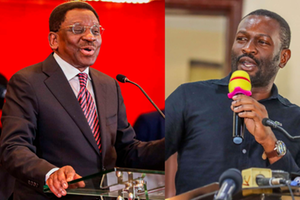
One reason Nairobi Senator Edwin Watenya Sifuna’s presidential aspiration is inspiring supporters and gaining traction is that the former Orange Democratic Movement (ODM) Secretary-General appears to have emerged, almost organically, as a people’s choice.
He may have packaged his approach and adopted the now-familiar “Mimi ndiyo Sifuna ” (“I am Sifuna”) tagline at public events, but in the early stages he did not personally — or through allies — formally announce his presidential interest or seek to impose himself on the electorate. This has since evolved into Sisi Ni Sifuna (“We are all Sifuna” or “Sifuna is our choice”).
As former Local Government Minister and Ford-Kenya chairman Musikari Kombo observes, this has elevated Sifuna to the pedestal of a natural leader — the proverbial anointed one who, by fate, circumstance or public goodwill, has emerged.
But this is about to change, thanks to Siaya Governor James Aggrey Orengo’s entry into the Linda Mwananchi presidential race.
Siaya Governor James Orengo.
Photo credit: Dennis Onsongo | Nation Media Group
The seasoned politician, with a long career as a democrat and rights campaigner, belongs to the same Linda Mwananchi political formation as Sifuna.
His interest in the presidency therefore has direct implications for the Sifuna wave, despite reports this week that the two politicians had entered a truce after days of tension. While Orengo is within his democratic rights to seek the presidency, his decision is likely to unsettle Linda Mwananchi and offer breathing space to President William Samoei Ruto’s camp.
First, it will draw Sifuna into a direct contest with Orengo, forcing him to defend and consolidate his position within the movement. In doing so, however, he risks surrendering his greatest political asset: the perception that he is a people’s project rather than a politician aggressively pursuing a personal presidential ambition.
Once Sifuna is compelled to fight for political space he has appeared to inherit organically, the mystique surrounding his candidacy could fade. What has looked like a spontaneous movement could acquire the contours of an ordinary political contest — rival ambitions, competing power bases and a struggle for supremacy.
This appeal is particularly significant with the Opposition facing a formidable candidate in President Ruto . Besides the influence and advantages of incumbency, Mr Ruto is a politically experienced operator who, in the last election, defeated the more seasoned former Prime Minister Raila Odinga, who was backed by then-President Uhuru Kenyatta.
To dislodge the President, the Opposition therefore requires an extraordinary approach and perhaps a unique flag bearer. This is the thinking behind those pushing the Sifuna candidature.
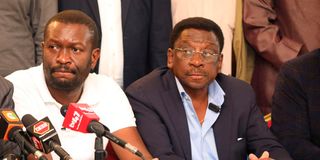
Siaya Governor James Orengo (right) and Nairobi Senator Edwin Sifuna (centre) speak to journalists at Ciala Resort in Kisumu on July 12, 2026.
Photo credit: Alex Odhiambo | Nation Media Group
Sifuna is considerably younger and, compared with established political heavyweights, less prominent nationally. Yet he is perceived to have an appeal that cuts across age groups and increasingly regional boundaries. This distinguishes him from better-known figures such as former Deputy President Rigathi Gachagua , former Vice-President Kalonzo Musyoka and former Interior Cabinet Secretary Dr Fred Matiang’i, all of whom have been in public life longer and had closer political encounters with the incumbent.
As Mary Kathomi, a civil-society campaigner and Sifuna sympathiser, puts it: “Edwin Sifuna is a national project who is in demand across the country. Many Kenyans have quietly anointed Edwin Sifuna as their presidential candidate.”
Ms Kathomi nevertheless argues that Governor Orengo should be free to challenge Sifuna for the Linda Mwananchi Movement ticket. Other political leaders allied to Sifuna, including Trans Nzoia Governor George Natembeya and Kakamega Senator Dr Boni Khalwale, are wary that opening the contest could create room for mudslinging, distract the movement and slow its momentum. They would rather see this chapter closed.
Orengo’s entry is not merely puncturing the Sifuna wave; it threatens to make Sifuna ordinary — which, in the strictest sense, he is, but which strategically could amount to an own goal for Linda Mwananchi and the broader Opposition’s quest to dislodge President Ruto.
Energy and Petroleum Cabinet Secretary Opiyo Wandayi appears to understand this dynamic. Besides questioning Sifuna’s political experience and governance credentials, Mr Wandayi has publicly encouraged Orengo, his neighbour in their rural home area, to wrest Linda Mwananchi leadership from the “little boys” — a reference to Sifuna and Embakasi East MP Babu Owino — or remain in ODM.
Siaya Governor James Orengo speaks to journalists at Kisumu International Airport on April 24, 2026.
Photo credit: Alex Odhiambo | Nation Media Group
Orengo is an old hand in Kenyan politics. Part of his motivation for challenging Sifuna may stem from the difficulty of playing second fiddle after decades at the centre of national political affairs. His presidential quest dates back a quarter of a century.
In 2002, Orengo ran for president on the Social Democratic Party (SDP) ticket, securing 24,524 votes, or 0.42 per cent of valid presidential votes cast. He finished fourth, behind National Rainbow Coalition candidate Mwai Kibaki, Kanu’s Uhuru Kenyatta and Ford-People’s Simeon Nyachae.
The people promoting Sifuna’s presidency are banking on surprise and political novelty to unsettle the formidable challenger — the incumbent — while hoping established politicians and rival Opposition forces, including Gachagua, Kalonzo, Matiang’i and former Chief Justice David Maraga, will ultimately embrace their proposition.
The strategy rests on a political paradox: a politician who declares, “I want to be President,” is immediately perceived as seeking power. But when politicians, civil-society actors, intellectuals, young people or ordinary citizens ask, “Why don’t you become President?” the relationship changes. The politician appears less to be pursuing power and more to be responding to public demand. That is the political capital underpinning the Sifuna proposition. Africa and the wider world have examples of leaders — some relatively obscure — who were initially reluctant to pursue the presidency but were drafted or propelled into the race by others in the name of the perceived public good.
Umaru Musa Yar’Adua of Nigeria is one of Africa’s clearest examples. As Governor of Katsina State, he had indicated that he intended to return to academia rather than pursue the presidency. Yet the PDP settled on him as its presidential candidate in 2006. He faced Peter Odili, who had already built an elaborate national campaign, but Yar’Adua won the 2007 election.
Namibia’s Hifikepunye Pohamba, described as the “reluctant warrior,” offers another example. He was propelled into the presidency with backing from the ruling SWAPO establishment and founding President Sam Nujoma, winning the 2004 election with about 76 per cent of the vote.
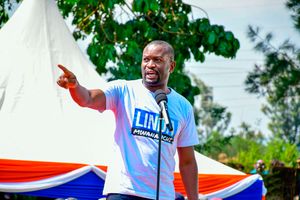
Nairobi Senator Edwin Sifuna addresses residents of Nyandiwa during the Linda Mwananchi rally on August 16, 2026.
Photo credit: Alex Odhiambo | Nation Media Group
Although he narrowly lost the 1993 Singapore presidential election with about 41 per cent of the vote, Chua Kim Yeow provides another example of the reluctant candidate. His campaign was low-key; on polling day, he told voters that his opponent was the better candidate.
These cases demonstrate how reluctance can become an electoral asset. Voters may interpret it as evidence that a candidate is not driven by an insatiable hunger for power, but is responding to a call from the people.
That is the script Sifuna’s political team appears to be attempting to emulate — or hoping will work in its favour.
The Kenyan political environment, however, presents a formidable complication. Voter mobilisation remains heavily influenced by ethnic and regional identity rather than ideology or policy, making the Sifuna strategy difficult to execute. Identity politics can overwhelm novelty, particularly when established heavyweights bring long-standing regional and ethnic constituencies.
Nonetheless, the ball remains in the Opposition’s court. Its success will depend on how effectively competing players can suppress the appearance of an unrestrained scramble for power, keep their claws sheathed until the larger prize is within reach, and balance individual interests against the broader public good.
The challenge is not merely to defeat the incumbent. It is to convince Kenyans that the Opposition is seeking power for them, rather than simply for itself.
Anything short of that balancing act could expose Opposition fault lines long before the ballot is cast. Once the public sees a coalition as a contest for the spoils of victory, the outcome can become clear well before election day.