There is a particular electricity that surges through politics when ordinary citizens decide they will no longer be spectators. It is a force that rises from the ground up, gathering momentum as people discover the power of participation. Linda Mwananchi leader Senator Edwin Sifuna has stepped directly into that current.
He appears determined to challenge the old ritual of campaign financing, long dominated by wealthy patrons and discreet benefactors, by placing it in the hands of citizens who were never meant to hold it. In doing so, he has stirred something in the national imagination that feels like a democratic reawakening. It has drawn even greater attention following claims by critics that he and the Linda Mwananchi faction are a project of former President Uhuru Kenyatta.
The psychology of crowdfunding is simple: once people realise that even a modest contribution is a civic declaration, they discover they are neither too small to matter nor too distant from power to shape the national story.
Sifuna’s call for ordinary Kenyans to fund Linda Mwananchi’s national tours through a Paybill number has stirred debate on social media. Within 36 hours of its launch, more than 9,000 Kenyans had contributed over Sh2.2 million, according to figures released by his camp.
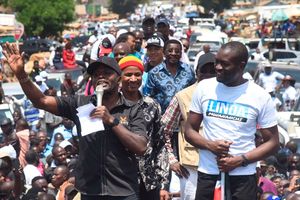
Nairobi Senator Edwin Sifuna addresses supporters of Linda Mwananchi during a political rally in Trans Nzoia County on July 25, 2026.
Photo credit: Jared Nyataya | Nation Media Group
The Nairobi Senator argues that people-funded politics could redraw the moral boundaries of Kenyan politics. If citizens finance campaigns, he suggests, governance itself could change.
“If our politics is financed by the people,” he says, “then once in office I can scrap the Housing Levy and repay every Kenyan their ten shillings. I can lower fuel prices by Sh5 each month, and within two months your debt is cleared.”
The argument is that politics financed by citizens becomes accountable to citizens. A government built on small contributions is not beholden to powerful financiers. More importantly, Sifuna argues, such a model would loosen the grip of wealthy political backers.
“This will end State capture,” he says. “Here, a handful of wealthy men who contribute millions to a presidential candidate end up controlling State power. If someone gives me Sh10 million and later calls asking for a tender, I will be expected to influence it.”
In Kenya’s political economy, money is rarely neutral. It comes with expectations, obligations and invisible strings. Sifuna argues that a public, traceable Paybill cuts those strings. He insists political campaigns need not be prohibitively expensive. In his telling, the high cost of Kenyan politics is not inevitable but a design flaw that can be corrected by returning power to the people who live with the consequences of political decisions.
Movements that seek to reorder political power often look outward for precedent. Linda Mwananchi’s experiment in citizen-funded politics invites comparison with the surge that propelled then-Illinois Senator Barack Obama into America’s national spotlight by turning small donors into a democratic force.
Obama’s movement showed that a modest contribution could become a badge of belonging. It told millions of Americans they were neither too poor to participate nor too distant to belong. Within weeks, they had built a civic army. “We are funded by people who give $25, $50, $100. That’s what’s setting this campaign free to tell the truth to the American people. We have created a parallel public financing system where citizens out of their own pockets, entire networks of people, are funding this campaign,” Obama said.
By the end of the race, those small donations had swelled into more than $340 million, largely from ordinary Americans. It was the largest haul from individual donors in American political history.
“From the very beginning of this campaign, I asked you to help me build a new kind of politics, a politics that is powered by people, not big donors or Washington lobbyists. And because you answered that call, we’ve built a grassroots organisation of over 1.5 million Americans who have funded this campaign,” said Obama, whose father was Kenyan.
His rallying cry, Yes We Can, promised that ordinary people could become co-authors of the political story. Sifuna’s movement seeks to channel that spirit through its own slogan, Mimi Ni Sifuna.
It is a declaration of identity and a Kenyan expression of the democratic energy that swept through America, with Linda Mwananchi turning contribution into participation, participation into ownership, and ownership into resistance against the political establishment.
Raila Odinga, the veteran opposition leader who left active politics last year while on a medical trip to India, regularly published Paybill numbers and supporters contributed. But the giving never became a movement. It reflected loyalty more than conviction.
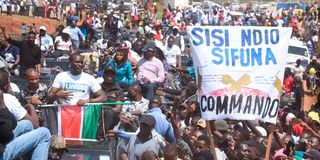
Supporters of Nairobi Senator Edwin Sifuna's Linda Mwananchi movement during a political rally in Trans Nzoia County on July 25, 2026.
Photo credit: Jared Nyataya | Nation Media Group
What Sifuna appears to have achieved in these early months is to make giving itself part of the cause. His movement feels authentic and alive, suggesting a new way for citizens to engage in politics through collective action.
Obama’s millions flowed under the watch of the Federal Election Commission, with strict contribution caps, disclosure requirements and compliance lawyers who refunded suspect donations almost immediately.
The Linda Mwananchi model, by contrast, rests on legal uncertainty. The Election Campaign Financing Act exists largely on paper, its implementation repeatedly postponed by Parliament. There are no enforced caps, no functioning disclosure regime and no settled rules on who may donate, how much they may give and how campaigns should account for the money.
In one sense, Sifuna is freer than Obama ever was because no regulator limits a mama mboga’s Sh10. In another, he is exposed. Where rules are absent, protection is absent too.
While Obama’s money flowed through thousands of banks and payment processors, Sifuna’s funds pass through a corporate entity in which the State has a substantial stake and significant regulatory influence. A regulatory, judicial or administrative intervention could disrupt the process.
Scrutiny follows closely behind. Millions of micro-transactions flowing into a political account resemble precisely the patterns anti-money-laundering systems are designed to flag. Every shilling must be traceable and every suspicious transaction refundable before questions are asked, because they inevitably will be.
Privacy presents another risk. Behind every donation is a name, and in a country where careers, tenders and licences can suffer official retaliation, a donor database can become a vulnerability. Linda Mwananchi must guard it carefully. Fraud is another danger. Fake Paybills carrying the movement’s branding could quickly emerge, harvesting goodwill while eroding trust. The campaign must make its official Paybill instantly recognisable and expose impostors swiftly.
Then comes trust. Movements built on small donations often collapse through financial scandal rather than political persecution. One case of embezzlement could turn supporters into critics. Nothing less than published, independently audited accounts will suffice. Radical transparency is not merely desirable; it is essential.
Beneath it all lies the economy. The same cost-of-living pressures that inspire giving also limit it. Sh50 is not disposable income for many Kenyans. It is a sacrifice, and sacrifice has limits. Between now and the 2027 General Election lies a long stretch of ordinary months in which enthusiasm fades and school fees fall due. The movement must become an institution before the excitement dissipates.
But suppose it succeeds. Suppose the tills remain open, the books stay clean, counterfeit Paybills are defeated and supporters keep giving.
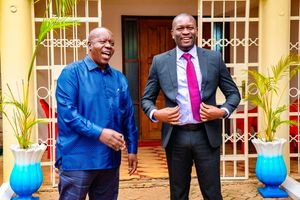
Nairobi Senator Edwin Sifuna during a women empowerment program on July 3, 2026.
Photo credit: Alex Odhiambo | Nation Media Group
Then Sifuna would enter a presidential race carrying something no Kenyan presidential candidate has carried before: money that owes nothing to tycoons, cartels or powerful benefactors.
A candidate financed by everyone is owned by no one. In a political culture where financiers have often been the real principals, that independence could itself become the platform.
“This movement is driven by ordinary people, reminiscent of the Obama moment and the Senegal experience. It is a genuine tsunami that will disrupt the established political order. I believe many Kenyans are hungry for real change, and they see that possibility in Sifuna. Anyone underestimating him is in for a rude shock,” Vihiga Senator Godfrey Osotsi said in Trans Nzoia on Saturday.
In a village in Bungoma, the boda boda rider who sent Sh30 to Linda Mwananchi last week may already have forgotten the transaction. But the message remains on his phone. It is a receipt for a small share in a larger idea.
Whether that idea survives the legal uncertainties, auditors, fraudsters and the long months ahead remains to be seen. Revolutions are cheap to start and expensive to sustain.
But one thing is already clear. For one brief season, some Kenyans stopped waiting to be bought and instead chose to buy in. History, like M-Pesa, keeps its own records. It has just recorded something significant.