The former Githunguri gallows is not a place you would like to build a house upon. Ever since a hotel was set up near Kiambu town on a Mau Mau graveyard in the 1990s, this is the first time there is some nerve to come up with a housing project on a colonial hanging ground.
Already, a petition has been sent to the National Museums and to the Cabinet Secretary raising alarm that there is intention to erect affordable houses on this open space, which had been preserved for the last 60 years as a national heritage. If we allow Githunguri gallows site to be swallowed by concrete in the name of “development,” we will not just lose land—we will lose memory, meaning, and moral direction.
Githunguri is part of what Historian Caroline Elkins terms Britain’s colonial “gulag” in Kenya: a landscape where detention, punitive law, and execution were used to crush anti-colonial resistance, including use of hanging as a means of terror. This was a site where state-organised death took place. To keep memory is not only to honour victims but to defend historical truth against erasure and to insist that political violence cannot be normalised, forgotten, or repeated.
This is why the current push to build affordable housing on or around the Githunguri gallows heritage site should be stopped. Not postponed. Not deferred for a later review. Even proposing it reflects a failure to think seriously about what this ground represents. Instead of encroachment, we should be planning a museum and memorial complex on the site, so that future generations can learn, mourn, and remember.
In David Anderson’s Histories of the Hanged, Githunguri emerges as one of the haunting spaces of colonial punishment in the network that included Nairobi prison, Kamiti, Manda, Mageta Island, and Manyani among others. It was in Githunguri where the first executions of 12 men convicted in connection with the Lari Massacre were hanged at dawn. Their executions were carried out in a public place in order to send fear among freedom fighters. Before the hanging, we are told, the government printed thousands of posters bearing the images of the convicts and announcing that they will be hanged.
What we learn from Githunguri is that colonial rule relied heavily on spectacle to sow fear. Its violence was not concealed but staged and presented as a public warning, ostensibly to maintain discipline. That is what took place in Githunguri. The executions, too, were ritualised with erection of an open-air gallow; a hangman brought in from Nairobi, and each hanging witnessed by both a doctor and the district officer.
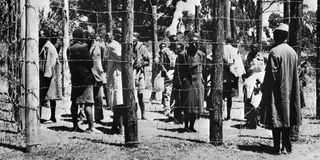
Soldiers guard Mau Mau fighters behind barbed wire in the Kikuyu reserve, October 1952. Mau Mau, primarily from the Kikuyu community fought against British colonial rule in Kenya from 1952 to 1959.
Photo credit: File | AFP
When a country treats such a site as “available land,” it tells its citizens something chilling: that the architecture of colonial violence can be forgotten as long as the title deed can be processed. That is unacceptable.
And this is not an argument against Ruto’s housing dream, the deals notwithstanding. Kenya needs housing. Young families need shelter. Workers need dignified homes near jobs. Urban pressure is real. But a mature nation can hold two truths at once: people need places to live, and people also need places that explain who they are. Development and heritage are not enemies unless planners choose to make them enemies.
So let us say this clearly: building affordable housing at Githunguri gallows would be an act of national carelessness. It would convert a site of historical pain into a planning convenience. It would replace remembrance with transaction.
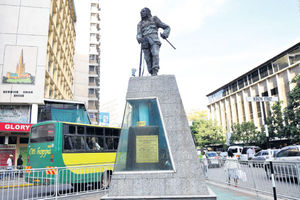
And that leads to the uncomfortable question many people are now asking: Is there a deliberate policy to interfere with Mau Mau sites and monuments? In these pages a few weeks ago, I raised the question of the Dedan Kimathi statue whose “gun” is now missing. I also raised the desecration of the Mau Mau monument at the junction of Uhuru Highwar and Kenyatta Avenue.
Maybe there is no single written policy that says, “erase Mau Mau memory.” But policy is not only what appears in official documents; policy is also what repeatedly happens in practice and nobody raises a finger. If heritage sites linked to anti-colonial struggle are consistently neglected, encroached on, underfunded, or reallocated, then the outcome is the same as deliberate erasure. Intent can hide in procedure. Amnesia can wear the mask of administration. This erasure started with Jomo Kenyatta, and we are not seeing the end of it.
Look at the pattern that communities have witnessed for years. First, sites are celebrated in speeches, especially during commemorations. Second, they are gazetted or symbolically recognised. Third, practical protection is weak: boundaries are unclear, signage is absent, local custodians are ignored, and development pressure grows. Finally, when land value rises, heritage is treated as an obstacle rather than a public trust. This is not conservation. This is slow deletion.
Let us not undervalue our heritage. If someone had chosen to build an office block at Fort Jesus in Mombasa, that site—and its history—would have been lost forever. If the Gedi ruins had not been preserved, that chapter of our past would have vanished as well. It is, therefore, essential to identify, map, and formally mark sites of historical significance. Doing so supports not only place branding, but also collective memory and remembrance.
Githunguri deserves better, especially given its layered significance. Beyond the gallows, is the former Githunguri Teachers College where Jomo Kenyatta and Mbiyu Koinange started teaching the first cohort of Kenyan tutors outside the British system. This was a radical move that equipped Kenyans with an education that was denied. The teachers’ college has long been remembered as a radical intellectual space in the anti-colonial period.
The late Mau Mau hero Dedan Kimathi.
Photo credit: File
Oral histories connect “Githunguri kia Wairera”, as it was known, to larger imaginations of liberation, including prophecies and community memory that interpreted the place as symbolically central to the end of colonial rule. Whether one treats such oral accounts as literal prophecy or political metaphor, their cultural value is immense. They tell us how communities understood freedom before it arrived in law.
The pro-affordable housing stalwarts might argue that only a small section can be used and the rest can be preserved. That might sound reasonable, but once major construction begins, the burden shifts permanently against conservation. Access roads, utilities, security perimeters, and commercial spillover steadily consume what was supposedly protected. “Partial preservation” often becomes total disappearance in slow motion. We have seen it elsewhere where historical sites have been encroached. The Hyrax Hill outside Nakuru town has always been under pressure from developers eager to grab it from the National Museums.
Other people might say that people cannot live in monuments. True. Yet monuments are where nations learn how to live with themselves. If we erase sites of suffering and resistance, we produce citizens who inherit rights without understanding the cost paid to secure them. We create a patriotism of slogans, not substance.
First, there should be an immediate moratorium on all construction decisions affecting the Githunguri gallows and its associated historical landscape until a full heritage impact process is completed. Second, government agencies must publicly map and publish exact boundaries of protected zones, buffer areas, and legally restricted uses. Ambiguity is the friend of encroachment. Third, the state should commit funds to restore and interpret the site properly.
Fourth, the national and county governments should identify alternative nearby land for affordable housing that does not carry the same historical burden. Kenya has options. What is lacking is political imagination, not physical space.
John Kamau is a PhD candidate in History, University of Toronto. Email: [email protected]