In Kenya’s early independence years, Jaramogi Oginga Odinga did not only battle local rivals and inherited colonial structures. He also battled something less visible but just as consequential: a foreign imagination—the way powerful outsiders chose to see him, describe him and warn others about him.
For years, scholars and journalists have tracked how British intelligence and colonial administrators framed nationalist leaders to fit imperial anxieties. But when you scan through American records, starting with the Central Intelligence Agency (CIA) reporting, United States Embassy assessments and diplomatic memoirs, you meet another workshop of image-making.
Here, Jaramogi is repeatedly cast as a Cold War problem: an ambitious politician with communist patrons, a tribal mobiliser capable of splitting the State, and a destabilising force shadowing Jomo Kenyatta’s nation-building project. The American imagination did not arrive as a single dramatic declaration. It arrived in fragments as briefings, cables and analysis notes that stacked suspicion upon suspicion until the portrait settled. The language was often bureaucratic, but the implication was sharp: Kenya’s independence could be compromised from within, and Jaramogi was the most likely doorway.
Understanding these historical nuances help us to see how political “truths” are often manufactured—how mythmaking and fearmongering can be built into official records until they harden into common sense, and then recycled to shape public opinion. When we read the archives with care, we learn how power learns to narrate, to label and to warn—and how those narratives can continue to inform our politics long after the moment that produced them has passed.
The mood is set even before Jaramogi becomes the main character. Early American reporting is preoccupied with Communist China’s reach into Africa and with the possibility that Beijing’s cultural diplomacy is a Trojan horse. One account circulating in the same stream describes Chinese communists as exploiting the Kenyan situation through scholarship and student exchanges (while being silent on similar US exchanges).
It repeats allegations that Kenyan and other East African students in China were poorly treated—ill-housed, ill-fed, denied freedom of movement—and taught mostly ideological subjects rather than what they had gone to study. On the surface, this reads like concern for students. Politically, it reads like a warning: China’s engagement is not education; it is indoctrination. The story establishes a broader frame in which communist contact is inherently suspect, and where a prudent nationalist leader must keep Beijing at arm’s length.
Into that frame enters the local rhetoric that US officials found useful. A senior figure from Kadu is quoted describing communism as the “greatest single threat” to an emergent African nation, saying communists “buy the individual with money” and replace human dignity with the myth of a communist god. He predicts that once British forces leave, Kenya will face a communist onslaught and warns that independence will mean little if Kenyans become “stooges and quislings” to the communist world.
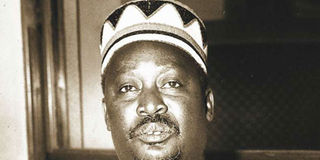
Jaramogi Oginga Odinga.
Photo credit: File | Nation Media Group
Then the accusation is made explicit: he names Jaramogi—echoing earlier claims—as the recipient of large sums from the communist bloc, often said to come from China. Jaramogi denies receiving money regularly but admits he has accepted some money in the past when it was needed for “very legitimate purposes”.
In Kenyan politics, such accusations are weapons used by rivals and parties competing for advantage. In the American file, they become a diagnostic tool, a way of interpreting Jaramogi’s ambitions and measuring his danger. From that point, money and ideology begin to travel together as a single story: communist cash translates into political influence, influence creates instability, and instability creates a vacuum for foreign powers.
CIA's financial narrative
By February 3, 1964, that story sharpens into alarm. An American assessment describes a struggle for power shaping up between Prime Minister Kenyatta and Jaramogi and says Jaramogi has long had financial ties with Moscow and Beijing. The reporting states that Odinga’s plotting against Kenyatta has reached “alarming proportions”. It is a phrase that does not merely describe a political rivalry; it sounds an internal alarm bell. A foreign service officer writing “alarming proportions” is telling Washington that the situation is urgent, that the stakes are more than electoral arithmetic.
The same assessment maps Kenyan politics onto an ethnic and security diagram. Jaramogi is said to be working to increase his influence among Jomo’s Kikuyu—particularly among ex–Mau Mau fighters and youth groups, and among the Kamba, described as a community with strength in the security forces. The embassy believed that Jomo was awake to Jaramogi’s manoeuvres and might emerge stronger if he moved fast enough, but it warned that serious splits could develop in the Kikuyu-Luo-Kamba alliance and in the security forces.
This way of seeing Kenya makes ideology inseparable from ethnicity and treats government as a fragile coalition of communities held together by elite bargaining and discipline. And it appears that we got fixed around ethnicity as the organising principle of our politics. In that framing, Jaramogi is not only an opponent with a dissenting vision; he is a wedge capable of prying apart the ethnic alliance that sustains the state. When foreign analysts begin to imagine a politician as the man who can fracture the army and police, fear becomes almost automatic.
By May 1964, the CIA pushes the financial narrative into near-certainty. One assessment says that Jaramogi has “pretty certainly” taken “rather more than $250,000” from the Chinese communists. It notes that he has gained political control of the large Luo community, thus capturing the natural popular base of Mboya. Then comes the line that turns a political actor into a Cold War asset: Jaramogi “looks like an excellent investment for Peking”.
In the American imagination, that “investment” language does something powerful. It implies Jaramogi is not merely sympathetic to the communist bloc; he is a project being funded to achieve an outcome. And if he is a funded project, then every rally, every alliance, and every conflict can be interpreted as part of a foreign strategy. Numbers play a special role here. The $250,000 figure, whether precise, estimated, or imagined, turns rumour into something that looks measurable. In intelligence writing, figures can function like verdicts.
By August 1965, the story evolves from urgent alarm into strategic watchfulness. The Kenyan government under Kenyatta is described as adopting a wary approach toward the Chinese. China itself is described as operating with caution, apparently not wishing to jeopardise what it regards as excellent opportunities for long-term gains.
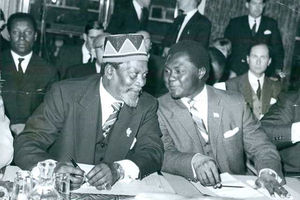
Mzee Jomo Kenyatta (left) with then Vice President Jaramogi Oginga Odinga.
Photo credit: File | Nation Media Group
Yet Jaramogi remains central: the Chinese are said to have wooed Kenya’s radical and influential vice-president, but to have suffered a loss of influence “commensurate with that of Odinga”. A Chinese news representative is asked to leave, and the Chinese ambassador makes a quick trip back to Beijing for consultation.
US Ambassador William Atwood’s description of Jaramogi was also telling. He terms him “a paradoxical figure, wealthy yet emotional, unsophisticated yet politically ambitious, dependent on communist handouts while trying to manage relationships with the West”. He offers a further judgment that fits the broader American storyline: Jaramogi was “shrewd but also naive,” underestimating Kenyatta.
The rupture of 1966 appears in the American narrative as confirmation of everything that had been feared. Jaramogi resigns from both government and party to form the Kenya People’s Union (KPU), calling for a quasi-Marxist, populist programme. The sharpest intersection of fear and force comes in October 1969. Following disturbances during Jomo’s Kisumu tour, the government arrests all KPU leaders, including Jaramogi and the party’s MPs.
The government claims these men were responsible for the disturbances. Here the US view is simply that “Odinga is dangerous”. He is described as a radical nationalist, and the crackdown is treated as both proof of the State’s determination and an illustration of how combustible politics around Jaramogi have become.
And that is what the press and the nation was fed for many years and left to digest. It will take many years to entangle that propaganda, and it still feeds our politics – even today.