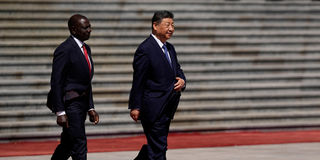
Chinese President Xi Jinping and Kenyan President William Ruto attend a welcome ceremony at The Great Hall of The People on April 24, 2025, in Beijing, China.

At the height of the feverish anti-China rhetoric that characterised the 2022 election campaign and its aftermath, I knew — and warned Kenya’s high and mighty — that the country cannot ignore China. The two nations are joined at the hip.
“We have achieved many things together,” President William Ruto told his Chinese hosts during his five-day state visit to China on April 22-26, 2025 — his third to China since taking office and the first by an African leader since the September 2024 Beijing Summit of the Forum on China-Africa Cooperation (FOCAC).
Currently, Beijing is Kenya’s largest trading partner, biggest source of its imports, its largest creditor, biggest provider of development financing, and leading source of foreign direct investments. Kenya is a member of China’s Belt and Road Initiative (BRI), humanity’s most ambitious multi-trillion dollar infrastructure project. Under the project, the Chinese government and firms have helped build the 600-kilometer Mombasa–Nairobi–Naivasha Standard Gauge Railway, the Mombasa oil terminal, the Lamu Port, the 27.1-kilometers Nairobi Expressway, the Global Trade Center (GTC), the Thika Super-Highway among other facilities.
The Kenyan leader has signed a new $1billion development deal with China to boost priority economic sectors, including manufacturing ($320 million), agriculture ($430 million), and tourism ($230 million), potentially breathing new life into his Bottom-Up Economic Transformation Agenda (BETA) ahead of his re-election bid in 2027.
China, too, cannot ignore Kenya, its most strategic partner, gateway to the heart of Africa and largest trading partner in East Africa. No doubt, Ruto’s visit has deepened the strategic partnership with a pivotal African partner. The new deal with Kenya will expand the footprint of Chinese investments, including $150 million investment with China Wu Yi for construction, $400 million in agricultural projects led by Zonken Group in Baringo, and a $230 million tourism initiative by Hunan Conference Exhibition Group.
Prosperous future
During President Ruto’s State Visit to America on May 21–24, 2024, President Joe Biden confirmed that Kenya had been designated a major non-North Atlantic Treaty Organization (NATO) U.S. ally (MNNA). During his Beijing Visit, Kenya has tightened its ties with China and lauded their “enduring friendship” and shared vision for a prosperous future. What does Ruto’s diplomatic volte-face and pivot to China mean for Kenya in the face of a turbulent international environment, global economic realignments, shifting alliances and cut-throat superpower competition? This requires a deeper and more nuanced understanding of China’s new “partnership diplomacy.”
In a profound way, Ruto’s headline-grabbing visit to China thrusts Kenya to the apex of China’s partnership diplomacy. In the wake of its Reform and Opening-up Policy after 1978, China mooted a new ‘partnership diplomacy’ as a peaceful alternative to the conflict-ridden “alliance diplomacy” — the system of alliances involving states, especially in matters of defence and security, for the purpose of mutual (military) support if an ally is attacked or threatened. During President Ruto’s State Visit to America in May 2024, President Biden upgraded Kenya into a major non-North Atlantic Treaty Organization (NATO) U.S. ally, the first in sub-Saharan Africa.
In contrast, China prefers Kenya as a partner, not an ally. But not all partnerships are created equal. While firmly anchored on the Confucian philosophy hierarchical relationships grounded in mutual respect, virtue, and moral authority rather than coercion, nations and multilateral institutions such as the African Union have different status in China’s partnership diplomacy.
The concept of “partnership without alignment” has become the hallmark of Beijing’s diplomacy since the end of the Cold War in 1989. In 1993, China forged a “strategic partnership” with Brazil followed by a “partnership of strategic coordination” with Russia in in 1996. According to the Chinese Ministry of Foreign Affairs, China’s partnerships fall into five discernible categories. The first, and lowest tier, is general partnerships, which include China’s ‘innovative Comprehensive Partnership’ with Israel.
The second tier is “Cooperative Partnership,” with a narrower focus on economic cooperation and trade. These include “all-round” cooperative partnership with Singapore; “comprehensive friendly cooperative partnership’ with Maldives and Romania; ‘comprehensive cooperative partnership’ with South Korea and the Netherlands; friendly cooperative partnership with Japan; and Beijing’s ‘new-type cooperative partnership’ with Finland.
Strategic partnerships
China has most countries in the world in the third tier of general ‘strategic partnerships’. Here, it has an ‘all-round strategic partnership’ with Germany; a ‘permanent comprehensive strategic partnership’ with Kazakhstan; a ‘comprehensive strategic partnership’ with over 40 countries, including eight EU member states and the UK; a ‘friendly strategic partnership’ with Austria; a strategic partnerships with 16 countries, including Canada and the Czech Republic; and an ‘innovative strategic partnership’ with Switzerland.
The fourth tier comprises of ‘Strategic Cooperative Partnership,’ which covers a wide range coordination both political and economic, with strategically important countries. Top on this category is the “All-Weather Strategic Cooperative Partnership.” During the Beijing FOCAC summit in September 2024, China elevated 30 African nations to an “all-weather community of common destiny” and China-Africa relations to an ‘all-weather China-Africa community of common destiny for the new era.’ Kenya joins Pakistan, Hungary, Ethiopia, Belarus, Pakistan, Venezuela among other nations in pantheon of ‘comprehensive strategic cooperative partnership.’ Under this rubric are 11 Southeast Asian countries, which enjoys ‘strategic cooperative partnership’ with China.
Only Russia is in the fifth and the highest tier of ‘Strategic Partnership of Coordination.’ Enjoying a ‘Comprehensive Strategic Partnership of Coordination for a New Era”, Moscow cooperates with Beijing on all issues, including international affairs, military and technological development.
Ruto returns from Beijing with a Herculean responsibility to move Kenya from the “Alliance Diplomacy” championed by America to China’s new ‘partnership diplomacy.” Amid change and turbulence in the world, Kenya and China have jointly agreed to “shape a fairer and more equitable international order”, resolutely rejecting “the law of the jungle, hegemonism, power politics and all forms of unilateralism and protectionism.” As they say, “the proof of the pudding is in the eating.” Kenya has to walk the talk.
Professor Peter Kagwanja is Chief Executive at the Africa Policy Institute.