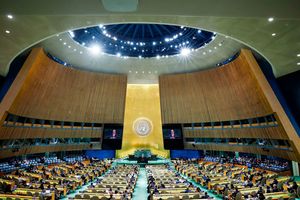
This week is New York Climate Week, another moment each year when climate action is supposed to move from talk to commitments. Running alongside the UN General Assembly, it brings together heads of state, global business leaders, philanthropic leaders, and civil society to accelerate climate action at scale.
With over a thousand events spanning energy, industry, finance, food, transport, and nature, it’s where governments and companies test new partnerships, announce funding commitments, and hold each other accountable to climate pledges, and this makes it one of the few times the entire climate ecosystem, from policymakers to grassroots activists, is in the same city at the same time, working toward shared solutions.
But this year New York is having its annual conversation about the future of climate action just as the Pacific is sending us a message about the present. There is something almost absurd about the timing. In Manhattan, delegates are gathering in rooms discussing transition, resilience, innovation, and debating how quickly we need to act as our world changes around us. Thousands of miles away, the Pacific is offering up its own update: an extraordinary El Niño reminding us that the climate is not waiting for our strategies, our debates, our pledges or our next summit.
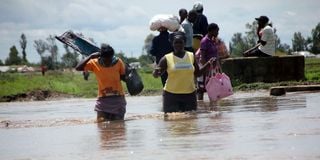
For much of Africa and the Global South, this is hardly news. The climate crisis has always been clear and present. It arrived as failed rains and floods, disappearing harvests, rising food prices, unbearable heat and communities being forced to adapt to a volatility they did little to create.
What is discussed in New York as tomorrow’s risk is already being experienced elsewhere as today’s reality. And this is perhaps the uncomfortable question Climate Week should be asking: what if the future we are debating has already arrived. Just not everywhere at the same time. The Pacific’s message is a reminder that the climate system is responding whether we act or not.
And its impacts do not respect the boundaries between climate, food, water, health, energy, finance and livelihoods. So the challenge before us is no longer simply to imagine a better future. It is to close the widening distance between those who have the luxury of preparing for climate change and those who are already living through it. The real measure of climate leadership now is how quickly that ambition reaches the people and places on the front line.
The beginning of this year offered a stark reminder of why this matters. The wars around the world, and the closure of the Strait of Hormuz exposed how quickly geopolitical conflict can reverberate through global markets.
In Kenya alone, the realities of the war saw a rise in the cost of fuel products and in turn a rise in the cost of living. This did not remain confined to what things cost, but also filtered into protests in the streets and unrest. An energy shock can therefore become a food shock, an inflation shock, and ultimately, a development shock.
This is really the time to deepen and champion local innovations and solutions. Community-led restoration & forest protection, community-led irrigation systems, indigenous seed banks, decentralised renewable microgrids, and locally financed early-warning systems that have kept people fed, powered, and safe long before any international pledge reached their doorstep. These solutions are not stopgaps while the world waits for global multilateralism to do its magic. This is actually climate leadership and climate adaptation in action. I love that there has been an effort to rename “Climate Week” to “Climate Action Week”.
That’s right, we need more and more action. The truth is that if Climate Week is to deepen its meaning, it must translate its ambition into capital, technology, and partnership that flow toward these frontline innovators. Because the true test of this week won’t be measured in the rooms of Manhattan but rather in whether the next failed rainy season, the next fuel shock, the next extreme heatwave finds communities more prepared than they were the year before.
I am particularly excited about the social bioeconomy as living proof that nature’s integrity and human dignity can rise together. What we witnessed in the Brazilian Amazon earlier this year, on a learning journey into the social bioeconomy, was a glimpse of a different future already taking root with urgency. The three critical forest blocks cannot wait.
We need the Amazon, the Congo, and the forests of Southeast Asia for our planet to stay in balance. We are toast without them. These forests can be, and in some places already are, the source of an economic sector that is sustainable, regenerative, local, and regional.
The future we seek is one where standing forests are worth more than cleared ones, where indigenous knowledge sits at the centre of innovation rather than at its margins, and where food security, income security, and human dignity are not traded off against climate resilience but grown together.
This is the future we owe the Pacific, the Sahel, and every frontline community watching New York this week. We owe them the courage to scale what already works, in the hands of the people who have protected these ecosystems all along. The bioeconomy shows us that the choice between people and the planet was always a false one. Now is the time to build accordingly.
Ms Mathai is the MD for Africa & Global Partnerships at the World Resources Institute and Chair of Wangari Maathai Foundation