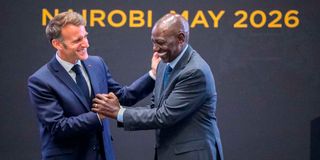
In Nairobi this week, French President Emmanuel Macron stood beside William Ruto and declared, with breathtaking audacity, that France and its friends are “the true Pan-Africanists.” It was the kind of statement only an empire could make without choking on its own history.
Pan-Africanism was not born in the salons of Paris. It was not midwifed by European presidents, development banks, defence pacts, or investment summits where African leaders are paraded as grateful junior partners in their own continent’s future. Pan-Africanism was born in resistance. It was forged in the fire of anti-colonial struggle. It was carried by people who understood, with painful clarity, that Africa could never be free while its destiny remained negotiable in foreign capitals.
France’s record in Africa is a crime scene. From Algeria, where colonial violence reached unspeakable depths, to West and Central Africa, where entire economies were organised around French extraction, Paris built an empire on plunder, humiliation, forced labour, military domination, and the careful manufacture of dependency. The French colonial project was never about civilisation. It was theft.
And when formal colonialism became too vulgar to defend, France simply modernised the machinery. It perfected Françafrique: a neocolonial architecture of puppet elites, monetary control, military interference, resource capture, and diplomatic blackmail. African flags went up, national anthems were composed, presidents were sworn in, but the essential question remained: who truly held power?
The CFA franc remains one of the clearest monuments to that arrangement. A currency system tying African economies to French and European interests, limiting monetary sovereignty while giving Paris enduring leverage over nations it claimed to have “liberated.” Liberated from who?
Then there is the bloodier record: France’s endless military footprint across the continent. Chad. Mali. Burkina Faso. Niger. Côte d’Ivoire. Central African Republic. Rwanda. Again and again, the same pattern emerges. France identifies a crisis, enters as saviour, secures its interests, props up friendly regimes and deepens resentment.
Deconstructing France’s imperial legacy
Yet in the Sahel, after years of French presence, instability did not disappear. Anger grew. Sovereignty became a rallying cry. French troops were pushed out not because Africans suddenly became irrational, but because people eventually recognise the hand on their neck, even when it is wearing diplomatic gloves.
Now, having been rejected in parts of the continent where its game has become too obvious, France turns to East Africa. Emmanuel Macron himself said it, that our president had to have been crazy to accept to co-chair the summit. Even he couldn’t believe that in big 2026, there existed pockets across the continent where French hubris wasn’t deemed obvious, let alone a sitting president.
Well, that is the tragedy of William Ruto’s government.
Kenya should know better. We are not naïve children in the theatre of empire. We know what foreign domination looks like. We know what legal exceptionalism looks like. We know what it means when powerful countries demand access to our land, our ports, our intelligence, our infrastructure, our politics, and then ask that their people be placed beyond the reach of our courts.
The reported defence arrangement allowing French troops on Kenyan soil with prosecutorial immunity is not a technical clause. It is a red flag soaked in history. Before the boots have even properly landed, immunity is already on the table. Not accountability. Not transparency. Not public consent. Immunity.
Why? Why must the partnership begin with the weakening of Kenyan jurisdiction? Why must foreign soldiers be shielded from the courts of the country hosting them? Why should Kenyan soil become useful to foreign militaries while Kenyan law becomes optional to them?
We have seen this film before. The Agnes Wanjiru case remains a national wound precisely because it revealed the cruelty of foreign military impunity. It showed us how easily Kenyan lives can be treated as collateral in arrangements negotiated far above the people affected by them. It showed us the real hierarchy: their soldiers, our silence; their interests, our grief; their protection, our humiliation.
And while all this happens, Ruto’s government wraps the spectacle in the language of progress. Eleven deals. Over a billion dollars. Port modernisation. Rail upgrades. Energy projects. Grand announcements. Big numbers. Foreign applause. The familiar theatre of a state desperate to appear attractive to outsiders while becoming unbearable to its own citizens.
But Kenyans must ask the questions power hopes we are too tired to ask. Who owns the benefits? Who carries the risk? Who gets the contracts? Who controls the infrastructure? What concessions are hidden beneath the glamour? What strategic leverage are we surrendering in exchange for press releases and presidential photo-ops?
Modern empire rarely arrives shouting conquest. It arrives smiling. It arrives through memoranda of understanding. It arrives through development finance, security cooperation, technical assistance, intelligence sharing, and infrastructure deals whose true cost is discovered only after the cameras have left.
This is why Macron’s statement was so obscene. France is not the true Pan-Africanist. France is one of the historical reasons Pan-Africanism had to exist.
And Ruto’s willingness to host this insult on Kenyan soil tells us something deeply troubling about the character of his presidency. At home, citizens are drowning in taxes, fuel costs, food prices, school burdens, unemployment, debt anxiety, and state arrogance. Yet abroad, the president performs competence for foreign audiences with the discipline of a man more concerned with applause than accountability.
But no investment summit can launder surrender. No defence pact can be sanitised by diplomatic grammar. No billion-dollar announcement can erase the fact that a government which cannot protect its citizens from economic punishment is now busy negotiating protections for foreign soldiers.
True Pan-Africanism demands a different courage. It demands leaders who can engage the world without crawling before it. Leaders who understand that sovereignty is a daily refusal to place foreign power above African dignity. It demands suspicion where suspicion is earned, scrutiny where scrutiny is necessary, and rejection where rejection is justified.
Africa does not need France to certify its Pan-Africanism. Kenya does not need Macron’s applause. And Kenyans certainly do not need a president so eager for global validation that he mistakes strategic exposure for sophistication.