On the eve of July 7, masked men riding pillion on motorcycles and on foot rushed the security at the Kenya Human Rights Commission in Nairobi, breached the gate and laid siege for an hour.
They would be joined by truncheon-welding acolytes and women in face masks shortly thereafter, and declare with finality that no demonstrations would be planned at the KHRC offices.
All Saints Cathedral, which had been slated to host the media event for mothers of survivors of previous public action, became unavailable at the 11th hour, and understandably so. The last time police assaulted and injured protesters taking refuge inside the church some three decades ago, the sanctuary had to be cleansed.
Scores of women who had come to appeal for de-escalation of violence during public protests took refuge inside the building after the attackers started assaulting them, seizing their belongings and creating a loud ruckus. The attackers appeared to have no fear of law enforcement or legal consequences.
Reinforcements from the security firm were not adequate to restore control of the property to its owners, and police were singularly uninterested in responding despite several distress phone calls. A lone man, who identified himself as a member of the local security community from the chief’s office nearby, arrived long after, showed up an hour after the attack, followed by the area chief much later. Attempts to formally report the incident to the police station some two kilometres away were met with casual dismissal.
The attack on the KHRC offices fits into an emergent plan of deploying insecurity to achieve political goal of stifling victims’ voices. This phenomenon was rehearsed during the 2023 cost-of-living protests when police officers at former President Uhuru Kenyatta’s farm were posted out to allow thieves to make off with his sheep.
It was perfected in June last year when the security services appeared to be overwhelmed by protesters, necessitating the deployment of the military to civilian policing duties. The untenable optics of such a prospect saw the increasing use of hired gangs to loot and destroy property in an attempt to contaminate protests.
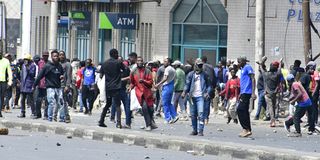
This year, the hiring and deployment of political gangs has evolved into an art form. On days of public action, gangs operating with impunity target businesses, offices and government installations — including police stations and courts — for destruction and arson to portray the protests as lawless and expensive for business. While this distraction was intended to create a cover for the violent crackdown on dissent, it has spawned a new security economy only comparable to the Covid windfall.
Business owners with shop windows have been forced to expend money on metallic shutters, while others have reportedly resorted to making private security arrangements for protecting their property. The people whose businesses are targeted have no protection from the police, who are conveniently engaged in lobbing teargas at protesters armed with only a phone and a flag.
More recently, gangs have had free rein in the streets, looting and pillaging as police battle protesters.
The prevalence of general insecurity during civil unrest creates opportunities for private security arrangements that enjoy police protection. This policing strategy is not as foolish as it seems. It achieves the political objective of dampening public support for civic action but also dissuades property owners from supporting civic engagement. Better than the political success it achieves, the vulnerability of businesses presents an opportunity for police commanders to offer selective protection for an unknown consideration.
Those establishments that are unwilling to fall in line would be the first to be encouraged to seek professional assistance. The select supermarkets that have been attacked and looted on the days of protests have experienced repeat episodes. A video was posted on the social media platform X, this week, showing uniformed police officers breaking the glass of a shop window next to a supermarket that would later be looted and burnt.
Businesses that do not pay protection fees to the local police command are vulnerable — and not just to anonymous criminals but individuals with deep connections in the security service.
The use of contract gangs is a telling admission that security agencies on their own are no match for protesters. The most recent report from the National Crime Research Centre, released two months ago, established that there were 309 criminal gangs operating in the country, concentrated in just 11 counties. This is the highest criminal gang count since the post-2007 election violence, in which politically funded gangs were active participants.
It is telling that no action has been taken against gangs captured on security cameras intimidating people and causing mayhem. Gangs that have drunk from the cup of impunity, complete with police protection, are much harder to demobilise than to recruit for one-off assignments.
The brazen activities of gangs with the approving wink of State security is dangerous dance with elections only a couple of years away.
History is replete with examples of private security actors that start off as fringe operators only to become institutionalised and even permanent societal features. Francois Duvalier, aka Papa Doc, established the Tonton Macoutes in Haiti in 1959; today, that nation is ruled by gangs. Closer home, experiments with groups like the Mungiki, Sungu Sungu, Angola Musumbiji and Chinkororo have deepened their roots to the point where they are almost impossible to uproot.
The brazen activities of gangs with the approving wink of state security is dangerous dance with elections only a couple of years away.
The writer is a board member of the Kenya Human Rights Commission and writes in his individual capacity. @kwamchetsi; [email protected]