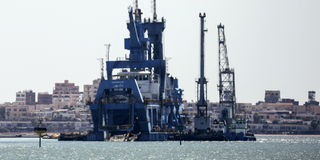
Egyptian dredging ship, Mashhour, is pictured at Egypt's Suez Canal in Ismalia, Egypt, April 16, 2025.

When United States President Donald Trump, never one to shy away from theatrics, declared on April 26 that American ships—military and commercial—should sail through the Suez Canal without paying a cent, he did not just ruffle feathers in Cairo.
For African securocrats who track these things with hawk-eyed intensity, it was a geopolitical grenade lobbed straight into the delicate choreography of Africa’s maritime affairs—one that could ignite a new era of coastal contention.
Egypt, already staggering from a 60 per cent drop in Suez Canal revenues in 2024—losing $7 billion due to Yemeni Houthi attacks in the Red Sea—now faces the prospect of haemorrhaging a further $470 million to $940 million annually if Trump’s threat sticks.
American vessels account for roughly 5–10 per cent of canal traffic. For a country where the canal contributes 2 per cent to GDP, that’s no small dent. But as Cairo nurses its bruises, the tremors are likely to hit as hard further south, along East Africa’s coast.
Trump’s Suez gambit is not just about Egypt. At a time when East African coastal nations are already entangled in their own “war of ports”, it could prove a clarion call to global and emerging powers—be it China, a resurgent India, Turkey, or the United Arab Emirates—to pressurise smaller African nations into offering free or heavily discounted access to their harbours. Picture Mombasa, Dar es Salaam and Mogadishu morphing into open-access zones where foreign navies and mega-freighters dock gratis. The implications are as chaotic as a Nairobi matatu at rush hour: sovereignty diluted, revenues drained and ecosystems degraded.
Kenya’s Mombasa port, which handles around 30 million tonnes of cargo annually, and Tanzania’s Dar es Salaam, a lifeline for several landlocked neighbours, are critical to the region’s economic blood flow. Free access could slash port revenues, kneecapping infrastructure plans and stoking unrest in coastal communities that already feel left behind. Somalia, haemorrhaging an estimated $300 million annually from illegal fishing, could watch Berbera slide into a foreign free-for-all, further eroding its tenuous hold on sovereignty.
Bagamoyo port deal
An escalated “war of ports” could also militarise the coastlines. Imagine American or Chinese naval facilities sprouting in Lamu or Zanzibar—mini Djiboutis bristling with guns and flags. The locals would not stay silent. Recall Tanzania’s protests in 2021 against the Bagamoyo port deal. Divert government funds from coast guard to guest facilities for foreign navies, and you might just roll out the welcome mat for pirates. The last time Somali piracy peaked—2008 to 2012—it cost the global economy $18 billion a year. A reboot would jack up insurance premiums and throw supply chains into disarray from Bujumbura to Juba.
And then there is the environment. A spike in shipping traffic could push East African waters, already on life support, into ecological collapse. These are seas home to 1,500 coral species and the endangered sea cows. One oil spill can wipe out entire mangrove swamps and devastate fish stocks.
Plastic waste—an estimated 23 million tonnes globally each year, 20 per cent of it dumped by ships—chokes beaches, kills marine life and hobbles tourism. Somalia’s coast, long a toxic dumping ground, loses hundreds of millions annually to poisoned fisheries. Unregulated access would accelerate the carnage, introducing invasive species and heavy metals like mercury into the food chain. Kenya’s $1 billion coastal tourism sector could collapse under the weight of oil sludge and plastic soup.
Illegal fishing, already costing the region $1.5 billion annually, would surge. Chinese fleets, infamous for overfishing and ghost nets, would have a field day in unguarded waters, collapsing fish stocks that feed over 200 million people. In Zanzibar, where coral reefs underpin 70 per cent of local fish catches, fisheries’ failure could trigger food crises.
Strategic backyard
In the worst-case scenario, East Africa becomes a pawn in the world’s latest chess game. China, which has fingers in at least 14 African port pies, will not sit idle while the US gets free passage. India, eyeing the Indian Ocean as its strategic backyard, might pile in with its own deals. The East African Community could find itself under stress—Kenya leaning towards Washington, Somalia flirting with Moscow and Tanzania playing the field. Regional bargaining power would wither, and once-sovereign ports could become neo-colonial trading posts draped in foreign flags.
Still, there is room for East Africa to flip the script. A coordinated stance, aided by tech tools like Fish-i Africa, could help monitor rogue vessels, slap fines on violators and demand environmental levies. Kenya and Tanzania might yet wring infrastructure deals or defence support out of the Americans or Chinese in exchange for structured access. Somalia, perched by the Gulf of Aden, could start charging tolls on Suez-bound ships. It is a long shot—but then again, so was a reality TV star rewriting global maritime rules.
For now, Trump’s Suez broadside should jolt East Africa into action. Time to fortify ports, tighten maritime law and unite. Or else, the coastline becomes the next battlefield—where great powers muscle in, pirates creep back and the ocean mourns its dead.
The author is a journalist, writer, and curator of the "Wall of Great Africans". @cobbo3.