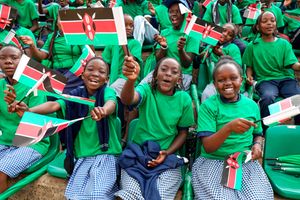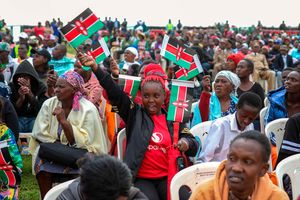
Youth hold peaceful protests along Kenyatta Avenue in Nakuru town. There is usually a very high social cost to ignoring youth revolution.

Youth in Kenya are routinely addressed in the third person plural, especially by the government. The paternalistic language used to speak to youth and the issues that affect them belies the reality of their alienation. Language performs power, and the distancing of youth from government in speech and policy documents is not accidental.
More than half of Kenya’s civil service is aged 50 years and over. Those aged 40 years and below accounted for just over 15 per cent of the workforce while 34 per cent were between the ages of 41 and 50, according to a 2021 study by Nnamdi Madichie and Margaret Nyakang’o. Contrast this with the hard fact presented at the National Population and Development Council conference last month: seven out of 10 Kenyans are below 35 years. Youth between 15 and 34 years constitute the highest unemployment rate of 67 per cent in Kenya.
Given Kenya’s demographic structure, it is no wonder that the country is restive—politicians distribute teachers’ appointment letters at a fee while police, prisons and military intakes are rent kiosks for the corrupt. Now, even the nursing profession is part of the gravy train for the shady. Private sector, which is wedged between official corruption and an underperforming economy, is gasping for air and cannot absorb the one million young people joining the labour market every year.
Many efforts to defuse the youth time bomb are therefore geared towards their inclusion in the economy through support for the informal sector. The Kenya Youth Employment Opportunities Project created 125,000 direct jobs and 30,000 indirect jobs last year. Its successor, the $229 million World Bank funded National Youth Opportunities Towards Advancement targets to include 800,000 young people in informal sector social insurance.
Youth protests
Youth have the greatest stake in the future of the country because they are more likely to live in it. Yet, not many programmes put them in the driver’s seat.
A glimmer of hope shone out of this gloomy picture of youth exclusion from public life last week when Siasa Place marked what it billed as “10 years of inventing the future”. For those government officials who have been struggling to understand the source of the rage that drove last year’s youth protests, they got their answer.
It has taken a decade for this youth organisation to surmount hurdles young people typically face to organise and to have their voices heard. It has not only harnessed youth voices in political discourses, but also mobilised youth-serving organisations.
It secured a major court victory when it challenged a presidential appointment of an elderly person to chair the National Employment Authority. The emergent narrative is that youth do not accept the designation of docile tenants, waiting on State goodies and favours, but full and equal citizens demanding voice, rights and recognition.
Its sights are set on devolution and local accountability; politics, tech and rights; and youth employability, skilling and mentorship. This is the notice to those who belong to a certain age demographic that the young people are coming for your lunch.
History is replete with cautions that when youth get together and focus on this country, change happens. The most glaring evidence of this is in the 2002 Youth Agenda publication, Recreating our Republic: The Ambitions of a Generation, in which aspiring young leaders not only expressed their disappointment with antecedent generations, but laid out a bold vision of the country they would like to see. Many of their proposals have come to fruition, such as the establishment of a youth enterprise fund. The ambition to free the university as a centre of ideas, policy debate and thought leadership remains a bridge too far.
So little has changed in the demands youth continue to make: It is instructive that last year, when the country was on the verge of revolution, legislators were arguing over how to secure the unconstitutional Constituency Development Fund rather than oversight of Executive profligacy.
Youth then, as now, recognise that the government is the chief steward of the economy, and must take responsibility for the consequences of that stewardship. When policy outcomes contradict political rhetoric and lead to economic difficulties, accountability conversations become unavoidable.
Youth have always provided the spirit for Kenya’s renewal. The Young Turks in the opposition brought the Kanu single-party monolith to its knees. The Seven Bearded Sisters in Parliament before them were also very youthful people. Earlier, it was impatient youth returning from the Burma Campaign in 1945 who formed the Anake a 40, who later went to the forest as the Kenya Land and Freedom Army led by a 31-year-old school teacher named Dedan Kimathi.
There is usually a very high social cost to ignoring youth: revolution. The words of Langston Hughes’ poem, Harlem, are prescient: “What happens to a dream deferred? Does it dry up like a raisin in the sun, or fester like a rotten sore and then run? Does it stink like rotten meat or crust over like a syrupy sweet? Maybe it just sags like a heavy load. Or does it explode?”
Frantz Fanon advises: “Each generation must, out of relative obscurity, discover its mission, fulfil it, or betray it.”
The writer serves on the board of KHRC and writes in his individual capacity. @kwamchetsi; [email protected].