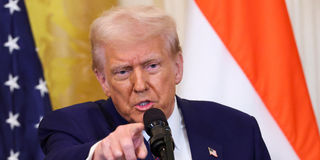
US President Donald Trump gestures during a joint press conference with Indian Prime Minister Narendra Modi at the White House in Washington DC on February 13, 2025.

Some 500 United Nations employees poured into the streets of Geneva in demonstrations outside the organisation’s offices on Labour Day this year to protest against brutal staff cuts proposed in the UN80 Initiative report.
The UN is looking to shed between 20 and 30 per cent of its133,245-strong staff around the world, mostly people in junior and middle-level positions, as a response to demands for a leaner, more efficient and effective organisation. In Kenya, the number of those affected could be anywhere between 1,000 and 1,500.
For UN Secretary-General Antonio Guterres, self-inflicted injuries could not be bloodier or messier than this one. Eight years ago, Guterres told United States President Donald Trump that the UN had “fragmented structures” and “Byzantine procedures” which needed reforming. Returning to the White House this year, Trump held back $3.34 billion in UN dues for peacekeeping and assessed contributions to “preserve maximum negotiating leverage”.
By the end of April, the US topped the list of nations owing the UN money for peacekeeping and assessed budgets at $3.1 billion, followed by China ($1.18 billion), Russia ($200 million) and Venezuela ($121 million), which created a $5 billion hole in the organisation’s budget. A Bill in the US Senate calling for America’s withdrawal from the UN seeks to cut all forms of financial support, prohibit involvement in peacekeeping operations, revoke diplomatic immunity for UN officials and pull the country out of the World Health Organization.
In the years of plenty, some of them under Guterres, the UN bureaucracy expanded by 150 per cent—with the number of under-secretary-generals rising from 60 to 88 and the number of assistant secretary-generals leaping from 88 to 121. These positions were the largesse the secretary-general used to secure votes in the General Assembly without disturbing the business and power interests of the permanent members of the UN Security Council.
Maintain international order
David L Bosco’s Five to Rule Them All: The UN Security Council and the Making of the Modern World lays out the architecture of power in the global body, which prevents the most powerful nations from going to war with one another while occasionally intervening in peripheral conflict situations to maintain international order.
Although the US helped to found the UN after World War II in order to prevent future global conflicts and promote international peace and security, it has been a major aggressor in some of the bloodiest conflicts, including Korea, Vietnam, Afghanistan and Iraq. The habitual handwringing over raging conflicts around the world by members of the Security Council, informed by their selfish national interests, has resulted in genocides. It is moot to expect nations that supply weapons to combatants in conflicts to stop the wars that benefit them.
Aware of its congenital defect, the UN has drifted from its mission to prevent conflict and allowed itself to be railroaded by powerful states into creating business opportunities for their nationals. Peacekeeping provides opportunities to supply rifles, uniforms and helmets and vehicles. Displacement and famine generate opportunities for farmers to grow food under government subsidies with a guaranteed buyer.
Control of the ever-expanding bureaucracies in the UN mirrors the power balance in the Security Council. Americans lead the Department of Peace and Political Affairs to gather intelligence, while the British hold the levers on the humanitarian assistance business available through the Office for the Coordination of Humanitarian Affairs. France manages peacekeeping operations to facilitate its mining activities in conflict zones, notably its former colonies, while China controls the Department of Economic and Social Affairs to cultivate global influence. These enterprises have seen the UN grow to the elephantine proportions where it can no longer carry its ivory.
Sustainable urban development
On March 11, Guterres appointed the UN80 Task Force to develop proposals on efficiencies and improvements, and structural changes. The April 24 progress report on the initiative lays out the terms of surrender in the following actions:
Development-related entities will be merged, operations relocated to Nairobi, which is considered cheaper, senior posts will be reduced, and administration centralised. Other proposals suggest collapsing UNAids under WHO, and merging UN Women with UN Population Fund while aligning it with Unicef and enhancing coordination between the UN Environment Programme and UN-Habitat to promote sustainable urban development.
This potpourri is expected to be endorsed later this year, debated by the General Assembly in 2026, and rolled out by 2028.
Still, the UN’s erstwhile biggest contributor is unlikely to be impressed. According former Trump advisor Hugh Dugan: “If Guterres really comprehends that the system needs a major overhaul, he should step down and facilitate an early UN Secretary-General election.”
The UN still refuses to consider a universe in which the US is not its member state.
The writer is board member of the KHRC and writes in his individual capacity. @kwamchetsi; [email protected].