Every morning in the remote village of Matondoni on Lamu Island, the air carries the salty tang of the Indian Ocean and the scent of mangrove-lined shores. But in this predominantly Swahili village, home to the Bajuni community, another transformation is taking place.
For years, many women spent their days largely dependent on their husbands and the seasonal fortunes of fishing. Today, their hands are busy with a new enterprise that is changing their livelihoods, households and community. Near the beach, an elevated, greenhouse-like solar dryer gleams under the bright equatorial sun.
Around it, more than 10 women from the Matondoni Tarazak Women Self-Help Group, dressed in vibrantly coloured buibuis, move quickly but carefully as they sort and process the day's fresh catch of prawns. In another corner, laughter and focused chatter fill the workspace as the women pack bright pink dried crustaceans into clean, labelled packages ready for markets within Lamu County and beyond.
Earlier this year, the Matondoni Tarazak Women Self-Help Group successfully applied for and secured a Sh1.7 million grant from the Kenya Marine Fisheries and Socio-Economic Development (KEMFSED) project, a joint initiative of the Government of Kenya and the World Bank.
The group used part of the grant to acquire high-value post-harvest equipment, including a solar dryer for drying fresh prawns and fish. Matondoni Tarazak Women Self-Help Group Secretary Swabra Mohamed Musa said the group also used part of the funds to purchase initial consignments of fresh prawns from fishermen across Lamu, enabling them to kick-start the venture.
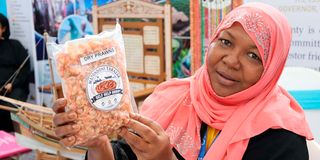
Dried and packaged prawns by Lamu's Matondoni Tarazak Women Self-Help Group displayed during the Mombasa 2026 Our Ocean Conference on June 16,2026.
Photo credit: Pool
Six months later, the simple solar-drying initiative has transformed the lives of women who were once largely dependent on their husbands, giving them greater financial independence.
Ms Musa said that since establishing the project, the group has continued to enjoy financial success and reach new heights through solar drying of prawns.
“We buy prawns from fishermen at Sh2,000 a kilo. After drying, value addition, including packaging them in branded packets, we sell them at Sh3,000 per kilo, something that has transformed our livelihoods, enabling us to generate profits to sustain ourselves,” said Ms Musa, adding that by shifting from traditional open-air mat drying to solar drying, the group can process higher volumes of prawns, often up to 50 kilograms in just five hours, while meeting strict hygiene standards.
According to Ms Musa, this earns the group about Sh100,000 from each batch.
“Apart from drying prawns, the facility also processes other fish. Fishermen and dealers in the dried fish (ng’onda) business have also been seeking our services where we dry each kilogram of fish for them at Sh30. This has enabled us to diversify our local income,” said Ms Musa.
Fatuma Bwanamzee, the chairperson of the group, said the initiative has completely transformed the daily routines of the women of Matondoni. Ms Bwanamzee pointed out that they are no longer confined to the kitchen or dependent on the seasonal fortunes of their husbands' fishing trips.
“This sustainable solar dryer technology has empowered us with financial independence. Instead of relying too much on our husbands for upkeep, we’re earning our own money. Some of us have even started our own shops and kiosks within Matondoni. The initiative has transformed us into community entrepreneurs,” said Ms Bwanamzee.
The women's first attempt to venture into fish drying using traditional methods, such as open-air mat drying, was unsuccessful. They spent long hours guarding the catch from birds and other threats on the open beaches. At times, they were forced to throw away batches of rotting prawns and fish.
"The time we would spend guarding prawns drying in the open can now be redirected toward family, rest and other economic activities. The solar dryer has also reduced our exposure to extreme heat and the physical toll of traditional drying,” she said.
Through the venture, the women have been able to take loans from the group to finance personal development, including constructing modern houses, paying school fees for their children and meeting other daily household needs.
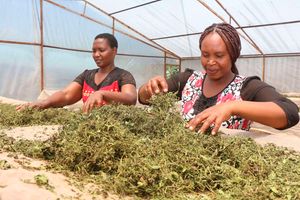
Lamu's Matondoni Tarazak Women Self-Help Group Secretary, Swabra Mohamed Musa inside a solar dryer while drying prawns at Matondoni village on June 5, 2026.
Photo credit: Pool
Nuru Shee, 72, a mother of six, said the initiative has been a saviour for women without husbands like herself. The project has transformed them from passive observers into active entrepreneurs, subsequently improving their households.
“With our own income, we can now independently manage household expenses, fund our children’s education, and invest in community micro-loans,” said Ms Shee.
The women currently rely mainly on local markets in Lamu and other counties within the Coast region to sell their prawns. Their key customers include local residents and tourists, while special orders sometimes come from hotels and restaurants.
The women are, however, appealing to the county and national governments, as well as well-wishers, to help them secure reliable markets within Kenya and beyond.
Lamu County Executive for Fisheries, Blue Economy, Cooperative Development and Livestock Sabrina Mkare Jefwa cited the success of the Matondoni Tarazak Women Self-Help Group as a testament to what is possible when communities are empowered beyond grant funding.
Ms Mkare noted that under the leadership of Governor Issa Timamy, the county's vision is to ensure that every community enterprise is supported to become sustainable, competitive and market-ready.
Matondoni Tarazak Women Self-Help Group chairperson Fatuma Bwanamzee Abdalla (left) and secretary, Swabra Mohamed Musa display dried and packaged prawns in Matondoni, Lamu on June 5,2026.
Photo credit: Pool
She said the overwhelming response to the Matondoni group's products at the Our Ocean Conference held in Mombasa in June 2026 confirmed that there is a strong market for value-added seafood products.
“For us, this is what the Blue Economy is all about. The women of Matondoni have shown that with innovation, determination, and the right support, our coastal communities can transform local marine resources into high-value products that create jobs, improve household incomes, and showcase Lamu’s Blue Economy potential to the world. Their journey is exactly the future we envision for our county,” said Ms Mkare.
Lamu County Fisheries, Blue Economy, Cooperative Development and Livestock Director Kamaludin Sharif said fishers in the region had for years been losing a significant share of their catch before it could be properly dried and preserved for sale.
Mr Sharif said that through the KEMFSED project, they had managed to issue grants that helped fishers acquire outboard engines for the timely transportation of fresh prawns and fish consignments for processing.
"I am happy that Matondoni Tarazak Women Self-Help Group is among beneficiaries of such grants that have enabled them to buy a solar dryer for drying prawns. This has revolutionised the local seafood industry by enabling group members to process high-quality, uncontaminated products. This allows them to bypass low-profit traditional selling methods, access lucrative markets, and achieve financial independence, shifting the traditional household financial burden,” said Mr Sharif.
He encouraged the women of Matondoni and Lamu at large to save and expand their small and medium-sized enterprises (SMEs) to achieve better returns.
“They make nice, well-packaged and perfectly dehydrated, high-quality prawns. Let them target prime markets including supermarkets,” he said.
Simon Komu, a fisheries expert, noted that in today's world, food is not just about taste. It is also about trust, nutrition and sustainability. Mr Komu said nowhere is this more evident than in the fishing sector. For decades, dried fish has been a vital source of protein for coastal communities. Mr Komu said the Matondoni group was on the right track, noting that solar dryers are among the best options in the modern world because they are also climate-friendly. He added that traditional methods of drying fish in the open sun came with numerous challenges.
Matondoni Tarazak Women Self-Help Group members dry prawns inside a solar dryer at Matondoni Village in Lamu County on June 5, 2026.
Photo credit: Pool
Key among them are excessive salt use, poor hygiene, contamination risks, high moisture content that leads to spoilage, and a short shelf life of barely two months. The result is lower nutrition, lower prices and limited market reach. He, however, emphasised that the introduction of equipment such as solar dryers has turned the tide, revolutionising the way fish is preserved.
"These dryers create a hygienic, enclosed environment where fish dries faster, cleaner, and with superior quality, almost doubling the protein of traditional dried fish. Solar drying generally ensures that fish doesn’t go to waste but reaches more plates, more safely and hence needs to be embraced," said Mr Komu.