When Benson Muchai visited his friend at Matuiku Farm, some kilometres from Elburgon Town, in 2020, he did not know that their lengthy conversation would lead him to start growing short-term crops rather than long-term ones, enabling him to make good sales without spending much at the end of the season.
Muchai, 38, said that he learnt from the farmer that he was growing black nightshade, commonly known as managu , on his one-and-a-half-acre plot of land.
His friend revealed that he received close to Sh1.5 million from the sales every three to four months, adding that it was cheap to grow and labour-intensive, and that the price was good at the market. When he asked his friend what the secret to this success was, Mr Muchai learnt that, with enough water, any farmer could invest in managu farming and thrive, even on a small plot of land.
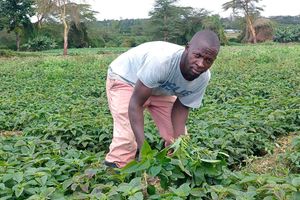
After consulting his wife, the couple decided to convert their maize farm and start growing managu on the half-acre plot of leased land they had in Elburgon, Nakuru County. In a recent interview, Muchai said that he had used savings of Sh20,000 to lease the half-acre plot of land for Sh7,500, and had bought 100 grams of black nightshade seeds and five bags of livestock manure, which he broadcast on the farm before tilling it. He mixed the seeds with a bag of sawdust, planted them in furrows spaced 15 centimetres apart, and sprinkled enough water on the farm.
Benson Muchai displays black nightshade he grows on a leased farm in Elburgon, Nakuru County on August 6, 2026.
Photo credit: John Njoroge | Nation Media Group
Depending on the water supply, the seeds germinated after two to three weeks. In the third week, he sprayed the farm with herbicides to kill weeds and, after one month, spread more manure. “The leafy vegetables are ready to harvest after one month and a week. In my first harvest, I harvested 800 kilos and sold them at the local market for Sh70 per kilo,” said Muchai.
He added that these sales could not be compared to the income he had earned from selling a 90kg bag of threshed dried maize, which retailed at Sh2,400 during peak season and Sh1,800 in low season. He added that, in a good season, he used to harvest between 25 and 30 bags from half an acre of land over the past five years of planting maize. This was in contrast to managu farming, where farmers can harvest over 1,500 kg every week from a similar plot of land.
Harvesting continues every 10 days as he applies CAN fertiliser to add nutrients and increase production with each harvest. To manage black nightshade, he adds foliar fertiliser and calcium to promote leaf growth, and sprays pesticides to prevent mites and insects, which mostly invade the crop during the dry season. However, during the rainy season, the crop is affected by blight, but he sprays it to prevent further attacks.
Mr Muchai says that the market for this crop is better than for maize because there are no brokers, unlike in maize and potato farming. This allows him to sell his produce directly to customers who come to the farm to buy it, and he has no regrets about abandoning maize farming.
He has used the profits from these sales to buy his own piece of land, on which he grows managu and other crops. He also uses the money to pay his children's school fees and to cover other domestic expenses. During good or rainy seasons, he harvests more than 2,500kg, with each kilo currently selling at Sh50.
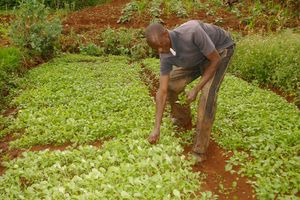
After four months of continuous harvesting, Muchai rotates his managu farm with crops such as carrots, broccoli, beans and peas, but ensures that his black nightshade continues to grow in a different area in order to maintain customer demand.
Benson Muchai harvests black nightshade (managu) at his rented farm in Elburgon, Nakuru County on August 6, 2026.
Photo credit: John Njoroge | Nation Media Group
“I have expanded my black nightshade farm to two-and-a-half acres, and I plan to increase this to over five acres within the next two years, provided there is enough water,” said the farmer. He added that he has a garden pond into which running water drains, and he also harvests rainwater to maintain a continuous farming process.
The black nightshade vegetables produce seeds that are harvested and preserved for planting. This allows him to generate enough seeds to plant in the next season without buying from farm input shops. Since he started growing managu six years ago, Muchai says he has never encountered any diseases affecting his crop, provided it is well managed and given the right nutrients.
He says farmers in the area have started to embrace planting black nightshade on their farms, as it generates income in a short period of time. As water is the main challenge and most important factor for many farmers across the region, Mr Muchai advises that those wishing to start growing managu should first ensure they have sufficient water. He added that with as little as Sh3,000, farmers can begin and succeed on the farm, making good sales every 10 days.
In the past, black nightshade grew unattended in forests, thickets, and by the roadside before it was introduced to farm input shops. Since then, farmers have embraced it and continued to grow it on their farms because it grows quickly and generates income in a short amount of time.
According to Ms Sarah Kimani, who grows the crop on her quarter-plot of land, she earns over Sh150,000 from sales every month, particularly when there is plenty of rain. She noted that, after benchmarking at Muchai’s farm, she decided to start farming herself. “For the past two years, I have had no regrets about planting black nightshade because I have been able to make a profit without spending much on the farm, unlike with other crops such as maize and potatoes, where I used to spend a lot. I plan to extend my plot and plant more to meet customer demand,” said Ms Kimani.
Farmers have called on the county government to provide them with large water tanks and to drill boreholes in every village, in order to reduce water shortages. Mr Kanyoro says that with adequate rainfall, young people can earn an income from a small plot of land without relying on their parents.
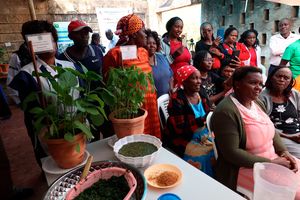
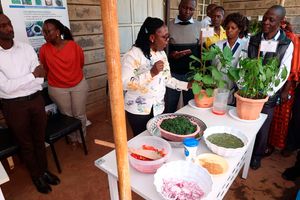
Nutritionists say that black nightshade is high in iron, calcium, and vitamins A and C, and supports digestion. It also provides traditional medicinal benefits and helps heal minor skin infections, among other benefits.
“We urge the agricultural extension officers in Molo to visit farmers more often at the grassroots level to understand the challenges they face, not only with maize and potato farming, but with all the crops they grow. Officers rarely visit us on the farm, either inadequately or not at all, especially in this area where small-scale farming is widely practised," added Mr Muchai.