Twelve-year-old Shelby Chebet can identify a rabbit by the colour of its fur, the markings on its body and even the shape of its ears. At St Jude Catholic School in Doonholm, Nairobi, the Grade Six pupil has learnt to distinguish the grey or silver-coated Chinchilla from the Checkered Giant, whose white body is marked with dark spots.
Chebet can also identify the Dutch rabbit by its distinctive white front and darker back. Her knowledge extends to the New Zealand White, a breed commonly kept for meat production, and the Californian White, recognisable by its dark ears, nose, feet and tail. She also knows rabbits with drooping ears, adding to the variety of animals kept at the school.
According to Shelby, these are not simply names learnt from a textbook. She has acquired the knowledge through handling, feeding and observing the animals, an experience that has nurtured her interest in agriculture and taught her the responsibilities that come with livestock keeping. “We feed our rabbits with manufactured pellets, hay and suitable leafy vegetables. We give them clean drinking water and ensure their hutches are clean. We also record their ages, feeding, breeding and health so that we can monitor their progress,” she opens up while identifying the different rabbit breeds and describing their behaviour, displaying an impressive understanding of the animals.
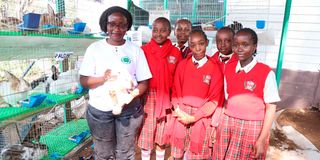
St Jude Catholic School, Doonholm, learners take turns attending to the rabbits during break and lunch times, cleaning their hutches, replenishing feed and water, observing their behaviour and checking for signs of illness. They also learn how to handle the animals gently and provide suitable housing to keep them comfortable.
Shelby says the lessons go beyond feeding and cleaning. The students are taught about breeding, including the importance of avoiding mating closely related rabbits to reduce the risk of inbreeding. They learn that a female rabbit’s gestation period is 28 to 33 days, with an average length of 31 days, and that appropriate care is necessary before and after birth.
When mating rabbits, Shelby tells Seeds of Gold that the female is taken to the male’s enclosure because the male is more likely to mate successfully in familiar surroundings. The learners are also taught to separate the animals after mating and provide appropriate care for the mother and her young ones.
“I enjoy feeding the rabbits and interacting with them, especially the young ones. My favourite breed is the Chinchilla because it is calm and does not make much noise. You have to handle rabbits gently because they can react when they feel uncomfortable,” she shares.
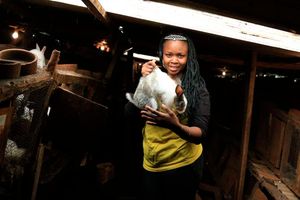
St Jude School, Donholm, pupil Shelby Chebet holds a rabbit at Jamhuri Park Showground in Nairobi on October 1, 2026, during the Nairobi International Trade Fair.
Photo credit: Sila Kiplagat | Nation Media Group
Her practical experience has also taught her that mistakes can affect animal health. On one occasion, she recalls she fed the rabbits a mixture of foods without understanding the risks associated with sudden dietary changes. The experience taught her the importance of adequate fibre and appropriate feeding.
“I would encourage other learners to take an interest in rabbit farming because it is enjoyable and educational. We learn to care for animals, breed them and keep records instead of being idle,” says Shelby, who hopes to become a lawyer or an agricultural farmer.
Her schoolmate Veronica Zawadi, 10, shares the enthusiasm. Having spent about one and a half years learning rabbit husbandry, she understands how rabbits reproduce and prepare for the arrival of their young ones. She has learnt that a female rabbit can give birth to between six and 10 kits in a litter and may pull out some of her fur to line the nest and keep the newborns warm. “When visitors come to our school and appreciate the rabbits, I feel encouraged to do even better. I love rabbits because they make me happy and give me something meaningful to do,” she tells Seeds of Gold.
Like Shelby, Veronica wants to become a lawyer, while 11-year-old Ivy Nyawira, a Grade Five pupil, hopes to establish her own rabbit farm in the future. Ivy can identify breeds such as the Chinchilla, New Zealand White, Californian White, Flemish Giant, Angora and Dutch. Her favourite is the Chinchilla because of its attractive coat. She has also learnt to observe changes in rabbits’ behaviour that may indicate illness and understands the importance of seeking veterinary assistance when an animal is unwell. “I would love to become a rabbit farmer and establish my own farm when I grow up. Rabbit keeping has taught me cleanliness, responsibility, breeding and how to care for animals,” she says.
The three learners are among 60 pupils introduced to rabbit keeping through the school’s agricultural activities under the guidance of Catherine Mboya, an Agriculture and Nutrition teacher, head of department and patron of the 4K Club. Catherine tells Seeds of Gold that the project began with six rabbits, comprising two rabbits from each of three breeds, to support breeding. “The number has since grown to about 157 rabbits, giving more pupils an opportunity to acquire practical skills in animal husbandry,” she reveals.
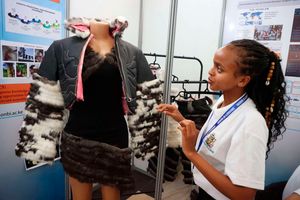
The school’s commitment to agricultural learning also took pupils beyond the classroom when they attended this year’s Nairobi International Trade Fair, organised by the Agricultural Society of Kenya (ASK) at Jamhuri Park Showground from September 28 to October 4, 2026. Held under the theme “Promoting Climate-Smart Agriculture and Trade Initiatives for Sustainable Economic Growth,” the fair offered learners an opportunity to encounter agricultural innovations, farming technologies and enterprises, broadening their understanding of the sector and its potential career opportunities. “I realised that some learners were interested in rabbits, so I brought together about 60 of them and started teaching them how to rear, feed and care for the animals. We begin by introducing them to different breeds, their colours, characteristics and behaviour before allowing them to interact with the rabbits,” Catherine said in an interview.
Although rabbit keeping is taught formally in Grade Six, learners in Grades Four and Five participate in the club’s activities. This, teacher Catherine says, allows them to gain practical experience before encountering related lessons in class. The pupils attend to the animals during their free time, learning how to clean the hutches (houses), refill drinkers, provide feed and monitor the rabbits’ health.
According to Catherine, these routine activities help nurture discipline and responsibility among children, including those who may not be accustomed to undertaking household chores. “The project also introduces the learners to agribusiness and income generation. During school holidays, some take at least two rabbits home to rear. After three or four months, they may return with rabbits to sell to fellow pupils,” she explains. Although the school has not recorded cases of learners using proceeds from rabbit sales to pay their school fees, teacher Catherine says the experience introduces them to the commercial value of livestock, customer identification and the basics of running an agricultural enterprise.
The initiative also encourages social responsibility. During Lent, for instance, St Jude Catholic School pupils are encouraged to support people in need, with some contributing money earned from rabbit sales while others donate food and clothing. Lent is a 40-day solemn Christian season of prayer, fasting, and almsgiving (charity) that prepares believers for the celebration of Jesus Christ’s resurrection at Easter.
Apart from livestock production, the school integrates rabbit keeping with crop farming through the use of animal waste. “Rabbit droppings are collected to make compost manure, which is applied to the soil to improve fertility. The school also grows vegetables, including sukuma wiki and spinach, helping pupils understand the relationship between animal husbandry, soil health and food production,” the teacher says.
Catherine says the activities introduce learners to resource recycling and the use of locally available materials in farming. Rabbit urine is also used in the school garden after dilution, with careful handling and appropriate application being important considerations. The school is considering expanding the initiative to include guinea fowls, which would expose learners to poultry keeping and broaden their understanding of livestock management.
The school’s programme aligns with the objectives of the 4K Club movement, which seeks to introduce schoolchildren to agriculture through practical activities and encourage them to appreciate farming as a productive and rewarding undertaking. The club’s name represents Kuungana, Kufanya, Kusaidia Kenya, meaning coming together, working together and helping Kenya. The movement was revived in 2019 under former President Uhuru Kenyatta as part of efforts to strengthen agricultural education and encourage young people to participate in food production.
At a time when climate change, rising production costs and other pressures are challenging farmers, exposing children to agriculture early can help build a generation that understands food systems and the importance of sustainable production.
School-based projects can nurture interest in farming while equipping learners with practical skills in animal care, crop production, record-keeping and enterprise management.