Young people in Nyandarua are on a mission to transform agriculture using a six-year-old innovation that is producing promising results.
This initiative is run by the Nyandarua Youth Agribusiness Forum, whose four-point approach has made farming an attractive prospect for young people.
The forum engages in conversations that address issues affecting young people in agribusiness, and aims to determine what works and connect young people with the realities of the agribusiness landscape.
This approach includes creating an enabling environment, accelerating or starting new agribusiness ventures, and providing funding, monitoring and evaluation.
Some members are still university or college students, yet they manage successful agribusiness ventures back home, earning well and creating job opportunities for other young people and local residents.
The success of these ventures is largely due to effective networking, which plays a crucial role in facilitating the sharing of information and skills, as well as fostering referrals and connections.
Interestingly, many of the young agripreneurs did not study agriculture at university or college, and the courses they have completed or are currently pursuing are not related to agriculture.
Mr Solomon Ngugi, a mechanical engineering graduate from Jomo Kenyatta University of Agriculture and Technology, is one of the success stories of the Youth in Agribusiness Forum (YAF) initiative.
He was one of the YAF founder members in 2019 and received agribusiness training organised by the youth group.“I attended a training course organised by Nyandarua Youth in Agribusiness in early 2020 in Ol Kalou.
The training covered various aspects of agripreneurship, including developing a business plan, digitalising a business, leadership, financial literacy and marketing,” Mr Ngugi explained.Following the training, he secured a Sh50,000 loan from Equity Bank later in the year, which partnered with YAF.
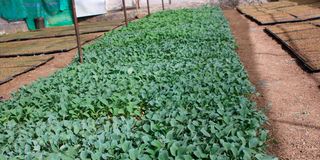
Mr Ngugi invested the money in producing vegetable seedlings and potato rooted apical cuttings. This venture succeeded thanks to the skills sharing offered by the forum.”I repaid the loan on time, qualifying for a larger loan of Sh400,000, which I invested in expanding my seed production business in 2023,” he explained.
Today, his agribusiness empire employs at least 20 young people every day.
When the Nation visited his farm, some employees were busy attending to customers, and the interview with farm supervisor Stephen Njihia was constantly interrupted by customers calling to book or enquire about collecting their seeds or seedlings.
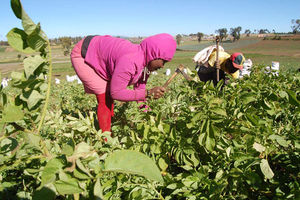
The farm is located in Karugutu village on the Gilgil–Ol Kalou border. It has a production capacity of 100,000 vegetable seedlings and 2,000 Irish potato rooted apical cuttings per month, as well as a 5–7 acre seed potato production farm per year.
The vegetable and potato-rooted apical cutting seedlings are produced in two greenhouses and some workers were clearing bushes to make way for a third greenhouse.
“My future plans are to increase the number of greenhouses from two to five to accommodate 200,000 vegetable seedlings and 5,000 potato-rooted apical cuttings per month. I also plan to increase the potato seed production farm from five to seven acres to ten to fifteen acres,” explained Mr Ngugi.
He manages the farm by implementing systems, such as hiring a manager and supervisors, who are paid slightly more than other employees.He also visits the farm every two weeks to check that activities are progressing as planned. Employees must send him photos and videos of the work in progress and the number of workers.
Mr Stephen Njihia, a farm supervisor at Mr Solomon Ngugi's potato seed production farm on January 31, 2026.
Taking the time to learn how the systems work at his farm and participating in peer learning under YAF increases the chances of not being misled by employees.According to the supervisor, the number of customers is increasing daily and the farm is currently unable to meet demand.
”We have customers from across the country and further afield, including Congo. Luckily, we do not rely on rain; we practise regenerative agriculture. The farm owner, Mr Ngugi, has invested in water harvesting systems which he is gradually expanding,” he explained.The farm sells a 50kg bag of potato seeds for Sh4,500, and an acre requires about 16 of these bags, meaning a farmer will need approximately Sh72,000 for an acre of land.
David Kuria, an agronomist and YAF patron, says the best option for farmers is to buy potato-rooted apical cutting seedlings and then multiply them at their own farms.
“The potato seedlings sell at Sh10 per stem; a quarter of an acre will take about 500 seedlings, meaning a farmer will need about Sh50,000. This quarter-acre plot will then produce seeds that can be planted in three to five acres.
The number of farmers planting certified seeds is increasing daily, but there is an acute shortage of farmers involved in seed production. These are the gaps that the young people involved in the YAF are filling,” he said.He says the forum was started by young people after a training course, and it is expanding to include young people from other counties.
“We all know that 64 per cent of unemployed people in Kenya are young. In Nyandarua County, 80 per cent of residents are farmers and the remaining 20 per cent are either employees or businesspeople who deal directly with farmers. That is why the young people came together to form a group through which they can gain meaningful employment or engage in economic activities. To succeed, we bring on board those who have already succeeded in agriculture to mentor the young people, and we partner with financial institutions such as Equity and Cooperative Banks to provide training and financing for entrepreneurs,&rdquo” said Mr Kuria.Ms Wambui Macharia, a regenerative agriculture practitioner, joined YAF in 2021 when she was just starting out in her career.
“At that point, I knew the only way I could make money was to work on a farm. But the moment I joined YAF, I had the opportunity to interact with other stakeholders in the agricultural supply chain and learnt that we could make money by venturing into different areas of the agricultural supply chain. That is when I identified a niche and started training farmers, particularly in regenerative agriculture. Most of my initial customers came through referrals from YAF members, and over time I have expanded my catchment area to cover parts of the country. YAF has played a crucial role in advancing my career and expanding my customer base,” said Ms Macharia.”
Mr Reuben Gitonga is the proprietor of Potato Republic, a company that primarily deals with agricultural mechanisation.”I joined YAF at its formation. We came together as young people to discuss how to shape the various value chains in which we operate. Although I never studied agriculture at university, after interacting with YAF and gaining exposure to their work, I ventured into climate-smart agriculture mechanisation services and climate-smart agriculture. I get a lot of customers from YAF,” said Mr Gitonga, a computer science graduate who does not regret switching to agribusiness.
He says that most of his customers are young people who are more open to change and technology than the older generation.”Most of the solutions are found within the forum since we come from different academic backgrounds,” said Mr Gitonga.
Moses Kamau, YAF Secretary General, says the forum was formed by young people who wanted knowledge, skills, connections and mentors.”We engage in conversations on issues revolving around youth in agribusiness. We explicitly try to figure out what works and link the youth to the reality of what is happening in the agribusiness landscape. We have trained more than 5,000 young people across the country and witnessed many success stories. We have recognised the need for young people to come together, share experiences and learn from each other,” explained the chairperson.