If you walk into any fresh produce market across the country, you are likely to see heaps of bruised or overripe fruit being thrown away.
Bananas, mangoes, avocados, oranges and watermelons, among other horticultural crops, make up a large proportion of this produce.
This calls for an urgent need to empower traders and farmers with better infrastructure for storage or processing to extend shelf life.
This familiar scene fuels Triza Mwaniki every morning as she unlocks the doors to Lynt’s Limited, a plantain processing company in Kahawa West, Nairobi.
“Food waste is a big issue in this country. Kenya loses between 20 and 30 per cent of its agricultural produce through post-harvest losses, transportation and marketing,' says Triza, the company's co-founder and managing director.
“What we are doing at Lynt’s Limited is helping to mitigate those losses, which eventually lead to food waste,” adds the agri-preneur.
The company is owned by two sisters: Triza and Lynn Mwaniki. Lynn, the CEO, focuses on strategy, financing and market analysis, while Triza oversees day-to-day operations.
The idea for Lynt’s Plantain Chips was conceived nearly a decade ago, far from Kahawa West.
In 2017, while studying in Uganda, Lynn observed the widespread consumption of plantains across the country.
They were fried, boiled and mashed, forming a staple in many households.
However, back home in Kenya, Lynn observed that plantains were largely overlooked, despite their natural sweetness and versatility.
“I realised we were missing out. Plantains are sweet, filling and nutritious, yet they were not common in Kenya. That's what inspired the idea of plantain chips,” she recalls.
The early days were marked by uncertainty and trial and error. When the sisters first embraced the idea, they had no recipes and no processing experience.
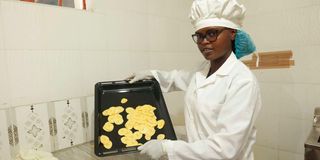
Co-founder and managing director of Lynt's Limited Triza Mwaniki during an interview at her business premises at Kahawa West in Kiambu County on February 2,2026.
Photo credit: Evans Habil | Nation Media Group
They travelled to Uganda in search of contract manufacturers, but the arrangements were unsuccessful. Their attempts to seek technical support from established processing institutions also bore no fruit.
Frustrated but determined, Triza retreated to her kitchen in 2021. Using borrowed utensils and small quantities of plantains, she experimented relentlessly until she finally produced crunchy, golden, flavourful crisps.
“That was our breakthrough moment,” she says. That same year, a small space on their parents’ property was converted into a processing unit. Certification followed in 2022, and in April 2023, the sisters officially entered the market. By then, the business had already survived the disruptions caused by the pandemic, which ironically helped to reshape their sourcing model.
Initially, Lynt's Limited sourced plantains from Uganda. During the pandemic, however, border issues forced the sisters to seek suppliers closer to home.
“We discovered that Kenyan farmers, particularly in the Mount Kenya region, were already growing plantains, but they lacked reliable markets,” says Lynn.
Since establishing operations in Kahawa West in 2023, Lynt's has relied entirely on locally sourced plantains, primarily from Kirinyaga County, with occasional supplies from Embu and Meru.
Capital was mobilised gradually. The sisters pooled their own savings, supplemented by small loans from their parents and chamas. They started with approximately Sh300,000 in seed capital.
“Over time, our parents contributed around Sh1.5 million and the chamas around Sh500,000. In total, the business has absorbed roughly Sh3 million in investment,” Triza reveals.
About 10 years later, the Kahawa West-based facility demonstrates how far they have come. The processing unit is simple yet organised, designed to meet food safety standards while maximising efficiency.
Plantain chips being prepared at Lynt's Limited in Kahawa West in Kiambu County on February 2,2026.
Photo credit: Evans Habil | Nation Media Group
At the heart of the factory lies the processing area, where freshly delivered plantains are washed, peeled and sliced into thin, even pieces.
Nearby are the frying section and the weighing and packaging area, where the crisps are measured, sealed in aluminium-lined packs and labelled.
A small office handles administrative tasks, record keeping and planning, while an adjacent store holds raw bananas awaiting processing.
The workflow is deliberate. Once plantains arrive, any that are not fully ripe are allowed to mature naturally until they reach the desired stage. They are then washed, peeled, sliced, fried, drained and packaged without any additives or preservatives.
“Our product is organic. We do not use any chemicals,” says Triza.