Mr Muraya Mburu stopped working as a casual labourer for the Nakuru Water and Sanitation Services Company (Nawasco) in 2012 and started farming at his Nyakiambi Farm in Elburgon, Nakuru County.
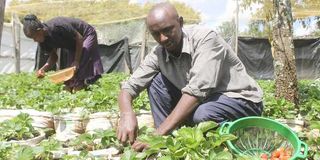
The farm is located about three kilometres from the Elburgon–Njoro road. On this day, we find the farmer harvesting and sorting his strawberries for sale.
“After growing maize for five years, I realised that my farming was not profitable, particularly when production was low and sales at the end of the season were not adding up. Using the money I made from selling bags of dry maize, I bought 12 rams, priced between 3,000 and 5,000 shillings depending on their size, and reared them for one year before selling them for Sh9,000 each,” said Mr Muraya.
David Muraya Mburu displays the suckers of his strawberries at Nyakiambi Farm in Elburgon, Nakuru County.
Photo credit: John Njoroge | Nation
He added that it had become difficult to keep his sheep any longer due to a lack of sufficient pasture. Generating money to sustain himself was also challenging.
Mr Muraya says he read an article in Seeds of Gold about how farmers had thrived by selling their produce online. After surfing the internet, he was inspired to start growing strawberries on his farm, having learned that it was easy to start, labour-intensive and generated income quickly. Unlike maize farming, which takes a year, strawberries only take a few months to mature, and sales were good even at the local market.
Mr Muraya began keeping tabs on farmers and visiting them, especially those who posted their agricultural produce online. From one of those farmers, he learnt about different varieties that suited certain areas.
“In 2019, I visited a farmer in Nyahururu in Laikipia County and bought 800 certified seedlings. I later added a second batch of 800 seedlings at Sh30 each from my capital of Sh120,000,” he said. He added that the type of strawberry seedlings he had bought from the farmer were ideal for the area and would do well.
David Muraya Mburu packs his strawberries in plastic containers at Nyakiambi Farm in Elburgon, Nakuru County.
Photo credit: John Njoroge | Nation
He used the rest of the money to buy water tanks, polythene bags for seedlings, piping, and fencing nets to keep birds away from the berries on the farm. After propagating the seedlings for a month, he transplanted them to his plot of land, which is one eighth of an acre in size.
“I put the top layer of soil in the polythene bags and planted the seedlings. As I didn't have any sheep manure to mix with the soil when planting, I added cow manure after three weeks," said Mr Muraya, adding that he continued to water his seedlings every morning and evening, especially when it didn't rain. After two months, however, he reduced this to twice a week.
To manage his farm, he weeded the strawberry plants after planting them, removed the suckers, and pruned them after two months to encourage them to produce more fruit. Mr Muraya says that strawberries do well during the dry season because they only need a little water and manure to survive, unlike when there is more rainfall, which affects the crop. If managed well, he says, one seedling or sucker can produce more than 20 strawberries.
After some time, he introduced punnet packaging and started selling his fruit to locals and in urban centres, later selling them at wholesale prices in supermarkets. However, he continued hawking his produce since some wholesale shops did not have refrigerators to preserve the strawberries.
David Muraya Mburu packs his strawberries in plastic containers at Nyakiambi Farm in Elburgon, Nakuru County.
Photo credit: John Njoroge | Nation
Mr Muraya says he has no regrets about starting his strawberry farm seven years ago as it has enabled him to pay his children's school fees and provide for their other basic needs. The farmer added that he harvests his fruit twice a week.
“During good seasons, I harvest between 40 and 60 punnets, selling each one for Sh150. At the moment, the market is not good because it depends on the country’s economy, which has not been good for the last four years,” he said, adding that inconsistent climate change has affected his farming, as well as that of other farmers growing various crops in the area.
He noted that crop rotation has become challenging for farmers, leading them to grow crops blindly without knowing what fertiliser to use or which crops to grow in which areas, as field officers rarely visit them on their farms.
According to Leonard Bor, the Nakuru County Executive Committee Member (CECM) for Agriculture, field officers are located throughout the county and at the grassroots level. He called on farmers to visit these officers and interact with them to learn more about various farming systems, pest and disease control, and other topics.
“We shall take more measures to raise awareness and reach out to farmers during field days, and we will visit them on their farms to help ensure the continued success of farming,” said Mr Bor, adding that farmers are also notified during Farmer's Day through the offices of chiefs and assistant chiefs in their respective areas.
His plan is to keep sheep, which will provide manure for use on the farm. Currently, he buys livestock manure from other farmers to maintain his strawberry farming, which is a big challenge for him.
Currently, a 60 kg bag of manure retails at Sh 300. He adds that strawberry pollen aborts when the plants are not given the right nutrients, so he boosts the crop by applying foliar fertiliser.
“I grow my fruit using organic manure and rarely use chemicals because the berries grow quickly and are harvested weekly. Using chemicals would have a negative effect on human health. I propagate my own seedlings and sell them to farmers for Sh50 each,” said Mr Muraya, adding that sourcing polythene bags for planting has been difficult since the government banned them a few years ago.
He hopes to extend his plot to five acres if the market continues to perform well. For about six years, he says, fruit has been grown and consumed in large quantities, as it helps to boost immunity and fight disease in humans. However, during the time of the Coronavirus pandemic, it was difficult to sell fruit from one place to another despite the high demand.