Emerging coffee zones are expected to increase coffee production in the country by around 100,000 metric tons over the next two years, with current production at half of the target output.
According to data from the Ministry of Agriculture, current production is between 40,000 and 50,000 metric tons per year.
In an exclusive interview with Seeds of Gold, Dr Zachary Kinyua, Director of the Coffee Research Institute (CRI) at the Kenya Agricultural and Livestock Research Organisation (KALRO), said that the country is relying on new coffee-growing areas to increase production and reach 150,000 MT by 2028.
He said that improved global prices have driven the revival of coffee production and renewed farmers’ interest in the crop beyond traditional coffee-growing counties.
“People are realising that there is a lot of money in the coffee sector, so many people are planting new coffee plantations,” said Dr Kinyua.
Traditionally, coffee production has been concentrated in the Mount Kenya region and parts of the former Eastern and Central provinces. However, the crop is spreading increasingly to the western side of the Rift Valley and other areas with potential for coffee production, including Baringo.
Non-traditional and arid-to-semi-arid regions are driving an expansion in Kenya’s coffee production, with farmers in these emerging zones shifting from traditional crops such as maize, sugarcane, and sisal to coffee. This shift is being supported by irrigation and new technologies.
Laikipia has recorded the highest national increase in new coffee acreage at over 32 per cent, followed by Taita Taveta with a 20 per cent increase in land under coffee cultivation.
According to Daniel Kiprotich Chemno, the Chair of the New Kenya Planters Co-operative Union (New KPCU), Nandi has emerged as a major coffee-growing county, ranking among the top three producers of clean coffee in the country.
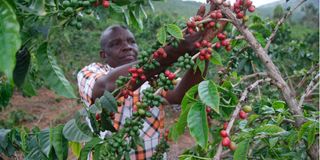
Ms Lucia Wanjiru harvesting coffee berries at a farm at Kabati in Murang'a County in 2015.
Photo credit: File | Nation Media Group
“Nandi County is one of the emerging coffee-producing regions, with farmers producing high-quality coffee that commands premium prices in the export market,” Mr Chemno told Seeds of Gold. While Nandi has traditionally been one of Kenya’s leading tea-producing counties, farmers are increasingly embracing coffee, popularly known as ‘black gold’, as they seek to diversify their income sources and benefit from improving coffee prices.
Elgeyo Marakwet has recorded a 17.2 per cent increase in new coffee-growing land as farmers diversify. In Siaya, coffee production is expanding through the Lake Basin Initiative, with a 16.2 per cent increase in land under cultivation.
Baringo is also embracing coffee production in its non-traditional semi-arid zones, while Kericho is rapidly expanding production through groups such as the New KPCU, as well as diversifying into new areas. Other emerging coffee frontiers include Narok, particularly along the Narok–Bomet border, Trans Mara, and parts of Kisii, West Pokot, and Mt Elgon.
Dr Kinyua, the CRI Director, said that farmers in these emerging zones are establishing new plantations, while those in traditional areas are reviving old farms that had been abandoned or uprooted when coffee prices were low, and the sector was facing management challenges.
“Some farmers are rejuvenating their old coffee trees, others are replanting where they had previously uprooted, and new areas are also coming on board,” he said. This expansion is expected to complement efforts to increase productivity on existing coffee farms. The government is considering both new acreage and higher yields as it works towards its 2028 target of producing 150,000 MT of coffee.
During the 2025–26 coffee season, the highest average cooperative payout was Sh157.15 per kilogram of coffee cherry, while the highest individual factory payout was Sh157.40 per kilogram.
Speaking on July 30 at the 2026 Food and Agriculture Organization (FAO) Hand-in-Hand (HIH) Local Private Sector Investment Forum in Nairobi, the Cooperatives and Micro, Small and Medium Enterprises (MSMEs) Development Cabinet Secretary, Wycliffe Oparanya, said that the government is encouraging farmers in areas outside the traditional coffee belt, particularly in western Kenya and the Rift Valley, to take up coffee production.
“We are encouraging more farmers in Nyanza, western Kenya, and the Rift Valley to start producing coffee, while farmers in traditional coffee-growing areas such as Mt Kenya must increase productivity,” said CS Oparanya.
He stated that to restore Kenya’s coffee production to more than 150,000 MT annually, the country would need to expand the area dedicated to coffee cultivation while improving productivity among existing coffee farmers.
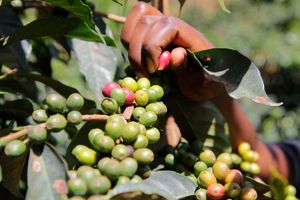
A farmer plucks ripe coffee berries from his farm. FILE PHOTO | NMG
This will take Kenya’s output back to the levels recorded in the 1980s when the country produced over 150,000 metric tonnes annually. Dr Kinyua said that production subsequently declined as farmers abandoned coffee farms, uprooting trees and bushes in the process, and shifted to other enterprises due to challenges in the management of the sector.
However, the current improvement in coffee prices has created renewed interest in the crop, with farmers returning to coffee and new growers entering the industry. Additionally, ongoing government reforms to the coffee sector are being credited with improved farmer payouts and increased production.
Dr Kinyua said that the KALRO Coffee Research Institute is preparing to support the expansion by ensuring that farmers in both traditional and emerging coffee zones have access to suitable planting materials and technologies.
The institute is increasing its production of high-quality coffee seeds and seedlings in response to rising demand from farmers establishing new plantations and those replanting old farms.
“Currently, our focus is on producing high-quality seeds and seedlings to ensure they are available to farmers replanting uprooted areas and those planting in new locations,” he said.
He added that research would also help farmers in emerging regions overcome production challenges that differ from those in traditional coffee-growing areas, particularly in the context of climate change.
The technologies being promoted include climate-resilient coffee varieties such as Ruiru 11 and Batian, which are resistant to major coffee diseases.
Dr Kinyua explained that changes in weather conditions have contributed to an increased incidence and severity of coffee berry disease and coffee leaf rust. This makes disease resistance increasingly important as production expands into new areas.
“The increase in the incidence and severity of these diseases has been triggered by environmental changes, including climate change, rising global temperatures and a lack of rainfall,” he said.
He encouraged farmers undertaking new planting to consider Ruiru 11 and Batian because of their resistance to major diseases. He added that traditional varieties remain productive, but require greater investment in pest and disease management.
The expansion into new coffee zones comes as Kenya seeks to regain its position as a leading producer in Africa. Despite its reputation for producing high-quality Arabica coffee, the country’s production has fallen sharply since the levels recorded four decades ago.
Dr Kinyua said that expanding into new areas, rehabilitating old plantations and increasing productivity offers an opportunity to close the 100,000 MT production gap.
He said that as coffee production expands beyond the traditional growing regions, CRI will continue to provide farmers with research, training, quality planting materials and technologies.