Hello

Your subscription is almost coming to an end. Don’t miss out on the great content on Nation.Africa

Ready to continue your informative journey with us?

Hello

Your premium access has ended, but the best of Nation.Africa is still within reach. Renew now to unlock exclusive stories and in-depth features.

Reclaim your full access. Click below to renew.

Josphat Kiarie
Caption for the landscape image:

From 3 sheep to 100: How Nakuru farmer built a thriving business

Scroll down to read the article

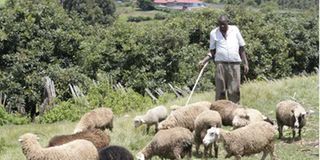
Josphat Kiarie with his sheep at his Turi Farm in Elburgon, Nakuru County on May 4, 2026.

Photo credit: John Njoroge | Nation Media Group

After a five-minute walk from the Elburgon-Njoro road, we arrive at the farm of Mr Josphat Kiarie, where we find him feeding his mixed breed sheep. Having started out as a butcher, Kiarie began keeping sheep in 2012. “I bought three medium-sized female Hampshire breeds from a farmer who reared them on a large scale in Narok County. I spent Sh15,000 of the Sh20,000 I had as my capital to purchase them, and used the balance to construct a simple, temporary structure,” said Mr Kiarie. He added that he had opted to keep sheep instead of cows since they were highly marketable and could be sold quickly to generate cash in an emergency, and it was easier to find customers for them than for cows.

As his land was big enough for grazing, the flock bred after five months, and by the end of the year, all three ewes had given birth. After five years of proper feeding and monitoring, Kiarie sold his flock when he realised that his breed only gave birth once a year, unlike others that gave birth twice a year. "I sold my entire flock and used the proceeds to buy another breed of five sheep, four females and one male, at a cost of Sh30,000. This breed was also good for meat and wool, just like my former breed. This breed was also able to give birth twice a year," said Mr Kiarie, adding that, every 18 months, he would sell some of his flock and replace them with new ones to keep his business moving.
Between 2012 and 2017, he sold large quantities of sheep's wool shaved from his animals to brokers at Sh10 per kilogramme. At that time, there was high demand for the wool sold to textile and knitting companies, most of which have since collapsed. Sheep farmers were unable to meet customer demand. In 2000, he experienced a significant increase in his flock, which increased his profits from wool and skins. A kilogramme of skin retailed at Sh50 before it was no longer needed. Currently, skins are disposed of due to a lack of customers, while the sheep are shorn for a fee of Sh20 and the wool is given to the shearers for free.

Josphat Kiarie

Josphat Kiarie with his sheep at his Turi Farm in Elburgon, Nakuru County on May 4, 2026.

Photo credit: John Njoroge | Nation Media Group

Mr Kiarie says he has no regrets about switching from cows to sheep because his farming business has flourished. “Demand for sheep is higher during peak seasons, especially between October and December, when prices increase and farmers fail to meet buyers' demand. Currently, a sheep weighing between 17kg and 36kg retails at between Sh15,000 and Sh36,000, depending on its size,” he said, adding that he sells his sheep at the local market through brokers. Currently, he has over 100 mixed breeds, having recently sold some to meet personal needs.

He plans to build a modern house and increase his flock to over 300, including Hampshire and Dorper breeds. To help other farmers who want to start this type of farming, he plans to buy quality feed and hay in large quantities, as some breeds consume dry matter, while others feed on grass and other pastures on the farm. However, he cites theft and insecurity as the main challenges facing livestock farmers in the area. The higher cost of feed, medicines, and other livestock supplies has recently become a burden, and he calls on the government to enable farmers to access these supplies at subsidised prices to help them increase their flocks.

Mr Kiarie said that due to the higher costs, he deworms his sheep every two months instead of monthly. His experience of keeping sheep enables him to determine how to feed them, administer growth-boosting medicinal injections and maintain their health. “There are only a few livestock extension officers in the sub-county, and they should visit sheep farmers more often and organise seminars to educate and inform them about management and disease control, as is the case in other areas of farming,” said Mr Kiarie.

Sheep farming has enabled Mr Kiarie to meet his domestic needs, pay his grandchildren's school fees, buy feed during the dry season, cover his medical expenses and purchase farm inputs during the planting season, among other things. He calls on other farmers to follow his example and embrace sheep farming on a large scale in order to access better markets and make their produce more affordable. When many farmers do this, he said, it becomes easier for companies to reach out to them and negotiate terms and conditions that would make their business successful.

When it is hot, the animals prefer to sleep in the shade, which helps to keep parasites and sheep lice at bay. These parasites primarily cause intense itching, leading to scratching.

Mr Kiarie encouraged those who would like to keep sheep for business to first ascertain the availability of feed, build a modern shelter to ensure the safety of their animals, and research which breeds are suited to a certain region, as their feeding requirements can differ considerably. He added that five sheep is a good number to start with, depending on cost and size.

He called on the government to revive the defunct wool and skin companies and enable farmers to sell their products at better prices. He also asked the county government to find better markets for small- and large-scale farmers, in order to prevent them from selling their animals to brokers, who dominate the business.

Major sheep-breeding areas include the Rift Valley, home to the Red Maasai breed, and Molo, well known for its Hampshire and Dorper breeds. Many of these breeds, such as the Red Maasai, are resilient to drought and poor nutrition, and can withstand local parasites.

Follow our WhatsApp channel for breaking news updates and more stories like this.