When you think of a typical Kenyan breakfast, you would probably think of bread, mandazi and chapati, which are usually served with hot tea or porridge.
This is what breakfast for low-income families mostly consists of. Upper-middle and high-income families also include other items in their breakfasts, such as boiled eggs, millet or sorghum porridge, githeri and fresh fruit.
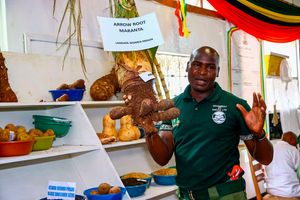
Where multiple food types are available, boiled roots such as sweet potatoes and arrowroots (nduma) are also part of the breakfast menu and are commonly found in hotel buffets.
Nduma is one of the most popular roots in such settings, and its consumption is becoming increasingly popular, particularly among hotel guests and families trying to prevent lifestyle diseases.
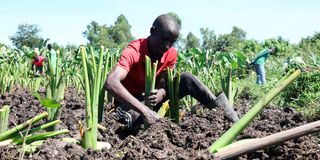
Brighton George Omondi plants arrowroots at his farm in North Kabuch Ward in Homa Bay County.
Photo credit: George Odiwuor| Nation Media Group
It is a nutritious, starchy root tuber that is popular across Kenya. It is usually boiled, roasted or fried, and enjoyed with tea or coffee in the morning. Arrowroot production is not as complex as that of other crops, yet only a few people grow it on their farms.
This is because it thrives in environments that are hostile to other crops. It grows in moist, fertile, well-drained loamy soils, mostly near river valleys, swamps or other water sources.
Most crops consumed at home cannot tolerate waterlogged or swampy areas as this causes root rot, stunted growth and death.
The nduma, on the other hand, requires consistent moisture, but the area should not be waterlogged A farmer in Kabuoch, Ndhiwa, Homa Bay County has leveraged this advantage to grow and supply arrowroot across the country.
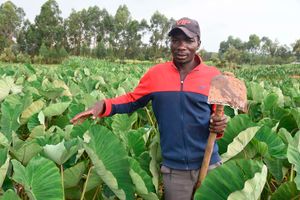
George Omondi supplies hundreds of kilograms of the tuber crop to different towns across Kenya every month from a farm located near a stream at Dani Stage along the Rongo–Homa Bay road.
Brighton George Omondi plants arrowroots at his farm in North Kabuch Ward in Homa Bay County.
Photo credit: George Odiwuor| Nation Media Group
His produce usually ends up on the plates of guests at high-end hotels, as some of his clients work in the hospitality industry. Families keen to avoid lifestyle diseases also rely on him as a key supplier for their breakfasts.
Omondi is passionate about environmental conservation and farming, and he pursues these interests simultaneously on a plot of land owned by his family.
He is the chairperson of a group called Jipange Echo Champions, which focuses on environmental restoration by creating household items as an alternative to plastic.
Members of the group also engage in various income-generating activities on a personal level. Omondi chose to produce arrowroots as an alternative source of income, and the business is thriving.
"I chose nduma because I saw its potential. My father cultivated the crop and earned money when people bought the tubers from his farm," he says.
After graduating from Pwani University in 2021, he took over the family business and continued producing arrowroots.
Brighton George Omondi plants arrowroots at his farm in North Kabuch Ward in Homa Bay County.
Photo credit: George Odiwuor| Nation Media Group
“I used to see people coming to our home to buy the crop. It provided my family with quick cash, so I developed an interest in growing it,” says the farmer. His two-and-a-half-acre plot contains more than 5,000 plants, which were planted at different intervals to ensure a continuous market supply.
“I got cuttings from a relative. I incorporated them with the ones my father used," says Omondi.
Nduma is planted by digging a large hole in which the suckers or rhizomes are placed. The soil should be deep, moist and well-drained. The farmer uses pits spaced 30–60 cm apart. Omondi says that he does not need to spend any money on buying seeds for production.
The cycle of propagating arrowroot starts with harvesting. The harvested crops are used to produce more tubers. During harvesting, he loosens the soil around the plant with a garden fork or shovel before digging up the tubers.
The plant is cut into three pieces: the tubers are separated from the stem and leaves. The stem is replanted and grows into a full plant. Omondi says that the planting hole should be large enough to allow the roots to grow and expand, as these are consumed as the main food source.
The leaves of the arrowroot plant can also be cooked and eaten as vegetables, but Omondi chooses to use them to make manure. At the farm, Omondi carries out regular weeding to remove competing plants.
Weeding is done whenever weeds are spotted, and it is the most difficult part of the production process besides protecting the crops from theft.
“Once you put the cuttings in the soil, no other practice is required apart from weeding. I don’t use fertiliser, which reduces production costs compared to other crops," says the farmer. Arrowroots typically take between five and ten months to mature and be ready for harvest.
Omondi says he harvests them after six to eight months. As he planted individual tuber crops at different times, he usually harvests part of the farm, as they mature at different intervals.
“If you plant the whole farm and harvest everything at once, it can affect market supply. The crop would flood the market, affecting prices. I ensure they are planted at different times so they can be harvested at least twice a month,” the farmer explains. He uses social media as his main marketing tool.