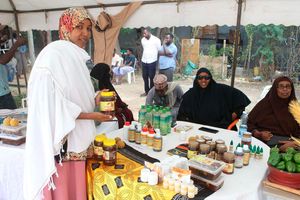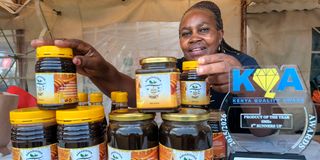
Diana Ngui, founder of Amaridina Enterprise, a beekeeper in Makueni County, during the 4th Kalro Open Week Exhibition at the Food Crops & Biotechnology Research Centre, Kabete, Kiambu, on February 27, 2026.

When Diana Ngui, a beekeeper in Makueni County, glances at the Kenya Bureau of Standards (Kebs) certificate and trophy she received last year, the recognition fuels her resolve to raise the bar even higher.
In October 2025, she was named the best honey producer nationally in terms of quality, an accolade that affirmed her approach to beekeeping and processing.
As the founder of Amaridina Honey, Diana had not only met national standards; she had surpassed them.
Her recognition comes at a time when cases of honey adulteration are on the rise across the country. Unscrupulous traders have increasingly been accused of diluting honey with sugar syrup, bananas, molasses and other additives that compromise the quality of the bee product.
“Certificate of appreciation proudly presented to Amaridina Enterprise for having participated in the Kenya Quality Award 2025 Edition,” reads part of the certificate issued to her on October 24, 2025, by the Kebs director.
According to Diana, the standards body conducted rigorous sampling of her honey collecting samples directly from the farm, at her processing unit and from retail shelves, before arriving at its verdict.
The results were identical: pure, unadulterated, and consistent. And for a sector infiltrated by cases of fake and diluted honey, that consistency set her apart.
The recognition, which runs for one year, placed the Makueni-based beekeeper at the peak of Kenya’s honey value chain. It was an affirmation of what she has always believed: that quality is the most powerful marketing tool.
“Bees produce the best honey. It is humans who adulterate it,” says the bee farmer.
Diana’s journey into apiculture did not begin with dozens of hives scattered across vast fields.
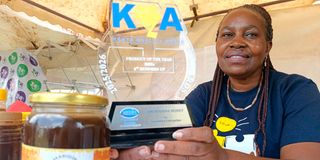
Diana Ngui, founder of Amaridina Enterprise, a beekeeper in Makueni County, during the 4th Kalro Open Week Exhibition at the Food Crops & Biotechnology Research Centre, Kabete, Kiambu, on February 27, 2026.
In 2023, she started with just five hives on her nine-acre farm in Makueni County, where she also grows cereals. At the time, she supplemented her supply by buying honey from neighbouring farmers.
She started small, and sometimes she could supply the market up to 20 kilogrammes a month. Over time, she narrates that her venture grew, and every three months, her own hives yielded about 50 kilos, with each hive producing between eight and 10 kilos per harvest.
Two years later, her apiary has grown to 20 hives. Today, she sells more than 100 kilos of honey per month, both raw and processed, to retailers in Nairobi and neighbouring counties.
However, even with contracted beekeepers supplying her, she admits that she struggles to meet demand for quality honey.
“Quality honey is key to maintaining the market clientele,” she tells Seeds of Gold.
Her recognition by KEBS, she says, was rooted in strict adherence to quality protocols. From harvesting to handling, transportation and processing, she ensures that the honey remains exactly as it was in the hive. She does not heat it excessively, dilute it, or add molasses, sugar syrup or bananas, substances some unscrupulous traders reportedly use to increase volume.
“I would rather sell nothing and have a client wait for pure honey than alter it and lose their trust,” she says.
To guarantee quality, Diana insists on supervising harvesting even for honey sourced from contracted farmers.
“I do not allow them to transport honey to their homes before delivery; therefore, I minimise contamination risks,” she reveals.
During harvesting, she wears full protective gear and follows hygienic procedures to prevent moisture contamination, which can affect fermentation and shelf life.
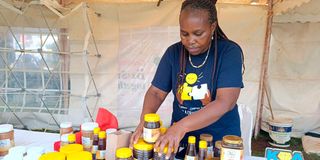
Diana Ngui, founder of Amaridina Enterprise, a beekeeper in Makueni County, during the 4th Kalro Open Week Exhibition at the Food Crops & Biotechnology Research Centre, Kabete, Kiambu, on February 27, 2026.
For Diana, understanding these standards has been very important for her. As a member of SOMO Africa and having trained at Kenya Industrial Research and Development Institute (KIRDI), she learned proper handling, processing, testing, packaging and labelling techniques that align with national requirements.
Her packaging choices also show her quality-conscious approach. She largely packages her honey in glass bottles, which she says reduces crystallisation of the bee product. However, she also does the plastic bottles.
“Honey stored in glass can last up to a year without crystallising, while that in plastic may crystallise after about two months,” notes the beekeeper.
“Though crystallisation is a natural process and not a sign of spoilage, customer perception matters.”
Her venture has had growth, she admits. From what began as a one-woman operation, Amaradina Honey now employs one permanent staff member and engages four casual workers.
Apart from honey production, Diana produces value-added byproducts including body cream, lip balm and propolis extracts, maximising returns from the hive.
Despite the successes and recognition she has earned, her journey has not been without challenges. With rampant cases of honey adulteration in the market, some consumers remain wary and winning their trust, she says, has been like climbing a muddy mountain in slippers.
Follow our WhatsApp channel for breaking news updates and more stories like this.