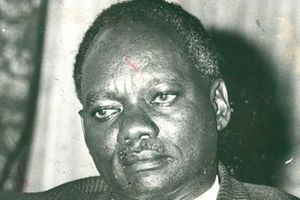
The most advanced communication technology in July 1926, when Manilal Ambalal (MA) Desai died, was the telegraph. Radio worked solely on the amplitude modulation technology and there was no television.
A hundred years later, technological advancement has brought Desai back to life, thanks to artificial intelligence (AI).
On Wednesday evening, during an event to mark a century since his demise, he starred in a film about his life and times that was beamed on a giant screen.
The packed Jalaram Auditorium in Nairobi’s Westlands was treated to an AI-made video that reconstructed what his journey was like from India to Kenya and what he went through while in the country.
Desai, an Indian-born journalist, activist and politician, became one of the leading voices against racial discrimination in colonial Kenya in the 1920s. Born in Gujarat in 1879, he arrived in Kenya in 1915 and took up the job of a clerk at a law firm run by Britons.
While historical records merely indicate that he resigned from the law firm after discrimination over smoking, the AI film added visual storytelling to the fact.
“His British boss caught him smoking at his desk. When reminded that others smoked in the office, the boss bluntly stated the truth: the rules for a European and a person of colour were simply not the same. Disillusioned by the profound injustice, the young clerk resigned on the spot, abandoning his fat salary without a second thought,” the film’s narrator says.
After leaving the law firm, he founded the East African Chronicle, formed an alliance with Africans’ defender Harry Thuku, led the East African Indian National Congress and was nominated to the Legislative Council. He was a member of the council until his death in Bukoba, Tanzania, due to heart complications.
From left: Archna Bulsara from the Desai Memorial Foundation, Secretary to the Cabinet Mercy Wanjau and Deputy High Commissioner of India to Kenya Sushil Prasad during the centenary commemoration of Manilal Ambalal Desai at Shree Jalaram Satsang Mandal in Westlands, Nairobi, on October 7, 2026.
Photo credit: Bonface Bogita | Nation Media Group
Ms Ananya Pal, the brains behind the video titled, A Hero Who Dared to Defy, said she blended “tech with my creativity”.
The big screen went blank on numerous occasions to pave the way for live performances that encompassed Indian and African dances. Some of the songs danced to were also composed by AI. That blend, Ms Pal said, was an effort “to spark the entertainment quotient even further”.
Thanks to the film, younger viewers will get to appreciate the rudimentary technology that existed during MA Desai’s time and the brutality of the colonial regime.
The film also dramatises the massacre of Africans who demanded for Harry Thuku’s release. Further, it visualises the realities of World War I fighting in Kenya, especially on the Mombasa-Nairobi railway.
The Wednesday evening centenary commemoration brought together various stakeholders, among them the partners of the Desai Memorial Foundation, which has been giving scholarships to needy students across the country.
President William Ruto, in a speech read on his behalf by one of the organisers, hailed Desai as “one of the early champions of equality and justice”.
“We are proud to count him as one of our own. One hundred years on, what he started is still growing. Some people plant a seed and it blooms for a season. Others plant a tree that gives shade for generations,” said President Ruto.
“Deserving students from low-income families are learning and rising through scholarships that you give. So are orphaned children and young people from single-parent households,” he said. “Schools, libraries, community centres are better equipped, thanks to the learning materials and equipment that you provide.”