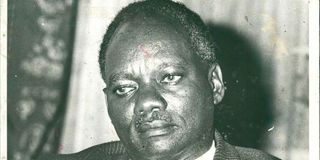
Burudi Nabwera, who passed on Friday at 99, was among independent Kenya’s first crop of diplomats, which included Adala Otuko (Soviet Union) T.A Koskei (China) Dr JN Karanja (UK) J. Shako (France and West Germany) and Henry Muli (Egypt).
As a diplomat to the important diplomatic station of Washington and as a Permanent Representative to the United Nations during the wave of decolonization across Africa and Cold War, Nabwera projected Kenya’s nationalist image at the UN while also fostering early trade, and economic ties and security cooperation between the US and Kenya.
The assignment required striking a delicate balance in order to navigate the intrigues of bilateral and multilateral diplomacy. But Nabwera already had political skills that were key in understanding and handling Cold War power plays and competing interests, while also building trust with the US. He had served as an active member of the nationalist party KANU and played a very important role in its organisation right from its formation.
In fact, according to declassified reports written by the Directorate of Intelligence and Security Kenya Colony in 1960, he played an important role in introducing Mwai Kibaki who was then teaching at Makerere to Jaramogi Oginga Odinga the then KANU deputy president.
It was in 1960, just after the First Lancaster Conference that set the ball rolling for self-rule triggering deep factionalism in the nationalists’ movement. In KANU there was the Mboya/Gichuru wing and the Odinga wing. While the Mboya/Gichuru faction manoeuvred with tact, those in the Odinga camp felt that Odinga was prone to making blunders, which made it difficult to clip the wings of the former faction.
Among those who felt this way was Burudi Nabwera, who was aligned to the Odinga faction.He was among the many young Western educated elites who were deeply immersed in the KANU nationalist movement, offering advice where necessary in attempts to chat the party’s ideological direction. However, he felt that Odinga was not tactical in handling the Mboya/Gichuru faction within KANU.
For this reasons, according to a report by the Directorate of Intelligence and Secretary Kenya Colony written in 1960 at 9.53 am and marked secret, Nabwera approached Jaramogi Oginga Odinga and informed him about his friend called Mwai Kibaki who was then working as a lecturer at Makerere. According to the report which was based on recorded information from one of the spies who were tasked with monitoring KANU leaders, Nabwera told Odinga that Kibaki could be a big asset in their camp.
Nabwera was well aware of Kibaki’s outstanding capabilities right from their days at Makerere. Furthermore, he felt that Kibaki could easily align with the Odinga faction because he was opposed to Mboya and Gichuru, who were seen as too moderate and pro-West. He subsequently approached his friend Mwai Kibaki at Makerere and convinced him to resign as a lecturer and take up full-time employment as a paid official of KANU.
The report marked secret compiled by the Kenya colony spy agency read in part: "NABWERA, who supports ODINGA, claims to have won over a powerful new ally to ODINGA's side in the person of Mwai KIBAKI, whom he has persuaded to resign his lecturership at Makerere College to take on full time employment as a paid official of KANU. NABWERA regards KIBAKI as having outstanding capabilities, and as the latter is strongly opposed to Tom MBOYA, he feels that he will support ODINGA."
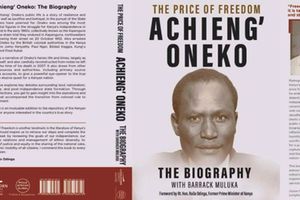
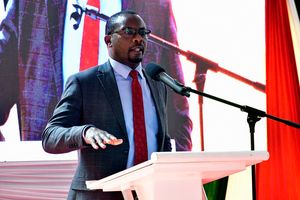
Burudi Nabwera's biography written by Masinde Kusimba.
Photo credit: Pool
In 1961 while Gichuru (KANU interim President) and Mboya KANU (Secretary General) were away in Europe, Odinga the KANU Deputy President appointed Kibaki the National Executive Officer of KANU, thus adding a strategist and an asset to his faction. Mboya and Gichuru were not happy with Odinga when they returned from Europe.
The intelligence report further read: "NABWERA intends to advise ODINGA to use KIBAKI as his closest adviser and to take him with him wherever he goes as a safeguard against making an occasional blunder which even ODINGA's closest admirers admit he makes from time to time."
Born in 1927, Nabwera was educated at Maseno School, Makerere University, where he was a year ahead of Kibaki. He taught then at Maseno and African Girls High School Kikuyu 1954-1956, before working as a civil servant between 1957-1958. He would later leave for London to study at the London School of Economics. London at that time served as an inadvertent intellectual incubator for anti-colonial thought, Pan-Africanism, and civil rights mobilization among young Africans such as Nabwera, Kihara Mtu, Waiyaki, Ngumbu Njururi, Othigo Otieno, Karuga Koinange and many others who were in exile or pursuing education there.
Many of them such as Nabwera carried their political agitation back home at the end of their sojourn in London. From 1962, he served as KANU Kakamega Branch Executive Officer until 1963 when he became Assistant Secretary General. He briefly served as a member of the Central Legislative Assembly before heading to Washington as Kenya's first Ambassador to the US immediately after independence.
He arrived in Washington at a time when race relations in the United States were at a critical turning point marked by intense state enforced segregation and violent pushback against civil rights activists.
This became his first biggest challenge considering that there was already a large number of Kenyan students in the US, who at times fell victim to these draconian government actions, and as Kenya’s ambassador it was his responsibility to intervene as required by the 1963 Vienna Convention on Consular Relations.
For instance, In July 1964 he protested to the US government after three Kenyan students were jostled by the police in New York on June 28, 1964. The US Undersecretary of State Averell Harriman later apologised over the incident.
On November 10, 1965, he made another formal protest to the US State Department after a Kenyan student Ralph Oduor was assaulted by the police in Nashville Tennessee. He personally visited C. Mennen Williams, the assistant secretary of state for African Affairs, and expressed Kenya’s government's concerns.
“It is because of the seriousness of the case in Nashville that my government asked me to come and discuss the matter formally with the State Department,” he told reporters after a one-hour meeting with Williams.
“Ralph Oduor was beaten up by the police and he suffered many injuries as the doctor’s report shows.”
He further revealed that it was the second case that year after another student David Nzomo was arrested and beaten by the police.
At the United Nations where he was also accredited as Kenya’s Permanent Representative, he did not only act as the official voice of Kenya, but also highlighted matters affecting Africa and the complicity of foreign powers in them.
On December 12, 1968, in an address to the US he said that South Africa would never stop its racial policies as long as it enjoyed a flourishing trade with the western powers.
“The real key to apartheid and the way to destroy it lies with the United States and Britain,” he declared. “As long as they continue to trade with South Africa that government will continue its policies, because it realises that sanctions will mean nothing.”
At the end of his diplomatic tour of duty, he ventured into elective politics, serving as KANU National Secretary General, member of parliament for Lugari and cabinet minister from 1988 to 1992, when he lost to Apili Wawire and retired from politics.