The field development plan (FDP) submitted by Gulf Energy for the Turkana oil is set for deeper scrutiny as the Energy and Petroleum Regulatory Authority (Epra) moved to lock in commercial gains from the long-delayed project.
Kenya, through Gulf Energy, expects to start commercial production on Block T6 and Block T7 by December 2026. An estimated 20,000 barrels per day (bpd) of crude oil will be produced in the first phase (2026-2032) before it is scaled up to 50,000 bpd.
Epra said the approved plan by Gulf Energy would be reviewed continuously to ensure compliance with committed parameters, regulatory milestones, and technical-commercial obligations.
“To this end, Epra has resolved to procure the services of a qualified consulting firm to provide commercial advisory services during the implementation of the South-Lokichar basin oil project for 24 months. The firm will also be expected to build internal capacity at Epra for handling similar future assignments,” the regulator said.
Epra said a consultancy will provide an independent analysis of the contractor’s submissions on development work programmes and budgets against approved FDP commitments.
The regulator said the same will also verify the contractor’s actual expenses by comparing proposed major expenditures against global and regional market rates to ensure cost fairness.
“Identifying potential overcharges or unnecessary costs before they are fully incurred and advising Epra on the justification required to formally disallow or reduce the claimed amount during the cost recovery process,” Epra said in a brief on the consultancy.
The Ministry of Energy and the Cabinet recently approved Gulf’s FDP for the Turkana oilfields. The plan is now awaiting a decision from Parliament before the end of next month.
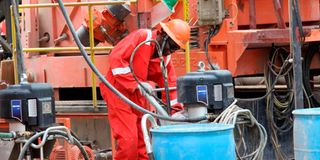
Tullow Oil facility at Ngamia 8 in Lokichar, Turkana County, on February 18, 2020.
Photo credit: File | Nation Media Group
Kenya plans to start commercial production of the crude oil in December this year and end a wait of over 13 years since the discovery of the resource in the South Lokichar basin. The FDP shows that 600,000 bpd of crude oil will be exported every month in phase one. This will jump to 1.5 million bpd in phase two.
Tullow Kenya BV— the local subsidiary of British oil exploration firm Tullow, discovered commercially viable oil in 2012 but was unable to start commercial production due to lack of a strategic investor and rejection of its FDP.
Appearing at a joint parliamentary Committee of Energy meeting last week, Gulf Energy E&P BV chairman, Mr Francis Njogu, said the firm will maintain world-class standards with a target to produce crude oil by 1st December this year.
Glencore Singapore Pte Limited and ChemChina UK Limited bought the Turkana oil for $28.34 million (Sh3.65 billion at prevailing rates) under a scheme that was meant to test the appeal of the oil in the global markets.
Disclosures from the Ministry of Energy and Petroleum show that ChemChina bought 240,150 barrels while Glencore purchased the remaining 174,627 barrels. Both deals were closed between 2019 and 2022.
Glencore Singapore Pte. Ltd. is a Singapore-incorporated entity within Glencore plc, a global diversified natural resources company engaged in the production, processing, and marketing of commodities.
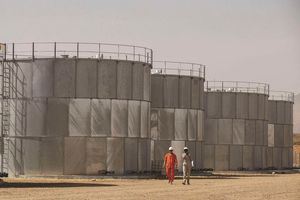
An oil rig at Ngamia 1 where Tullow Oil Company is exploring oil, 25km from Lokichar in Turkana County.
Tullow Oil exported the oil under the plan dubbed the Early Oil Pilot Scheme (EOPS) from June 2018 to 2020. EOPS was meant to test the competitiveness of Kenyan crude oil in the global markets, ahead of the start of commercial production.
EOPS laid the ground for Kenya to start commercial production of the oil wells, but funding hitches and delays in approving the commercialisation plan for the oil derailed the quest.
But $62.73 million (Sh8.08 billion) was spent on drilling, storing, and transporting the crude oil, leaving Tullow and the government of Kenya in a net loss position.
“The revenue realised from the sale of crude oil was $28,340,340.45 against an expenditure of $62,726,205.36,” Opiyo Wandayi, the Cabinet Secretary for the Ministry of Energy and Petroleum, says in the disclosures.
The government earned $1.915 million (Sh246.8 million) in royalties for the crude oil exports. Royalties are cash payments that oil exploration firms pay governments for the extraction of oil or gas.
Besides testing the global appeal of the Turkana oil, EOPS also provided critical data on the reservoirs and production models.
Commercial production of the Turkana oil was expected to start in 2020, but this was pushed forward as Tullow struggled to get financiers to de-risk the project.