A proposed 85 per cent cost recovery cap for Turkana’s oil blocks in the South Lokichar Basin has drawn sharp criticism from MPs and local elders, who warn that nearly all early oil revenue could flow to investors, leaving Kenyans with little benefit.
The dispute centres on Blocks T6 and T7, where Gulf Energy is now allowed to recover almost all of its investment costs before any profits are shared with the government or local communities.
Residents and local leaders have warned that the deal between the Government of Kenya and Gulf Energy E&P B.V could deprive Kenyans of meaningful oil profits.
The bold proposal, contained in the newly approved Field Development Plan, marks a significant shift from the previous administration’s hardline stance.
The proposed cost recovery cap allows the oil investors to recover their expenses before sharing profits, and the increase from 55 per cent for Block T6 and 65 per cent for Block T7 to 85 per cent has been met with outrage.
Critics say the high cap risks turning Kenya’s oil wealth into a resource curse, arguing that the high cap exposes the country to environmental and economic risks while offering little immediate reward, while supporters argue it is necessary to attract financing for the $6.1 billion South Lokichar project.
Turkana elders, through their Esanyanait Assembly and representatives at public participation forums have demanded independent audits of project costs and called for stricter scrutiny of the Field Development Plan before ratification.
The controversial clause on Kenya’s oil production sharing contracts is under consideration before Parliament, which is reviewing oil development plans for blocks T6 and T7. The plans were tabled in Parliament last year and must be approved before oil production can proceed.
The debate also touches on wider fiscal policy, with supporters of the higher cap arguing that it is necessary to attract financing for the $6.1 billion South Lokichar oil project, which has struggled to secure strategic partners.
Opponents, however, question why onshore oil in Kenya is being offered fiscal terms comparable to deep-water projects abroad, warning that unchecked recovery could swallow local profits for years.
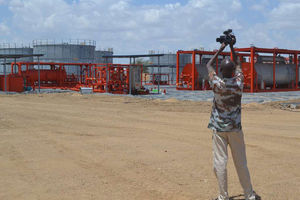
A journalist takes a clip of oil storage tanks at Ngamia II oil fields in Lokichar, Turkana County, May 25, 2018.
Photo credit: File | Nation Media Group
During public participation forums on the South Lokichar Field Development Plan and the Production Sharing Contracts (PSCs) for Blocks T6 and T7, the Esanyanait Assembly, which represents elders in the South Lokichar Basin, warned that Turkana oil development should not become a death sentence for the environment and the community’s economic future.
Mr Julius Loyolo, Secretary of the Esanyanait Assembly, said the PSC in its current form is a blueprint for a resource curse if the increased cost recovery cap is not amended.
“The law states that the community is entitled to five per cent of the Government’s Profit Oil. By raising the cost recovery cap to 85 per cent, Gulf Energy ensures there is no profit left to share. Why is an onshore oil basin being given the same fiscal terms as a deep-water oil project?” he said.
“We demand a return to the global industry standard of a 60 per cent cost recovery cap. Using 85 per cent authorises a deal where Kenya bears all economic and environmental risks, while the contractor takes nearly all initial revenue,” he said.
Mr Loyolo told the joint parliamentary committee, comprising the National Assembly Departmental Committee on Energy and the Senate Standing Committee on Energy, that a full, independent audit of costs already incurred by project proponents should be conducted before ratification.
“We will not allow unverified costs to become bottomless pits that swallow our community’s future revenue. Do not let the fear of delayed investment force you into a bad deal. If the oil is as high quality as claimed, the contractors will stay at the table,” he stated.
Dr Malcolm Lochodo, an opinion leader from Turkana South Sub-County, noted that as of December 2025, the Kenyan government had granted Gulf Energy and its subcontractors extensive tax exemptions for the $6.1 billion South Lokichar oil project, including VAT, Railway Development Levy, import declaration fees, and withholding taxes, to expedite development in Blocks T6 and T7.
“Exemption from VAT is criminal. We are likely to witness one of the greatest scandals of our time. How can a multinational company be exempted from tax? We want the Senate to ensure our rights are protected. We will always protest if our rights are infringed,” Dr Lochodo said.
Nairobi Senator Edwin Sifuna, who did not accompany his colleagues to the joint committee sessions officially launched by Siaya Senator Dr Oburu Odinga and Nakuru Town East MP David Gikaria at the Turkana County Assembly, said Kenyans should brace for the world’s biggest scandal. He argued that with an 85 per cent cost recovery cap, the country might not see a single shilling of revenue.
Mr Sifuna said he had planned to join the committee in Turkana, but noted that raising the cost recovery rate from 55 per cent to 85 per cent shortly before approval of the Field Development Plan points to obvious corruption if not addressed early.’
At Lopii village in Turkana East Sub-County, Mr Gikaria had questioned why Senator Sifuna had not attended the Turkana sessions. He emphasised that the present residents are privy to discussions around the cost recovery cap and have pertinent questions.
He assured, however, that the joint parliamentary committee will later engage the National Treasury, Kenya Revenue Authority (KRA), and other energy stakeholders to scrutinise the proposals.
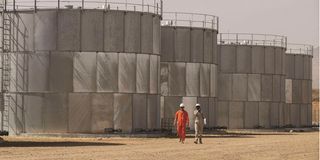
Workers walk past storage tanks at Tullow Oil's Ngamia 8 drilling site in Lokichar, Turkana County on February 8, 2018.
Photo credit: Reuters
“I heard Senator Sifuna, a respected lawyer, calling it the biggest scandal due to corruption. He knows the provisions of the Standing Order. As a select committee member, it is not right to discuss these issues publicly before the report is finalised,” Mr Gikaria said.
Mr Gikaria explained that the addendum has been reviewed by the Attorney General and will also be scrutinised by the Auditor General after consultations with stakeholders.
“We hope for a thorough report. In Nigeria, cost recovery is 75 per cent; in Cameroon, it is 85 per cent; and in Ghana, it is 100 per cent. Kenyan investors will be in business for 25 years. An 85 per cent cost recovery cap allows the contractor to recover investment quickly, after which profits can be shared with the government and community,” he said.
“If you are given money by a bank and told to repay in four years, the interest will be high. If you recover in one year, the higher cap is a proper incentive,” he said.
The committee co-chair also noted that joining the league of global oil producers is expected to strengthen Kenya’s foreign exchange reserves.
The county government, through legal representative Ekai Nabenyo, expressed concerns over the current legal framework governing oil in Kenya.
“The county government did not exist when the original PSC was signed with Tullow Oil in September 2008. We recommend a new PSC. Why is Gulf Energy signing an addendum with a contract they were not party to in 2008?” he said.
He added that the county government has not been mentioned in the Field Development Plan, meaning oil could be extracted in areas without local representation, with land held in trust for the people.
When the committee met, Energy Cabinet Secretary Opiyo Wandayi, concerns over the cost recovery cap were raised, with members questioning why Gulf Energy is allowed to use up to 85 per cent of revenue to repay initial investment before any profits are shared.
The ministry cited the competitiveness of the project, noting that previous Tullow Oil terms of 55 per cent and 65 per cent failed to attract funding. Debt financing was also highlighted as a key factor.
Mr Wandayi told the joint committee that the adjustment was necessary to attract financing for the capital-intensive project, which has struggled to secure strategic partners due to its marginal nature and shifting global investment away from hydrocarbons.
He said Gulf Energy is permitted to use up to 85 per cent of all revenue generated (known as cost oil) to repay initial investment and operational expenses before profit sharing, an increase from the previous 65 per cent under the Tullow Oil contract.