The thing about Mathare, one of Kenya's informal settlements and a reflection of many low-income communities across the country, is that it holds many realities. Some are good.
Some are difficult. Others are the kind that can feel like scenes from a horror movie. Life here can shift quickly, what looks ordinary in one moment can become a struggle for survival the next.
El Niño is a climate phenomenon caused by unusually warm waters in the central and eastern tropical Pacific Ocean, which can disrupt weather patterns across the world. In East Africa, it is associated with periods of heavier-than-normal rainfall.
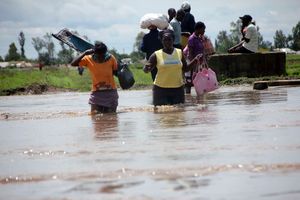
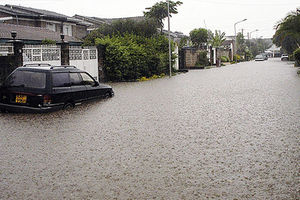
In Mathare, the rains turned deadly. In late April, the Nairobi and Mathare rivers burst their banks, sending water gushing through the area. At least 15 people died in the settlements, with the Ng'ondo area in Kiamaiko among the hardest hit.
For some women, the floods came at an especially vulnerable time. They were pregnant and expecting their little ones around that period. How bad could it get?
Two years later, Climate Action returns to Ng'ondo. It is a Thursday morning. We spot a tractor levelling the ground just a few metres from the main road.
A clean-water tank ferries water from a filling point. A salon operates in the open. Young men sit around, talking and watching the morning pass. Children are being children; crying, playing and running between the houses.
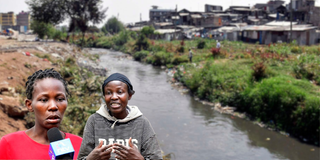
The Mathare River, a stone's throw from many of the houses, flows quietly. The water has long since receded. To an outsider, it looks like a typical morning, nothing unusual about the scenes.
A section of the Mathare River as it flows between Mathare and Ruaraka Constituencies, acting as a border between Kiamaiko ward and Ruaraka, pictured on August 20, 2026.
Photo credit: Francis Nderitu | Nation Media Group
"You see that tractor? Some houses are being brought down," shares Demtila Wairimu, a community organiser and human rights defender. "Residents living in the plots have been ordered to vacate to safer places. No help has been given to them, though."
Nairobi County says it has identified 227 flood-prone hotspots across 17 sub-counties. Sixteen of the 227 hotspots have been classified as very high priority, 189 as high priority, and 22 as medium priority.
The week of the floods, as Wairimu recalls it, was one of her worst as a community mobiliser. "I was born here, so I know the ins and outs of this place.
The water was too much. Think of a storey building, the water was up to the first floor. It tore down a wall of a school around here. Many people here live hand to mouth, and when they get unwell, they run to the clinics around here.
Those too were brought down by the rains. I saw death, destruction of property, and people being carried away by the water," she says.
In June that year, the World Weather Attribution (WWA) released a report stating that human-induced climate change had worsened the torrential rainfall across East Africa during that period.
Scientists who authored the report found that climate change had made the disastrous rains five per cent more intense and twice as likely. With further warming in the future, heavy rains will continue, the study predicted.
Data released this week by the Copernicus Climate Change Service suggests that oceans have hit the highest temperatures on record, the first time in millennia.
Back in Ng'ondo, every resident holds memories of what happened during the last week of April that year. Some speak of a particular date, hour, and even minutes when the deluge happened. But Wairimu's memory of those floods leads us to women who were carrying babies when the waters rose and tore homes apart.
A baby born in the house, then the floods – Shantell Akinyi
"I used to live around this area, but I have since shifted to another place which I hope will be better. I know, though, that I am not very safe because it is not far from here. I am a mother of four, and my last born came on the same day as the floods. I gave birth that morning, alone in the house, unaware of what was happening outside. I didn't know how to go about it; I was guessing my way through everything. I hadn't even recovered when suddenly the water tore down our door. I didn't have a phone to call anyone for help.
Shantell Akinyi Okumu gestures during the interview at her home in Mathare on August 20, 2026, when she spoke about her experience while raising a newborn during the 2024 floods.
Photo credit: Francis Nderitu | Nation Media Group
"There I was, with a newborn and three other children. I wondered what to do. I was alone. My husband had abandoned me that very night of the floods. I still remember the cries of my children that early morning: 'Mama, maji inatupeleka' (Mum, the water is overpowering us). All of them are below 10 years old. I told them instinctively to hold tightly onto me because if they didn't, they would drown.
"There was no time to pack clothes or collect anything. We managed to get out and reach a makeshift tent. Thankfully, well-wishers supported me with clothes and found us a place to stay. However, after a few months, I had to move out because I couldn't afford the rent. What happened in April 2024 has impacted me daily. I am not okay. I get throbbing headaches every day because I lost everything that night.
"I have relocated to a small kibanda just to shield my family. My daily work involves cleaning bottles at one shilling per bottle. How many bottles I manage to clean in a day determines how much I earn. The most I earn in a day is Sh350. Given that I am raising them single-handedly, I cannot afford to move to a better place, at least not without external support."
A baby born by the road – Monica Magudi
"I have four children. Before the heavy rainfall that took away my home, my journey was not an easy one, but the floods left me with nothing to fall back on. I used to attend my antenatal clinics as expected. I had a smooth pregnancy.
"Before that fateful night, floodwater had already entered our house, submerging household belongings, including the clinic book. It wasn't a big deal because I went back to the hospital and was handed another booklet.
"On that April night, the water began seeping into the house slowly. Living here, we were accustomed to this—when the water came, you did what you could, scooping it up and pouring it outside. It was around 10 pm, and I was making supper when I realised the water was rising. Outside, people were shouting. I left with my three children, and a friend took us in until she could no longer accommodate us.
Monica Dreda Magudi gestures during the interview at her home in Mathare on August 20, 2026, when she spoke on her experience while raising her newborn during the 2024 floods.
Photo credit: Francis Nderitu | Nation Media Group
"I found myself out on the street with my children. I was about seven months pregnant at the time. Then I heard that people had moved to a makeshift tent, and that is when I decided to go back.
"I was very stressed. I wondered where we would live, what to eat, or even how to clothe my baby. One day, I started feeling contractions as I was walking around the neighbourhood. I gave birth by the road. I was taken to a nearby health facility where I was monitored for two days.
"Afterwards, I was among those selected to receive Sh10,000 from the government, an amount meant to help us start life afresh. But I couldn't continue living in the house that was rented for me because it was beyond my budget. I came back to this place because this is where I can afford to live as I do menial jobs. My landlord is also understanding; he lets me pay my rent sometimes even in instalments.
"I have heard that we are expecting heavy rainfall again later this year, but what option do I have? I have nowhere else to go."
Monica Dreda Magudi sorts through her personal belongings at her home in Mathare on August 20, 2026, when she spoke about her experience while raising her newborn during the 2024 floods.
Photo credit: Francis Nderitu | Nation Media Group
The children born around that time are no longer newborns. They are toddlers now. They run through the neighbourhood, tug at their mothers' clothes, and cry when they are hungry. Thankfully, the two mothers say the children are healthy despite the tumultuous beginning of their lives.
On this Thursday morning, the river gives no indication of what it once did. Children play near it. Salons are open. The water tanker comes and goes. Life in Mathare continues.
Weather forecasters predict that most parts of the country will receive above-normal rainfall during the October-November-December season. Again, the rains will be influenced by El Niño conditions that are already described as "very strong."
Last year, Save the Children International compiled a series of scientific studies, including those assessed by the Intergovernmental Panel on Climate Change, highlighting the impacts of the climate crisis on children.
An earlier report by the same organisation shows that children born in 2020 will live through double to seven times more climate disasters than their grandparents born in the 1960s. Without proper preparedness, Wairimu is certain that another baby could be born into this chaos.