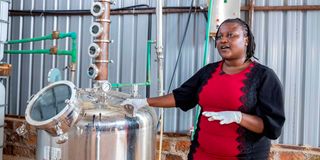
Yvonne Mose, founder and CEO of Moma Renewable Energy explaining about their newly acquired distillation unit that is fully automated for the process to turn organic waste into ethanol.

Walk into many homes, especially in rural areas, and the first sign that someone is home is the smoke billowing from the kitchen. For millions of families, cooking with firewood is an everyday reality.
The International Energy Agency estimates that at least 2.3 billion people, nearly one-third of the global population, still rely on open fires or basic stoves for cooking, exposing themselves daily to harmful smoke from coal, charcoal, firewood, agricultural waste, and animal dung.
Another report “Tracking Clean Cooking in 100 Countries (2026), reveals that only about 32 per cent of Kenyans use clean cooking methods. The reliance, the report finds, has a huge toll on public health. Across Africa, indoor air pollution from cooking with inefficient solid fuels contributes to nearly 700,000 premature deaths every year, with women and young children bearing the greatest burden, and facing a higher risk of respiratory illnesses from prolonged exposure to the smoke.
Now, one duo- Yvonne Mose and her partner, Jeremiah Mabiria are on a mission to tackle indoor air pollution and organic waste management. Yvonne shares that the Kisii based company was founded in 2019.
“My co- founder started the organisation as an experiment to see whether he could make ethanol sustainably from organic waste. Mostly, the traditional way of making ethanol is using things like corn or sugarcane juice but we didn't want to compete with human food,” she shares.
At the time, Yvonne was in formal employment. Through her work, she visited households across the country and noticed that clean cooking remained out of reach for most families.
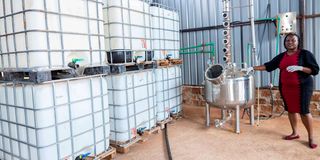
Yvonne Mose, founder and CEO of Moma Renewable Energy.
“And most of the clean energy solutions that the government was promoting were electric cooking. But then you find that by then, only 31 per cent of households in Kisii were electrified, meaning that these options were not available to these households. So we realised that it's an actual need.”
And, that’s when they decided to bring this option to the rural areas of Kisii County.
“First, making ethanol in a sustainable way and two, making it affordable enough to reach the rural communities that are currently not able to access clean cooking options. While electrification is the future, the near future for most households is liquid renewable fuels because we still don't have the infrastructure yet,” she offers.
The duo started off at Nyachaki Market in Kisii County. At the end of the market days, they would pay the women in the market for the waste.
“We were buying at a shilling for every kilogramme because we didn't want them to sell us food that could still be consumable. The only thing was that it needed to be rich in sugars and carbohydrates. Later, we realised that the more we grew, the more we needed to go into other markets and uptake the waste,” she notes.
Logistics, in her telling, became their first nightmare so they decided to pilot a new business model; partnering with food processors.
“We are piloting the project with a banana processing plant. They normally uptake green bananas from small-scale farmers and turn them into other products such as crisps. But then when they uptake the bananas, some start ripening and can’t use them in the production process. That is what we use for ethanol production. What we can’t use, we feed to black soldier flies for animal feed production. We are 100 per cent circular,” she says.
Yvonne Mose, founder and CEO of Moma Renewable Energy explaining about their newly acquired distillation unit that is fully automated for the process to turn organic waste into ethanol.
On average, the 29- year- old shares that they get about 10 tonnes of waste from the company. “They give it to us because it is a waste to them.”
The waste is then taken through the pre-treatment process. The breaking down process takes a maximum of seven days.Once fermented, she shares, it gets to about 15 per cent alcohol. It is then taken through the distillation process to make ethanol. “Once we have the 96 per cent profane ethanol, then we denature and we color it. And then from there, it can now go for retail. From 10 tonnes, they get about 1,100 litres of ethanol,” she shares.
Across villages in Kisii County, the duo and their 15 staff are teaching households how to use it alongside makeshift stoves. “The ones who already use the three-stone cooking fuel, we just show them how to use it, or the ones who use kerosene stoves, we just show them how to retrofit their current cooking methods to feed our fuel. At the moment, we sell it at Sh90 per litre.”
At different points, they have piloted initiatives like working with women who are survivors of gender based violence.
“Our aspiration is to create employment more so for women in rural areas and that’s partly why we are in the process of getting a license so we can move into other markets in Kenya.”
Towards the end of last year, they were among the winners of the fourth edition of the Young Innovators Challenge (YIC 4) by Kenya Community Development Foundation (KCDF) and partners, which saw them receive a Sh5 million grant. “Ithelped us to get a new industrial production unit,” she offers.
“In future, we're looking to venture into sustainable aviation fuels.”
Follow ourWhatsApp channel for breaking news updates and more stories like this.