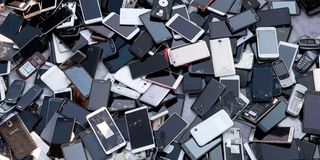
Detectives from the Directorate of Criminal Investigations (DCI) have unearthed a mobile phone syndicate in the South Rift region involving criminals who steal mobile phones, which are later refurbished and sold to unsuspecting members of the public in various towns across the country.
The syndicate is also believed to be part of a cartel that sneaks out phones stolen in Kenya for sale in East African countries, including Uganda, Tanzania, Rwanda and Burundi, according to the DCI.
Two suspects believed to be ringleaders of the syndicate have been arrested in Bomet and Kericho counties.
“We have arrested a suspect and recovered more than 20 stolen mobile phones in his possession in a major breakthrough in the theft and sale of the gadgets. We are on hot pursuit of his accomplices,” Mr Kello Musyimi, the Londiani East sub-county DCI boss, said.
Mr Musyimi revealed that some suspects who had earlier been arrested in connection with the theft of mobile phones had cases pending before the Kericho and Molo courts.
He added that there were a number of cases under investigation and that more suspects were being sought for arrest and prosecution.
Another suspect was arrested in Bomet Central with mobile phones snatched from members of the public in neighbouring Kisii and Migori counties.
“The mobile phones recovered include Vivo, Infinix, Samsung, Tecno and Nokia models snatched from innocent members of the public in Kehancha (Kisii), Migori and Bomet,” the DCI stated in a report.
Police have been tracking criminals involved in the racket, who are believed to be tampering with the registration details of the stolen mobile phones before selling them to unsuspecting members of the public.
“Through intelligence-led operations, forensic analysis and close collaboration with members of the public, the DCI remains relentless in its war against mobile phone theft and all forms of street crime that rob hardworking Kenyans of their hard-earned property,” DCI boss Amin Mohamed stated.
The DCI is understood to have sought the support of Interpol to deal with the sale of stolen devices in Kenya, which are later sold in neighbouring East African countries.
Recovered mobile phones and other computer accessories displayed at DCI office in Nakuru town on February 9, 2021.
Photo credit: Cheboite Kigen | Nation Media Group
According to the DCI, once the phones’ registered IMEI numbers are changed, they are repackaged and transported to neighbouring countries through public service vehicles (PSVs) or private high-end vehicles to conceal the trade.
“We are working with telecommunications companies in East Africa, and soon data on blacklisted phones will be shared to put an end to the criminal enterprise,” a senior DCI officer said.
The DCI confirmed that once stolen — in cases of burglary, pickpocketing in streets, clubs, hotels, public service vehicles and markets — the criminals tamper with the gadgets’ registration details, making them difficult to trace digitally.
A number of innocent Kenyans have been put behind bars for several years after being found with stolen gadgets that they had bought on the streets or from dealers.
Some of the gadgets have been found to have been obtained through robbery with violence and, at times, murder, complicating legal matters for those who purchased them.
Mr Amin last month confirmed that some of the recovered devices had been flashed, while others still had their original details intact.
“Some gadgets were dismantled and sold as spare parts, making them difficult to trace despite ongoing investigations into reported theft cases. We are going after the technicians involved in the crime and those transporting the gadgets to neighbouring countries,” Mr Amin said.
Phone experts say that by flashing the devices, technicians are able to install new operating systems or reprogram smartphones that have either been blocked by telecom providers or PIN-locked by their owners.
“The technicians change the phones’ unique International Mobile Equipment Identity (IMEI) numbers to prevent them from being traced or blacklisted by Kenyan authorities,” Mr Amin said.
Mr Fred Mokua, an official at Mogo Kenya, a company that sells phones on hire purchase, said more than 1,500 devices had been lost in the recent past.
“We have lost gadgets worth more than Sh40 million, some of which have been tampered with and sold in the local market,” Mr Mokua said.
The five cities where the crooks are known to operate —Nairobi, Nakuru, Mombasa, Kisumu and Eldoret—are the major sources of stolen phones sold through a cross-border syndicate linked to a complex web of trained and technology-savvy individuals.
Flashing mobile phone devices, where new operating systems are installed, making it difficult for owners to track them even after telecom providers have blocked them, is the main occupation of technicians involved in the crime.
Director of Criminal Investigations (DCI) Mohammed Amin.
Photo credit: File | Nation Media Group
The DCI’s elite Operation Support Unit (OSU) is involved in the crackdown against the criminals, with the recent arrest of nine suspects and recovery of over 1,000 stolen gadgets, including laptops, in Nakuru and Nairobi counties.
Two of the nine suspects were arrested last month and 900 stolen mobile phones recovered, while another suspect had 75 electronic gadgets and two laptops. The arrest of another suspect led to the recovery of 16 tablets and 19 mobile phones.
Another suspect was arrested with two stolen mobile phones, two laptops, and 21 phone casings and related components. In yet another arrest, a man was found with 46 mobile phones at his home, while another man was found with eight phones and a laptop in Ngara, Nairobi.
Last month, raids by the DCI in Shauri Moyo, the Nairobi Central Business District and Kasarani unearthed over 150 high-end smartphones, 16 tablets and six laptops — gadgets suspected to have been stolen in public service vehicles, clubs and house break-ins.
Two Ugandan nationals were also arrested recently on suspicion that they were involved in the packaging and transporting of stolen gadgets to neighbouring countries.
In 2025, police in Nyeri arrested three suspects at a cellphone repair shop with 417 smartphones and 47 SIM cards.