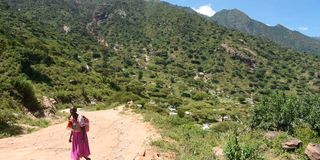
As you drive from Kapsowar Town in Marakwet West down the slopes to Chesoi, Chugor, Kilangata, and Chesongoch in Elgeyo Marakwet County, houses built on steep ‘hanging’ slopes dominate the view as the road winds sharply into the Kerio Valley belt.
Beyond the breathtaking beauty of the escarpment, as the road curves, hugging the mountain’s ribs all the way from Baringo to Elgeyo Marakwet and West Pokot, a frightening reality unfolds. Another disaster is clearly waiting to happen on the fragile slopes, and the potential for many more to come is high.
Farming, charcoal burning, and wanton felling of trees are evident along the hanging valleys where people have made their homes. In a region where farming and felling trees are part of survival, farms stretch from the top to the foot of the slopes with only a few trees surviving the deforestation.
Many houses are built beside or beneath large rocks that hang precariously on loose soil, literally clinging to the steep escarpments like birds’ nests perched on the edge.
Dangerous history, tough choice
Despite the history of past tragic landslides claiming dozens of lives, residents continue their daily lives seemingly unbothered. They know the stories of the nights when the mountains moved, and the stones roared downhill, but leaving remains a harder choice.
In 2010, a landslide in Kittony Village, Kaben location, killed more than 15 people and caused massive destruction of property and livelihoods. A decade later, in 2020, another landslide struck the Liter and Chesegon areas along the West Pokot–Elgeyo Marakwet border, killing more than 20 people.
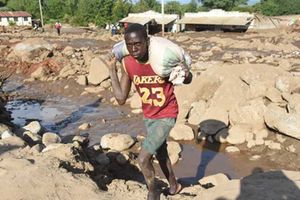
Come November 1, 2015, another devastating landslide hit four villages in Chesengoch, Marakwet East, claiming at least 40 lives, and leaving behind a trail of destruction of flattened homes and social infrastructure.
Despite the dangers posed by the extensive human activity on the slopes, locals say they have not left because they have nowhere else to go.
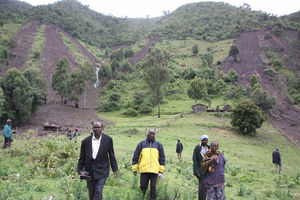
A view of some of homesteads at a section of the Kerio Valley escarpment, at Murkutwo in Elgeyo Marakwet County, on November 04, 2025, where mudslides occurred uphill on Friday night, causing 34 deaths.
Photo credit: Jared Nyataya| Nation Media Group
When Nation visited the area this week, it had become evident that many have been forced to live along the escarpments, slopes, and valleys because it is the only land they can safely occupy without fear of banditry from the plains below.
Insecurity in the lowlands drove many upwards, and poverty and lack of land have conspired to keep them there. Yet every rainy season revives the fear that the earth might give way again, taking away with it more lives and leaving a trail of destruction as it has done in the past.
In Kasegei village, Chesongoch Division, we found Mr Joseph Kipkeu, a teacher who has lived on the fragile slopes for over 45 years. He said people remain on the steep slopes because the lower parts of Kerio Valley have been plagued by rampant stock theft and banditry for years.
“If you move along the escarpment all the way from Baringo to West Pokot, you will find people living in ‘hanging’ valleys because that is their home and they have no alternative place to go,” he said.
Mr Kipkeu, who narrowly survived the recent landslide that destroyed his home and livelihood, added : “In Marakwet East, we have a good number of locals who live on the plateaus, the escarpment, and in the valleys. Personally, I grew up on the slopes of the escarpment because there was insecurity in the Kerio Valley. We could not settle in the lowlands just like the other villagers.”
Mr Kipkeu blames the worsening situation on human activity upstream and minimal government sensitisation on environmental conservation and land management. Most families also graze livestock on the same steep slopes, and residents are well aware of the human pressure and environmental neglect.
“People have lived here for decades, but conserving the environment has been the least of their priorities. As you can see up the escarpment, people have cultivated the land down the slopes here, and there is also wanton felling of trees,” he said.
A view of some of homesteads at a section of the Kerio Valley escarpment, at Murkutwo in Elgeyo Marakwet County, on November 04, 2025, where mudslides occurred uphill on Friday night, causing 34 deaths.
Photo credit: Jared Nyataya| Nation Media Group
“There is no advocacy on environmental issues. People are cultivating along the escarpment, cutting trees and burning charcoal, yet little has been done to tame the menace. It is sad that awareness creation only comes when there is a disaster like this,” he added.
Mr Kipkeu further questioned why the government keeps building projects in such risky areas, citing the multimillion-shilling Mulwaber Irrigation Scheme designed to tap water from the escarpment for irrigated agriculture in the valley, and road construction along the escarpment.
“There are projects ongoing in this area. If these areas are unfit for habitation, why are development projects being initiated here?” he asked, noting that corruption and lack of proper environmental impact assessments are worsening the situation.
“Some are disasters waiting to happen because contractors open up roads without considering proper drainage systems. We are left wondering if the government conducts environmental impact assessments before initiating such developments,” he noted.
Another resident, Mr Charles Cheboi, cited unsustainable farming practices as a major concern. He said the region’s farming methods are worsening soil instability.
“There is very little environmental conservation here. The farming methods are not environmentally friendly because people plant crops like millet that require fine tilling, clearing the land, and exposing the soil,” he said.
NTV team witnesses first-hand debris washing following Marakwet landslide that killed 21
He blamed this on upstream farming and human activity for the frequent landslides and urged the government to deploy agricultural extension officers to promote sustainable practices.
“The frequency of landslides in Kerio Valley is becoming alarming, an indication that earlier generations were more conscious of the environment than the current one,” he added.
Mr Cheboi criticised the human activity in Embobut Forest and Cherangany Hills, saying it affects those living downstream. According to him, elders have long warned that the area was prone to mass wasting and flooding.
“We knew it was risky, but we had no alternative,” he said.
In his opinion, the government should upscale conservation advocacy, and the Ministry of Agriculture should deploy extension officers to advise farmers on better practices.
Prof Simon Onywere, a spatial environmental planner and geologist and an Associate Professor at Kenyatta University, warns that Kerio Valley’s steep, volcanic slopes are fragile and unsuitable for settlement.
“The slopes are unstable and over time, increased weight and rainfall will trigger collapse,” he said.
He explained that most volcanoes in the region are layered, with water flowing through the slopes, weakening the rocks.
“Land management is critical, where you build must depend on soil stability. In places like Chesongoch, soils allow mass flow to take place,” he explained.
Prof Onywere cautioned that continued human settlement and road construction are worsening instability, and the government must designate specific land uses, such as areas where people cannot plough but can plant trees.
“The national and county governments are opening more roads along the escarpments, allowing people to move to dangerous areas. There is a need for designated land use; locals must be told what can and cannot be done. For instance, you can’t plough here, but you can plant trees,” said Prof Onywere.
“If locals have title deeds, then it is the government that allowed them to live there. There should be management institutions in place to guide land use,” he said.
While touring parts of Chesengoch that were plagued by the recent landslides, Elgeyo Marakwet Governor Wisley Rotich expressed concern that people are living in dangerous, uninhabitable areas, calling for their resettlement so that they can be moved to safer grounds.
“I am wondering if trees should be in a good area like Embobut, while people live in dangerous escarpments. People should be resettled where the forest is, and the trees planted on the slopes instead,” he said.