Maize farmers in the North Rift are facing a difficult choice of replanting with short-maturing crops or waiting for the long rains and risking another season after drought and disease outbreaks damaged crops across the region.
For farmers who have already spent heavily on land preparation, seeds, fertiliser, weeding and pest control, the decision could determine whether they recover some of their investment or suffer another loss.
The Ministry of Agriculture has admitted that the country could record up to 30 per cent crop failure and is urging farmers to take advantage of the September-December rains to adopt climate-smart farming practices.
“We are in discussions with other stakeholders on how to support farmers who have incurred losses to invest in alternative food crops. The government will offer subsidised seed and fertiliser to empower farmers to cultivate short-term crops,” Principal Secretary for Agriculture Dr Paul Ronoh said during a fact-finding tour of Trans Nzoia and parts of the North Rift.
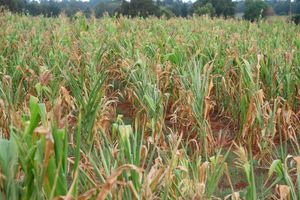
A maize plantation ready for harvest in Katakala, Narok West constituency in the backdrop of poor production in this photo taken on July 22, 2026.
Photo credit: Vitalis Kimutai | Nation
The ministry has deployed experts to assess maize performance in the region and establish the extent of the losses before recommending interventions.
But farmers say the damage could be worse than the government’s initial estimates, with some areas projecting losses of up to 50 per cent.
“We are anticipating losses in the current season, with low production because the maize cobs did not fully form as expected. The alternative is to plant short-term crops during the upcoming short rains to help us recoup our investment,” said Mr Mathew Koech, a farmer from Ziwa in Uasin Gishu County.
For such farmers, crops such as beans and potatoes offer a possible lifeline because they mature faster than maize and could provide food and income before the next maize season.
The Kenya Agricultural and Livestock Research Organisation (KALRO), however, is advising farmers to avoid rushing into another planting season without seeking technical advice.
“There is a need for farmers to adopt certified and early maturing and droughtresistant seed varieties that suit their agro-ecological zones,” said KALRO Director-General Dr Patrick Ketiem.
A heap of maize stalks cut and ready for harvest at Katakala in Narok West constituency in this photo taken on July 22, 2026.
Photo credit: Vitalis Kimutai | Nation
The warning comes as the Kenya Meteorological Department predicts warmer-than-normal temperatures, which could increase evaporation and soil-moisture loss and further stress crops and livestock.
Farmers have therefore been urged to monitor weather updates and consult agricultural extension officers before deciding what to plant.
The government is working with KALRO, the Kenya Plant Health Inspectorate Service, the Agriculture and Food Authority, the Food and Agriculture Organisation and Kenya Seed Company to promote varieties capable of withstanding shorter and less reliable rainfall seasons.
The crisis has also drawn the attention of Parliament, with the National Assembly Agriculture Committee having toured parts of the North Rift to assess the damage and explore ways of cushioning affected farmers.
“The committee will retreat and table its report on how farmers can be cushioned from the losses and avert possible food shortages,” said Soy MP David Kiplagat.
The government's response comes amid growing concern that crop failure could deepen pressure on food supplies and prices at a time when Kenya is still dependent on imports to bridge production gaps.
Deputy President Kithure Kindiki has already chaired a high-level meeting bringing together Cabinet Secretaries and Principal Secretaries to assess the expected decline in food production and the country's preparedness to avert a food crisis.
The government has also proposed converting damaged and immature maize into animal feed, allowing farmers to recover part of their investment instead of losing the entire crop.
A heap of maize stalks cut and ready for harvest at Katakala in Narok West constituency in this photo taken on July 22, 2026.
Photo credit: Vitalis Kimutai | Nation
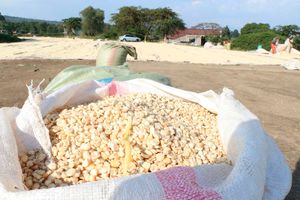
Other measures include improving drying and storage of the available harvest and supporting farmers with subsidised seed and fertiliser during the next planting season.
“The government is fully aware of what has happened to this season’s crop and what is projected later in the year. We are taking every possible measure to ensure no Kenyan goes hungry and that farmers are supported to recover from the losses caused by the prevailing weather conditions,” Prof Kindiki said.
But the crisis exposes the vulnerability of Kenya's food production system, which remains heavily dependent on rainfall.
President William Ruto's administration has made increasing domestic food production one of its key priorities, promising to reduce maize imports and eventually position Kenya as an exporter.
The government has also targeted maize production of more than 70 million metric tonnes and committed to building strategic food reserves equivalent to four million bags of grain.
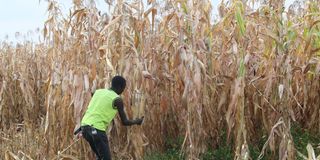
A farm worker cutting maize stalks ready for harvest in Katakala area of Narok West constituency, Narok county in this photo taken on July 22, 2026.
Photo credit: Vitalis Kimutai | Nation
According to the Ministry of Agriculture, maize production rose from 34 million metric tonnes in 2022 to 67 million metric tonnes in 2025. Treasury Cabinet Secretary John Mbadi, in the budget presentation in parliament on June 11, said the increase had helped reduce maize imports from 9.9 million metric tonnes to 3.3 million metric tonnes over the same period.
Kenya secured a commitment from Zambia in February to import up to one million 90-kilogramme bags of maize as the country sought to build a buffer against drought, low local reserves and rising unga prices.
The 2026 Economic Survey by the Kenya National Bureau of Statistics also showed that maize imports increased by 51.4 per cent in 2025 to 468,109 metric tonnes.
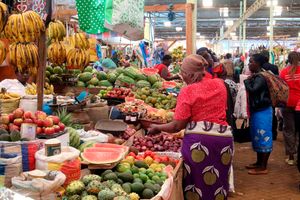
In Nakuru, maize prices have risen from about Sh3,700 to Sh4,500 a bag in two months, while in Narok a 90-kilogramme bag is selling for between Sh4,000 and Sh4,600.
Farmers, however, say brokers are taking advantage of the situation, with some buying maize for as little as Sh3,500 to Sh3,700 a bag.
The South Rift has also recorded poor rainfall, with farmers demanding better prices to compensate for rising production costs and declining yields.
“We have incurred huge losses as a result of rainfall failure, leading to low harvests despite high production costs, which the prevailing market prices cannot cover,” said Mr David Bett, a farmer in Ololunga, Narok West.
The government has reduced the price of subsidised fertiliser to Sh2,500 from Sh7,000 before the 2022 General Election in an effort to lower production costs.
The immediate challenge is therefore how to recover from the current season while avoiding another gamble with increasingly unpredictable weather.
PS Ronoh has urged farmers to move away from over-reliance on rain-fed agriculture and embrace irrigation and other climate smart technologies.
The government is constructing 50 dams in the region, which it hopes will provide water for farming and livestock during dry periods.
“We need to prepare to harvest the excess water from El Niño so that it can be used in the next crop season. Crop production will definitely be affected by El Niño as well,” Dr Ronoh said.
For farmers, however, the solution cannot wait for large infrastructure projects sayng they need to decide what to do with their land now.
Planting four-month maize could expose them to another failed crop if the rains are inadequate. Waiting for the long rains, meanwhile, means leaving their land idle and losing an opportunity to recover some of the money already spent.