Newly proposed mining projects in the Coast region have opened a fresh focus on Kenya's mineral wealth, as the country seeks to expand its mining sector and attract investment into the extraction and processing of minerals.
The Coast region is particularly emerging as a strategic minerals frontier, with significant potential for niobium and rare earth elements in Kwale’s Mrima Hill, as well as titanium, chromite, coltan and gemstones across several counties.
A Nairobi-based company recently submitted its Environmental and Social Impact Assessment Study report for the proposed mining of coltan, beryllium and cerium on a section of Kora National Park in Tana River County, to the National Environmental Management Authority (Nema).
The Kenya Wildlife Services (KWS) describes Kora National Park as “The Last Wilderness” and the home of renowned conservationists George and Joy Adamson. George was a game warden and conservationist, while Joy was a naturalist, artist and author.
They became internationally known for raising Elsa the lioness and successfully helping her return to the wild. Joy later wrote the bestselling book Born Free, which inspired the famous film of the same name. Their work helped popularise wildlife conservation and the idea of reintroducing captive or orphaned animals into the wild.
The three strategic minerals sought by Maboka Mining Limited in Kora are used in important modern industries, including electronics, aerospace, defence, advanced manufacturing, clean-energy technologies, medical equipment and other high-tech applications.
The company stated that area was previously explored and the exploration and feasibility study indicated that there were significant and abundant deposits of the mineral’s worth exploitation. It proposed to establish mining and processing of the rare earth elements in the area at a cost of approximately Sh461 million.
“The benefits notwithstanding, the proposed project has the potential to impact negatively on the environment,” the report stated, while outlining mitigation measures.
“Due to the presence of minerals in the area, illegal small-scale mining has been ongoing in the past leaving depressions and un rehabilitated land. The mining operations should be carried out within the shortest time possible and rehabilitation conducted to restore the land,” it added.
In Kilifi, a proposed manganese mining licence application by Leibra Investments Limited, whose address is listed as Mombasa, was published by the Cabinet Secretary for Mining, Blue Economy and Maritime Affairs Hassan Joho in the Kenya Gazette of July 17. It gives members of the public and affected communities 42 days to submit objections to the CS.
Manganese is primarily used in steel production, where it enhances strength and helps remove impurities. Its importance is however growing in electric vehicle battery technologies, amid a broader global push to secure critical minerals essential for technological innovation and military defence applications.
According to the latest Research and Markets report, the manganese mining market is projected to grow from $32.98 billion (Sh4.3 trillion) in 2026 to $45.35 billion (Sh5.9 trillion) by 2032.
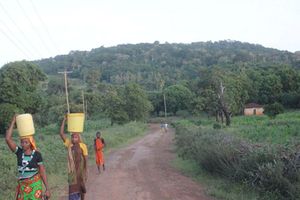
Mrima Hills in Kwale County. The Mrima Hill complex, known to host one of the largest rare earths minerals globally, has become a recent cause of tension.
Photo credit: File | Nation
Asia-Pacific dominates manganese mining and consumption, driven by its large steel industries and growing battery-materials sector. China leads regional demand, while Australia has significant reserves and export-oriented mining.
If approved, the Kilifi project targeting a 0.5328-square-kilometre area (about 132 acres), would complement the Lali Hills Manganese mining plan in Tana River.
According to the Ministry of Mining, the Lali Hills potential was discovered by the Kenyan Mines and Geological Department in 1950s. The mineral was previously extracted in small scale in Kilifi.
“Manganese has been mined from Kilifi County for a long time now. The deposit presents itself as nodules and pebbles whose source has never been established. The deposit unconformably overly coral reefs suggesting transportation and deposition from a nearby fumarole sources,” an Expression of Interest for the Lali Hills project published in March by the Principal Secretary, State Department for Mining Harry Kimtai stated.
Manganese is among several strategic and critical minerals that the government intends to commercialise due to its importance in the green energy transition that is driving global demands.
The government has been working on reforms aimed at attracting investment while strengthening safety, environmental protection and the welfare of communities living near mining operations.
In his recent speeches, President William Ruto was categorical that mining agreements must ensure the minerals are processed in Kenya, for the country to maximise benefits from its natural resources.
At the sidelines of the G7 summit in France last month, President Ruto stated that there was a proposed Kenya-US deal to exploit the strategic mineral deposits at Mrima Hill in Kwale.
However, a lobby group is seeking to halt the plan in court, arguing that the agreement was negotiated without adequate public participation. The site contains significant deposits of niobium and rare earth elements, which are critical for technology, defence and advanced industries.
The mineral wealth is estimated to be worth about $62 billion (approximately Sh9.7 trillion), making it one of Kenya’s most valuable mineral prospects.
Other mining and prospecting applications published on Friday are by Kilungu Kaolin Limited for a prospecting licence covering 4.2723 square kilometres in Makueni County to search for tremolite. The public has 21 days to submit comments or objections.
A. Jiwa Shamji Limited applied for a mining licence covering 0.2138 square kilometres in Bomet County for aggregate extraction, while Chaju Builders Limited applied for a mining licence in Kakamega County for phonolite over an area of 0.0618 square kilometres. Those applications also opened 42-day public objection periods.