Stray donkeys in Lamu could soon find themselves impounded after the county government unveiled plans to construct a dedicated animal holding facility.
Lamu County Executive for Livestock and Cooperative Development Sabrina Mkare Jefwa said the stray donkey menace, particularly in Lamu Old Town, had become increasingly difficult to manage.
Ms Mkare said the county government was partnering with the Donkey Sanctuary Kenya (Lamu Office) and other animal welfare organisations operating in the county to establish the facility, which she believes will restore order and address the problem.
“Part of the reasons behind building this particular donkey pound is to tame the stray beasts of burden and ensure their welfare is met at the facility while waiting for owners to show up and claim them. This initiative aligns with our proposed Animal Welfare Bill, currently being drafted for public participation, which will set a specific fine that irresponsible owners must pay first before their impounded donkeys are released,” she said.
Alongside the planned facility, the County Livestock Department is also preparing to conduct a livestock census in two months, aimed at promoting owner accountability and curbing the spread of animal diseases.
Ms Mkare said the county had previously encountered challenges during mass animal vaccination campaigns due to a lack of data on livestock numbers and their locations.
“We’re rolling out the livestock census in Lamu. This exercise will finally show us how many donkeys, cattle, sheep, goats, camels, dogs, cats and other animals we have in our county. With the database in place, it enables us to know who owns what and where to access them. This will subsequently make it easy for us to conduct effective coverage when vaccinating and treating sick animals,” she said.
In August 2026, Lamu County launched its Five-Year One Health Strategic Plan (2026-2030), which focuses on linking human, animal and environmental health to address zoonotic diseases and other public health threats.
Ms Mkare said the planned census was aligned with the strategic plan and called on partners to support its implementation.
“The One Health Strategic Plan we launched nearly three months ago aims at strengthening coordination between human health, animal health and environmental sectors to better prevent and respond to disease outbreaks. The intended census, as well, goes hand in hand in fulfilling the objectives of the One Health Strategic Plan,” she said.
She added that the county would work with national government agencies, development partners and other stakeholders to conduct the exercise.
The proposed donkey pound has already sparked mixed reactions among residents and donkey owners. While some community members welcome it as a necessary measure to keep areas such as the historic Lamu Old Town clean and orderly, others fear it could expose donkey owners to harassment and extortion by county enforcement officers.
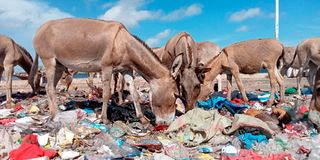
A herd of donkeys feed on garbage dumped in one of the undesignated disposal points in the Domoni area in Mkomani, Lamu Town in 2022.
Photo credit: Kalume Kazungu| Nation Media Group
Community elder Ahmed Bakari said he supported the county's plan to impound stray donkeys and fine their owners.
“These roaming animals have become a menace. They’re dirtying our historic Old Town with dung, wandering around unchecked, and destroying traders’ wares by eating vegetables right off the stalls. Holding owners accountable will finally bring order and sanity back to Lamu,” he said.
Donkey owner Omar Ali said he had no objection to the proposed facility provided it was implemented fairly.
“I have no issue with the introduction of a donkey jail, provided the impounding of stray animals is done fairly. Enforcers shouldn’t use it to frustrate us or slap us with extreme charges just to satisfy their own egos,” he said.
Another resident, Suleiman Mahmoud, welcomed efforts to restore order in the town but expressed concern that the facility could become another source of revenue for unscrupulous county enforcement officers.
Meanwhile, residents, particularly herders, welcomed the proposed livestock census and called for its implementation to be fast-tracked.
Lamu County Pastoralist Community Chair Muhumed Kalmei said an accurate record of livestock would help prevent cattle theft and improve disease control.
“Every year, Lamu receives hundreds of heads of cattle from other counties seeking pasture to this place. The livestock census is a welcome step for us in Lamu. Even better, it ensures that veterinary officers reach every corner of the county during vaccination drives, giving us total disease control and protecting our livelihoods,” he said.