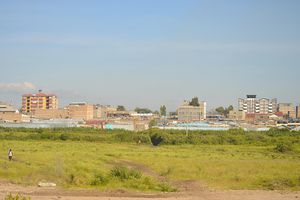
Every plot has a number. Every buyer has a story. But in Syokimau, Machakos County, the question of who owns the land is being fought in court long after buyers have paid, titles have been issued, and construction has begun.
For many people seeking affordable land on the outskirts of Nairobi, a title deed is supposed to mark the end of uncertainty. In this rapidly developing estate, however, competing ownership claims, disputed subdivision records and questions over land reserved for public use have turned some title deeds into the beginning of fresh battles.
The disputes are not just about boundaries drawn on survey maps. They concern homes, investments, development approvals and the public spaces a growing town needs to function.
Court records reveal a complex picture of land ownership in Syokimau, with some buyers accusing sellers or intermediaries of failing to honour transactions, while residents question how portions of larger tracts were subdivided and whether land intended for public use ended up in private hands.
At the centre of the controversy is a fundamental question: when two parties claim the same piece of land, which documents and records establish the legitimate owner?
The answer, the cases show, depends on the history of the original parcel, the subdivision process, the registration records and the evidence presented in each dispute.
One of the prominent battles involves the Syokimau Residents Association, which has challenged developments on parcels it says were irregularly acquired or reserved for public use.
In Syokimau Residents Association v Pinnacle Development Limited and 121 others, Environment and Land Case E092 of 2021, the association asked the Environment and Land Court at Machakos in a filing in October 2021 to stop construction on 10 identified parcels and any subdivisions arising from them.
The case brought into focus the concerns of residents who feared that developments could proceed while the legality of the land allocations remained contested.
The National Land Commission (NLC) and the County Physical Planner for Mavoko Sub-County were listed as interested parties.
The residents’ association had also lodged a complaint with the NLC over the alleged irregular acquisition of land set aside for public use. However, the commission’s failure to conclude its investigation for years became a dispute in itself.
Hearings began on December 10, 2018, and ended on January 11, 2019, over a period of seven days. Yet the commission had not issued a final determination several years later.
In its explanation to the court, the NLC said parcel LR No. 12715/189 had been omitted from a list of disputed properties submitted to the Chief Land Registrar for restrictions. It said it needed more time to audit and reconcile the records before completing its decision.
In a ruling delivered on July 30, 2026, Justice Nelly Matheka faulted the commission for taking too long to resolve the complaint.
“It is more than seven years since when the applicant lodged the complaint. This, in my consideration, amounts to inordinate delay,” the judge said.
The ruling was significant for residents who had waited years for answers. However, it did not establish that the disputed land belonged to the association or declare every contested title unlawful.
Instead, it required the commission to complete its work and make a decision, leaving the underlying ownership questions to be addressed through the relevant processes.
The unresolved complaint raises concerns beyond the interests of the parties involved: was land reserved for public use irregularly allocated, and, if so, what action should follow?
The controversy has also reached the Machakos County Assembly, where another group of landowners has sought official intervention to protect its property rights.
On April 7, 2026, the Syokimau Developers and Business Association petitioned the Assembly on behalf of 124 members who say they own parcels numbered LR Nos. 13323/1 to 13323/124.
According to the petition, the land originally belonged to the Syokimau Farmers Association and was subdivided through the relevant survey process.
The petitioners say they hold title deeds, have paid the required land fees and have consistently remitted county rates.
They accuse the Syokimau Residents Association of continuing to challenge their ownership and discourage development despite earlier court proceedings.
“Despite the ruling, the Syokimau Residents Association has continued to propagate misinformation, branding members as ‘land grabbers’ and discouraging development on lawfully owned property,” the petition states.
The 124 landowners argue that the uncertainty has prevented them from developing their properties and deprived the county government of potential revenue from rates and development approvals.
They want the Assembly to investigate the competing claims and intervene to protect what they describe as their legitimate development rights.
Their petition presents a different side of the dispute from that advanced by residents questioning the allocation of land. While one group raises concerns about the legality of certain subdivisions and the possible loss of public land, the other insists that its members acquired their parcels lawfully and should be allowed to develop them.
The allegations in the petition are claims made by the landowners and should not, on their own, be treated as proof of ownership or wrongdoing by their opponents.
“A title deed is an important ownership document. However, when fraud or irregular allocation is alleged, the history of the title and the legality of the process through which it was obtained can come under scrutiny,” says lawyer Tom Maosa.
A separate court case involving Mungai Ngaruiya and buyers Stephen Mbithi Mwikaya and Lucia Mary Mbithi illustrates how transactions involving subdivided land can unravel even after money has changed hands and some titles have been issued.
In Mwikaya & another v Ngaruiya & another, Civil Suit E014 of 2021, Justice J.A. Mogeni delivered judgment on June 2, 2022, over land that included LR No. 12715/5813.
The buyers told the court that they had purchased four parcels in 2008 through Geotechnics Land Surveyors Limited.
They obtained titles for three plots but said the title for LR No. 12715/5813 had never been processed.
Ngaruiya denied selling the disputed properties to them. He accused the buyers of fraudulently obtaining registration documents through an intermediary.
The buyers, for their part, maintained that they had paid for the land.
After considering the dispute, the court ruled in favour of Ngaruiya and his co-defendant, declaring the disputed parcel their property.
It ordered the buyers to surrender vacant possession, allowed the removal of the caveat registered against the parcel and awarded costs to the defendants.
The judgment demonstrates the risks buyers face when relying on intermediaries without independently establishing whether they have authority to sell land on behalf of the registered owner.
A buyer may have receipts, documents and a history of dealing with a seller, but those details do not necessarily settle whether a valid sale took place.
For Syokimau, the disputes show that reliable land records, transparent subdivision procedures, public participation and effective planning enforcement are closely connected.
For prospective buyers, the cases offer a cautionary lesson: purchasing land requires more than being shown a title deed or a beacon on the ground.
A prudent buyer should independently search the land registry, establish the identity of the registered proprietor and examine the history of the original parcel.
Where land has been subdivided, the buyer should confirm that the subdivision was properly approved and that the resulting parcel corresponds with the relevant survey records.
It is also important to establish whether the seller has the authority to transact, whether caveats, restrictions or court orders affect the property, and whether the intended development complies with planning requirements.
Where a parcel is suspected to have been reserved for public use, clarification should be sought from the relevant authorities before money changes hands.
Payment of county rates or possession of a document described as a title does not, on its own, answer every question about the legality of an allocation.
Public agencies also have a responsibility to ensure that complaints are investigated promptly, records are consistent, and decisions are transparent.
The NLC dispute illustrates the cost of administrative delays. When a complaint remains unresolved for years, uncertainty persists for residents, developers and prospective buyers, potentially affecting investments and development decisions.
The County Assembly’s consideration of the petition by the 124 landowners offers another avenue for scrutiny. Any investigation, however, must distinguish allegations from documents submitted by interested parties and facts independently established.
“Syokimau’s land battles are about more than rival groups claiming the same ground. They raise questions about whether the systems governing land allocation, subdivision, registration and development can keep pace with the growth of a residential area on Nairobi’s doorstep,” says Mr Maosa.
Until those questions are answered through reliable records, timely decisions and properly enforced planning rules, a plot that appears ready for development may still carry the risk of a dispute that takes years to resolve.