In the rolling hills of Kathiani in Machakos County, water is more than a basic need, it is a daily struggle measured in footsteps, time and resilience.
And at the heart of this struggle lies Muooni Dam a once-promising lifeline that today tells a story of neglect, stalled interventions and a community still clinging to hope.
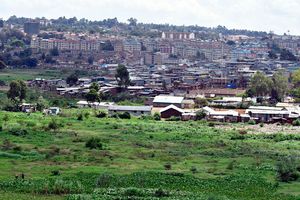
Built decades ago to serve thousands of residents across Isyukoni, Kathiani town, Kisovo, Kalunga, Kaewa, Mbee, Mutuyu, Imilini, Kauti and surrounding areas, the dam was meant to ease chronic water shortages in this semi-arid region.
For years, it supported the town and sub county headquarters, a level four hospital and learning institutions, households and small-scale farmers downstream. But over time, that promise has steadily faded.
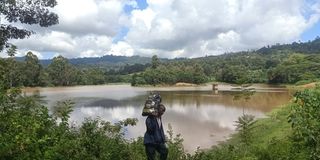
Today, what remains is a shrinking reservoir, choked by silt and unable to meet the needs it was designed for.
Residents recall a time when the dam held enough water to last through prolonged dry spells. That memory now feels distant. Heavy siltation, largely driven by soil erosion from surrounding catchment areas, has drastically reduced the dam’s storage capacity.
During the rainy season, the dam still fills up. But the water does not last.
“The dam used to sustain us even during drought,” says 85 year old John Mutiso. “Nowadays, it fills when it rains, but within a few weeks, the water levels drop sharply.”
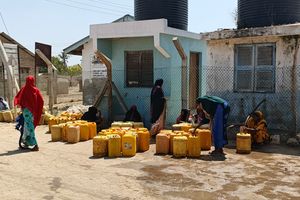
For many families, this has turned daily life into a relentless search for water.
A resident of Isyukoni, Ms Nduku Kioko describes the situation as exhausting. “We wake up very early to look for water. Yet we have a dam here that should be helping us,” she says.
Experts note that siltation is a common problem in many small dams across Kenya’s semi-arid regions, particularly where conservation efforts are weak. Without regular desilting and proper land management, reservoirs inevitably lose their capacity.
At Muooni, the problem has been for years.
The issue of desilting the dam has repeatedly been raised in community meetings, political forums and development plans. Leaders have acknowledged the crisis. Promises have been made.
Residents say that the Muoni Dam in Kathiani has been neglected and is filling with silt.
Photo credit: Benson Matheka | Nation
“We have heard about desilting for many years,” says Joseph Kioko, a youth leader. “Every time leaders come here, they promise action. But nothing significant has been done.”
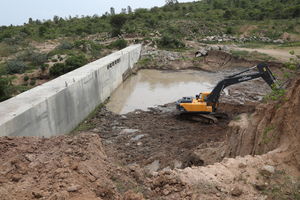
At one point, residents say, there were signs of hope when machinery from the National Youth Service (NYS) was reportedly deployed to begin rehabilitation works. But the effort was short-lived.
“They started, then stopped. Since then, we have not seen any serious work,” Kioko adds.
In 2025, hope flickered again, this time in the form of a formal procurement process.
The Machakos County Department of Water, Irrigation, Sanitation, Environment and Climate Change advertised a tender for the proposed desilting of Muuoni Earth Dam under Tender No. GMC/WIECC/CC/007/2025–2026 (Negotiation No. 1982758).
The tender, which closed on November 10, 2025, invited qualified bidders to undertake the long-awaited rehabilitation works. It was to be processed through the Integrated Financial Management Information System (IFMIS), with submissions strictly done online.
Bidders were required to submit proposals in Kenya shillings, inclusive of all taxes, and provide a tender security of Sh2 million.
For residents, the advertisement of the tender signalled something they had not seen in years, a formal commitment.
“It gave us hope that finally something would happen,” says Kioko. “We thought this time the government was serious.”
But months later, that hope has yet to materialise into action on the ground.
The dam remains as it was, silted, shallow and struggling.
The lack of visible progress has raised questions among residents about what happened after the tender closed.
Was it awarded? Was funding secured? If so, why has implementation stalled?
A senior official from the county’s water department, who spoke on condition of anonymity because she is not authorised to speak to the media, said Muooni Dam remains a priority.
“Muooni Dam is among the water infrastructure that requires urgent rehabilitation. Plans for desilting have been considered, but budgetary constraints and competing priorities have slowed implementation,” the official said.
As for the tender, the official said it is being considered.
The official added that the county is exploring partnerships with national government agencies and development partners to mobilise resources for the project.
However, the gap between planning and execution continues to frustrate residents.
“We are not being told the truth,” says Kioko. “If there is no money, let us know. If there is a plan, let it be implemented.”
For communities that have waited years, the existence of a tender without visible results only deepens concerns about transparency and accountability.
Families are forced to rely on unsafe water sources, increasing the risk of waterborne diseases. Farmers, too, are feeling the strain.
Peter Muli, who once grew vegetables downstream of the dam, says unreliable water supply has forced him to abandon farming.
“I used to depend on the dam,” he says. “Now it is impossible because there is no consistent water. Farming has become a gamble.”
The Muoni Dam in Kathiani was a source of hope for the community, but it has now been filled with silt.
Photo credit: Benson Matheka | Nation
The ripple effects extend beyond households to the local economy. Reduced agricultural activity means lower incomes, diminished food security and increased vulnerability to poverty.
Even as Muooni Dam struggles, Machakos County has launched several new water projects aimed at improving access across the region.
While these initiatives are welcomed, they have also raised questions among residents about priorities.
“We see new projects being launched, but this dam is being forgotten,” says Mr Mutiso. “If it is restored and promises of water supply honored, it can help so many people.”
Still, for residents of Kisovo, Kalunga, Kaewa and Mbee, the continued neglect of Muuoni Dam feels like a missed opportunity.
Experts warn that even if the tender is eventually implemented, desilting alone will not provide a lasting solution.
Deforestation, overgrazing and poor farming practices upstream have increased soil erosion, leading to rapid silt accumulation. Without addressing these root causes, any gains from desilting could be short-lived.
Mr Joseph Nzola, an environmental expert, says a comprehensive approach is needed.
“Desilting alone is not enough,” he explains. “We need to address the root causes by promoting soil conservation and protecting the catchment area. Otherwise, the problem will recur.”
He adds that climate change is compounding the situation, with erratic rainfall patterns leading to intense runoff during rains and prolonged dry spells.
“This combination makes small dams even more vulnerable,” he says.
Residents say that the Muoni Dam in Kathiani has been neglected and is filling with silt.
Photo credit: Benson Matheka | Nation
Despite the challenges, residents have not given up hope.
Community groups continue to push for action, while local leaders have renewed calls for the dam’s rehabilitation. There is growing consensus that restoring Muooni Dam could significantly improve water access in Kathiani.
“We are not asking for miracles,” says Ms Nduku. “We just want the dam to work.”
For now, however, Muooni Dam remains a shadow of what it was meant to be—a reservoir that fills with promise during the rains but quickly empties into disappointment.
The 2025 tender, once seen as a turning point, has become another chapter in a long history of unfulfilled plans.
And as the sun sets over its shallow, silt-laden waters, one question lingers among residents: how much longer will they have to wait?