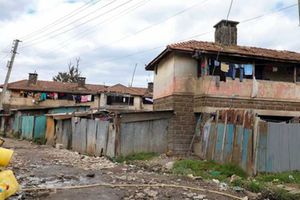
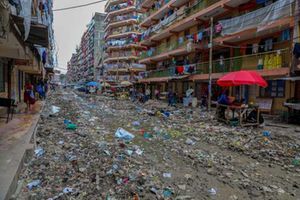
In this weekly series on living in Nairobi, Elvis Ondieki boards one of the city’s loudest and creatively coated matatus to Buru Buru, an estate that was once a jewel but which has lost its lustre thanks to insatiable land grabbers, insecurity and negligence by the county.
One may wonder why there are two desolate tree stumps lying about, not rooted to the ground, near the Buru Buru post office in Nairobi. Was someone on a mission to make firewood out of them but somehow abandoned the mission? Are they some avant-garde work of art?
Stumps of two trees in Buru Buru Phase Two pictured on October 14, 2025. They belong to trees planted by Prince Charles (now King Charles) when he visited Kenya in 1987.
Photo credit: Lucy Wanjiru | Nation
It is none of the above, says Mr Patrick Njogu, an official of the local residents’ association. They are remnants of two trees planted when Prince Charles, who is today King Charles of the United Kingdom, visited the area in 1987.
The trees would have been standing tall today if it weren’t for a grabber who felled them and uprooted the stumps, keen to clear the area. Before the stumps could be taken away, Mr Njogu says, the residents’ association showed up and stopped the grabber in their tracks.
“They were uprooted by somebody who wanted to grab the piece of land in front of that post office. [The person was] stopped by Buru Buru Residents’ Welfare Association for Phase Two,” he says.
Patrick Njogu Mwai, the chairman of Buru Buru Phase One Residents Welfare Association and the vice chairman of the Buru Buru Umbrella Residents Association. He has lived in Buru Buru since 1973.
Photo credit: Lucy Wanjiru | Nation
Grabbing of public pieces of land is one of the major problems plaguing Buru Buru, one of the early examples of urban affordable housing in Nairobi. At least two major churches in the estate, Mr Njogu tells us, stand in spaces that were meant to be children’s playgrounds.
The presence of King Charles in the Buru Buru story should bring an important component into the conversation: the Commonwealth Development Corporation (CDC), today called the British International Investment. When he visited the area, he did so as a CDC representative.
It is the CDC that financed the construction of Buru Buru, with 5,000 units built from Buru Buru Phase One (the earliest) to Buru Buru Phase Five and its extension.
In the Daily Nation
In the same report, the then president, Daniel arap Moi, praised the CDC for spending £67 million (Sh11.5 billion in today’s rates) on various projects in Kenya, which included Buru Buru.
A view of Buru Buru Phase One estate in Nairobi in this photo taken on October 14, 2025.
Photo credit: Lucy Wanjiru | Nation
Buyers got loans from the Housing Finance Corporation that they repaid as they occupied Buru Buru. Mr Njogu, who settled in Buru Buru when Phase One was opened in 1973, recalls that it cost around Sh44,000 to own a house. At a time when the average middle class worker’s salary hardly reached Sh1,000, he said, it wasn’t an easy sum to raise.
“We could not afford that kind of money. That is why we got our loans from Housing Finance,” he says.
And whereas King Charles is associated with Buru Buru Phase Two, Buru Buru Phase One was launched by Margaret Kenyatta, a daughter of Kenya’s founding president Jomo Kenyatta, who was the Nairobi mayor between 1970 and 1976.
A plaque in the estate indicates that Ms Kenyatta officially opened the estate on March 23, 1973 and also planted trees.
“I have been in the estate for the last 52 years,” says Mr Njogu, who is the chairman of Buru Buru I Residents Welfare Association and the vice chairman of the umbrella body for the residents’ associations in Buru Buru.
Patrick Njogu Mwai, the chairman of Buru Buru Phase One Residents Welfare Association and the vice chairman of the Buru Buru Umbrella Residents Association. He has lived in Buru Buru since 1973.
Photo credit: Lucy Wanjiru | Nation
His recollection of the original Buru Buru gives the aura of a dream dwelling. Neatly designed and spaced houses, ample playing spaces for children, lush fields, promptly collected garbage, steady supply of water and orderliness are some of the images that run through the 87-year-old’s mind when he lets the memories flow.
“I agree with that,” he says when we put it to him that Buru Buru has lost its glory.
“It is the residents who are left now to manage the estates,” he adds as he demonstrates the aloofness of the county administration in terms of maintaining infrastructure and attending to features such as overgrown trees and worn-out inroads.
Going through one of the books written by an architect involved in designing Buru Buru from ground up, some interesting facts emerge.
Mr Braz Menezes, in his 2023 book Ghosts of Greed in Kenya: Tsavo, The Money-Eaters ”, reveals how contractors were chosen for the job, the intricacies of building the estate from a thick bush and the some of the corrupt manoeuvres by government officials.
One of the facts is that Buru Buru was mooted for the lower middle class. Mr Menezes relays details of a January 1970 meeting where the concept of Buru Buru was communicated; and it was that this was to be a “major housing project for lower income workers”.
Mr Njogu says this is why the early houses in Buru Buru were bereft of many fancy features. After complaints by the first dwellers, he adds, the constructors added more features. By the time they were doing phase five, he notes, they were even installing water heaters.
“CDC had now to start improving those houses by putting wiring in the kitchen,” he says. “They found that people wanted to buy electric cookers and they had not been provided for. It’s because they thought the occupiers were of a low class who could not afford that.”
A playing field in Buru Buru that has partly been encroached, in this photo taken on October 14, 2025.
Photo credit: Lucy Wanjiru | Nation
Mr Menezes writes that his firm, Menezes and Partners, was given “a blank canvas” to work its magic. He remembers saying: “It is our responsibility to create something that will add value for the city and leave a legacy for the future...We will cover the canvas with a creation that will set a new standard for African housing in Nairobi and help shape a new urban neighbourhood model for the future.”
Mr Njogu tells the Nation that before it was developed, Buru Buru was a bush where young people would hunt game.
“Youngsters from Bahati, Makongeni, and Shauri Moyo used to come to do hunting in this area. There used to be swaras [gazelles]. They were coming to hunt in this area. By 1967, the road had reached Jerusalem [an estate about two kilometres from Buru Buru]. There was no way you could come this way. There was no road,” he says.
Another fact from Mr Menezes’ book is that before the estate got the name Buru Buru, it was called the Nairobi Eastern Extension Area. The name “Buru Buru” was communicated to them by the city council one morning via a phone call.
The other disclosure in the book is that the team that designed Buru Buru also drew up Loresho, the United Nations Environment Programme (Unep) offices, among other projects.
Now in its fifth decade, Buru Buru sits under the sun like a person navigating a midlife crisis. In its heyday, it was associated with everything cool. The fanciest nganyas (fanciful matatus) in Nairobi wanted to be associated with Buru Buru. Children flaunted being raised in Buru Buru like it was currency. Coveted entertainment joints such as Tents, Winds, and Hornbill had Buru Buru as their mainstay.
A view of Buru Buru Phase One estate in Nairobi in this photo taken on October 14, 2025.
Photo credit: Lucy Wanjiru | Nation
Amid all this, the degeneration was accelerating. Fences that were initially constructed up to three feet high using wood just to keep dogs at bay were torn down and ten-foot stone fences were erected. Mr Njogu says this was due to rising insecurity.
Then grabbers swung into motion. Many public spaces in Buru Buru have either been partially or wholly been put into private use. The houses have also been changing hands and with new owners coming in, some don’t see the need to maintain the initial design of having two or three storeys at most.
“There is no law on the zoning, but what was initially done has been maintained and there has been almost some agreement that people should not go further or higher than that,” says Mr Njogu. “Houses have been left to children [descendants of original buyers]. Others have been bought by people. And these people, because they are not original owners, come with minds of doing development in a way they want.”
The first of the Buru Burus, Phase One, is also currently facing pressure from a fast-growing informal settlement — City Carton. Illegal tapping of water and electricity have become a common phenomenon, as is the usage of an “unofficial” path on the edge of Phase One that the residents plan to seek a court order to have it blocked.
Mr Robert Mbatia alias Mr Good, who represents the Kariobangi South Ward at the Nairobi County Assembly, told the Nation that the devolved government is addressing that by formalising the settlement.
“They also need the services,” he said. “They need the water, they need electricity and all that. So, there emerges the conflict between the two estates. What we have done – and I want to thank the county government for this – is that we have made efforts to formalise and upgrade the slum. And we’re in the process. The area was surveyed and currently they are being given their titles to own the land.”
“Also, there is a slum upgrading programme that has been kick-started in City Carton. Once we upgrade the slum, they’ll definitely have their services. They’ll get their own electricity, they’ll get their own water supply, they’ll have the sewer lines, and they’ll have their roads. Once the informal settlement is upgraded, the conflict will be minimised,” added Mr Mbatia.
“All these are houses from way back,” he said. “We have a challenge with the old systems. The population then wasn’t like it is now. Now, as the population has grown, there is a strain on the infrastructure; be it roads, water availability, sewer lines, open storm drainages; all those ones now have been strained. We are currently renewing them.”
A tree that was cut down in Buru Buru Phase One estate, Nairobi in this photo taken on October 14, 2025.
Photo credit: Lucy Wanjiru | Nation
He promised to address the dilapidated inroads that have never been repaired since Buru Buru was inaugurated and to fix the “worn out” street lighting system.
How is the demand for houses in Buru Buru? Moses Akumu, a property agent in the area, said that most tenants live in bedsitters and one-bedroom houses.
“They are simple, cosy, and affordable; perfect for students, young workers, and small families starting out,” said Mr Akumu, who has been in the business for 12 years.
In Phases Two, Three, and Four, the streets are always full of movement and here is where a majority of the people hunt for houses. Mr Akumu explained that these areas are hotcakes because they are near the shopping centre.
“Shops, schools, and matatus are just a short walk away, making life easy and convenient,” he said. “People love Buru Buru because it has everything nearby. Even the old houses get new life through renovations, and demand never goes down.”
The rental price for a single room, Mr Akumu said, ranges from Sh4,000 to Sh8,000 a month while a bedsitter ranges from Sh8,000 to Sh12,000. One-bedroom houses average between Sh12,000 and Sh20,000 while two-bedroom units cost anything from Sh18,000 to Sh30,000.
A view of Buru Buru Phase One estate in Nairobi in this photo taken on October 14, 2025.
Photo credit: Lucy Wanjiru | Nation
With those rates, even with its fading stature, Buru Buru easily becomes a grabber’s dream, and Mr Njogu says there is always a fight being waged against a grabber.
“The grabbers are the ones who are fighting with the residents because they want to put up high-rise houses,” he says, adding that most of the grabbing happened when public participation had not been entrenched in Kenyan laws.
Meanwhile, the stumps of the trees planted by King Charles rest in their place, overlooking a spot where revellers enjoy their liquor under a tree. Lying motionless near the post office, they look like cargo without an address or an owner.
“Fortunately, no one has made charcoal out of them,” Mr Njogu remarks.