Life has taken a difficult turn for thousands of shoe traders relocated from Nairobi’s bustling Gikomba Market, with their once-thriving businesses now struggling to survive in a cramped and uncertain new reality.
For decades, Gikomba was more than just a marketplace for them but a lifeline. Traders built loyal customer bases, honed their craft and supported entire families from the steady flow of buyers that defined the sprawling open-air hub.
Today, the crowds are thinner, the sales weaker and the optimism that once defined the traders is steadily fading.
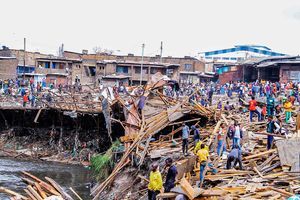
Traders conduct business at Kamukunji Grounds in Nairobi on April 7, 2026, after being temporarily relocated from a section of Gikomba Market known for the shoe trade. The move follows recent demolitions to pave the way for the first phase of construction under the government’s market upgrade plan and the Nairobi River Regeneration Programme.
Photo credit: Wilfred Nyangaresi | Nation Media Group
Fewer customers, slow business
When authorities first announced the relocation was part of a broader plan to modernise Gikomba and clear structures along riparian land, the resistance was immediate. Many traders feared exactly what is now unfolding: fewer customers, rising costs and an uncertain future.
A visit to the new site by the Nation on Tuesday reveals a stark contrast to the old market. Where once there was order born of familiarity, there is now congestion, disarray and discomfort. Traders are also squeezed into tight spaces, some operating under makeshift coverings while others are exposed to the harsh sun or sudden rains.
For Cecilia Muthoni, who has depended on the business for years, the relocation has upended not just her work but her entire household economy.
“Most of us depend on this business to take care of our families. School fees have gone up and some of us have children in university. How are we supposed to manage when business is this low?” Muthoni says.
Despite being told the holding ground would be free, Ms Muthoni says she paid Sh7,000 to secure space and continues to incur additional costs for security.
Traders conduct business at Kamukunji Grounds in Nairobi on April 7, 2026, after being temporarily relocated from a section of Gikomba Market known for the shoe trade. The move follows recent demolitions to pave the way for the first phase of construction under the government’s market upgrade plan and the Nairobi River Regeneration Programme.
Photo credit: Wilfred Nyangaresi | Nation Media Group
But even then, basic amenities remain elusive.
Access to clean water and sanitation is limited and the traders now operate dangerously close to open sewer lines and sections of the Nairobi River that emit a persistent choking stench.
“We were moved from riparian land only to be brought next to a sewage line. We are breathing this in the whole day and it’s not safe,” says Margaret Njeri.
The relocation has also fractured the tight-knit trading community that once defined Gikomba. Some traders have been unable to raise the required fees to secure space and now hawk their goods along nearby roads and others have quietly returned to sections of the old market that escaped demolition.
A trader inspects second-hand shoes at Kamukunji Grounds on April 7, 2026, where vendors have resumed business after being temporarily relocated from a shoe-trading section of Gikomba Market.
Photo credit: Wilfred Nyangaresi | Nation Media Group
“We are scattered. Some of the people we worked with every day are no longer here,” Ms Muthoni explains.
For younger traders like Victor Okiya, the move has been nothing short of a financial blow. Having sold shoes and clothes for years, he says the drop in shoppers has forced him to rethink survival.
“I have had to rely more on social media to sell but it’s not the same. We want development yes but we also need money to circulate at the ground level. Without that, we are just struggling,” he says.
Victor Okiya, a shoe trader for over 7 year conduct business at Kamukunji Grounds on April 7, 2026, following their temporary relocation after recent demolitions.
Photo credit: Wilfred Nyangaresi | Nation Media Group
Others like Jackline Mutua speak of a harsher daily grind, recalling making profits of up to Sh3,000 a day at the old site. Now, she is lucky to make Sh500.
“The sun is too much and the related marketplace is stuffy and when it rains, we are forced to close. Only a few people got spaces with proper shelter. The rest of us are just enduring,” she says.
But security too has become a concern, particularly in the early mornings and late evenings when traders feel most vulnerable.
Gikomba Market Association chairman Mbugua Kibathi insists the relocation is temporary and is part of a larger vision to modernise the market. He says the government has committed to completing the first phase within four to six months, after which traders will be allowed to return.
“The President assured us that the first phase will be prioritised. We agreed to relocate because we want development,” Mr Kibathi told the Nation .
But on the ground, patience is wearing thin.