For years, Edwin Ogembo earned a living hawking boiled eggs in Molo town, Nakuru County, a modest business that supported his young family.
But in 2017, his life took an unexpected and devastating turn when he was arrested and accused of stealing 50 chickens from a neighbour, an offence he insists occurred while he was at work.
“I was set up by my friends and I ended up in jail. The thought of leaving my wife who had just given birth three months earlier, was painful,” Ogembo recalled in an interview with the Nation . “It was like falling into a dark pit. You scream, but no one hears you. Everyone assumes you are guilty simply because a court said so.”
Ogembo describes prison as dehumanising.
Photo credit: File | Fotosearch
Despite maintaining his innocence and presenting witnesses, he was held in remand for nine months before being convicted and sentenced to four years at Naivasha Maximum Prison.
When he went to prison, he left behind his wife and their newborn twins with the young family bearing the heaviest burden of his incarceration.
Ogembo vividly remembers the cold echo of prison cell doors, the day of his sentencing and the weight of punishment he still insists he did not deserve.
“Prison life was not something I ever imagined. The first months were the hardest—cut off from my family, surrounded by strangers and battling the stigma that gripped me like a shadow. I often wondered whether I would survive,” he said.
According to him, food was scarce and of poor quality, yet inmates scrambled for every bite.
“You count yourself lucky if you get a small slice and some thin soup. But I soldiered on,” Ogembo said in the interview on Monday.
While in prison, he learnt welding and other artisanal skills—knowledge that would later save his life.
Ogembo was released in 2021, only to confront a painful reality. His marriage had collapsed, friends kept their distance and he could not trace the good Samaritan who had taken in his abandoned twins. His wife had reportedly remarried and later left for Saudi Arabia.
During his imprisonment, he also lost his mother and elder brother.
He moved to Barnabas Estate in Nakuru East and began rebuilding his life from scratch, doing casual construction jobs, running errands at the market—anything to put food on the table.
He later secured a job as a security guard at a private company where he earned Sh5,000 per month. After three months, he moved to work at a car wash where he stayed for a year.
“Life was hard. I had no house. I slept under a tree during the day and worked at night,” he said.
During this period, he learnt that his former wife had given birth again and later left the country. In 2023, he managed to gain custody of his twins, who now live under the care of his sister while he continues to hustle in Nakuru.
One evening, while watching roadside vendors sell roasted and boiled maize, an idea struck: what if he could design a more efficient maize-boiling machine?
Armed with the welding skills he had learned in prison, he began collecting scrap metal from dumpsites, garages and welding shops. At night, he sketched designs in old exercise books. For months, he hammered, welded, cut and rebuilt prototypes, failing many times but refusing to give up.
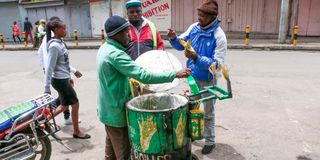
Edwin Ogembo hawks hot boiled maize from an improvised mobile boiler with a holding capacity 300 corn along Biashara Road in Nakuru City on November 9, 2025. Each corn retails at sh30.
Photo credit: Boniface Mwangi | Nation Media Group
After six months of trial and error, he finally assembled a machine unlike any other used by maize vendors in Nakuru.
The large metal boiler can cook up to 300 maize cobs at once. It is efficient, durable, mobile and cost-effective
Starting in Barnabas and later moving to Pipeline and Nakuru City, he now serves hundreds of customers daily—from students and boda boda riders to office workers and travelers. Many are drawn by the efficiency of his machine and the fact that the maize stays hot for long and is served faster.
“The first time I hawked maize, I was arrested by Nakuru City enforcement officers. After explaining myself, they released me and directed me to pay Sh300, which I still pay,” he said.
“On a good day, I boil more than 250 cobs, sometimes even 300. On a good week, I can make up to Sh6,000. Business has slowed lately, but I hope it picks up,” he says.,
Despite his progress, the emotional wounds of his wrongful imprisonment remain.
Some nights, he wakes up sweating from nightmares that drag him back behind the cold prison walls. Strangers and old acquaintances sometimes treat him with suspicion because of his past.