Pain of dialysis patients in Nakuru after machines breakdown

Nakuru County Referral and Teaching Hospital.

For the past six years, Mr John Munya has been attending his dialysis sessions at the Nakuru Teaching and Referral Hospital, a lifesaving treatment he has relied on to survive.
Mr Munya has been undergoing four-hour regular dialysis sessions twice a week at the facility, as each session removes toxins and excess fluids from his body that his kidneys can no longer handle.
However, he said that changed following frequent breakdowns of dialysis machines, forcing the hospital to reduce dialysis sessions from the recommended four hours to three hours to accommodate the growing number of patients.


Mr Munya, who was addressing the press after staging a protest to air their grievances, noted that the World Health Organization(WHO) recommends a minimum of four hours, saying that the reduced treatment is already taking a toll on their health.
He accused the County government of neglecting the renal unit, claiming that the machines have been breaking down for months without being repaired and despite frequent complaints, nothing much has been done about it.
According to Mr Munya, only three of the nine machines at the renal units were operational, leaving nurses struggling to accommodate the growing number of patients.
Also Read: ‘I will not lose hope’: An orphan’s battle with kidney disease and broken education dreams
Mr Munya regretted that the reduced treatment time is exposing patients to health risks, with some already experiencing the effects of inadequate dialysis, including dizziness, weakness and other complications.
“The machines have been breaking down frequently and repeatedly; sometimes you will find three are working or two; there has never been 100 percent operational. We are now forced to undergo a three-hour session. We have started feeling the repercussions; some of us are sick, some are weak because of that accumulation of one-hour reduction. I know they are expensive but they should repair them," he said.
Mr Munya also decried the dilapidated state of the renal unit, saying the ceiling was damaged months ago after a water plant malfunctioned.
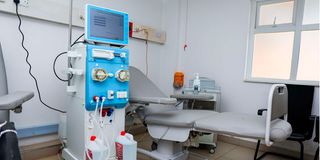
A dialysis machine.
Ms Sylvia Wanjiru, another renal patient attending dialysis during the 3 pm to 6 pm shift at the facility, said the breakdown had disrupted treatment schedules, forcing nurses to work extra shifts to accommodate patients.
Ms Wanjiru, a resident of Gilgil subcounty who visits the facility twice a week, said that she was shocked when nurses informed her that her sessions had been reduced to three hours to accommodate everyone.
She warned that inadequate dialysis could lead to accumulation of toxins such as urea and potassium in patients’ blood, which can trigger serious complications, including heart problems.
Ms Wanjiru appealed to Governor Susan Kihika and the County Department of Health to urgently intervene, noting continued delays in repairing the machines could put more lives at risk.
“To be dialysed for three hours is affecting us; urea and potassium are building up in our bodies, yet we are not getting the help we need. Our lives depend on the machines. The three hours are not enough; patients are breaking down. We have tried to reach the CEC of health but he has been postponing meeting us. We are just wondering who will help us,” she said.
Gilbert Murimi, a resident of Munanda village in Subukia subcounty, said patients were also struggling with the cost of other medical services, even though they are covered by the Social Health Authority (SHA).
He said they are sometimes forced to pay for laboratory tests and X-rays out of pocket as SHA only pays for Sh10,650 twice a week.
Mr Murimi further raised concerns over shortage of essential medication, saying some drugs which they are supposed to receive weekly have not been consistently available at the facility, forcing them to go for months without them.
“We used to have a doctor who would attend to renal patients mostly who required medical attention but we do not know what happened now we have to wait for up to two weeks. We would like the facility to look into that,” he said.
At the Naivasha subcounty hospital, the situation is similar following the breakdown of several machines at the facility.
Mr Samuel Githinji has been undergoing dialysis twice a week and has relied on the hospital for treatment since his condition began in 2022.
Mr Githinji said that all five machines were previously working, but now only three are functional, including one kept in a separate room for patients with Hepatitis B.
The two other machines ordinarily serve patients in morning and afternoon sessions, while the machine in the separate room handles one patient daily, according to Mr Githinji.
He says the arrangement limits the number of patients who can receive treatment each day, particularly as the hospital also receives referrals from other areas, including Rongai, Mai Mahiu and Kinangop.
He recalled an incident when a breakdown of the hospital's water plant disrupted dialysis services, forcing patients to seek treatment at another facility before the system was repaired.
“Before, all five machines were working and the unit was functioning well but now the machines' breakdown is the order of the day and yet we have many patients coming here for their sessions but the machines are few," he said
When reached for comments, Nakuru Teaching and Referral Hospital, hospital director Santosh Deveraj disputed the patient's allegation and insisted that the machines are working.
"I can take you round the hospital; everything is functional; just avail yourself at the facility," he said
On her part, Naivasha Sub-County Referral Hospital, Med Sup Dr. Murage Mumbi referred our questions to the county heads, saying she is not authorized to speak to the media.
Attempts to get comments from the County Health Executive, Stephen Kuria, were futile as he maintained he was in a meeting.
Follow ourWhatsApp channel for breaking news updates and more stories like this.