By 9 am in Lodwar, the Turkana County headquarters, the sun is already scorching. Inside poorly ventilated homes, the heat becomes unbearable, forcing some residents to seek refuge under trees during the day and sleep outdoors at night.
For families without fans or air conditioners, cooling down has become a daily struggle. Others are improvising ways to keep drinking water cool, while the cost of staying hydrated is rising amid water shortages across Lodwar municipality.
Daytime temperatures have been fluctuating between 38 °C and 40 °C, with residents complaining of sleepless nights, profuse sweating and difficulty concentrating at work.
The situation is compounded by prolonged and irregular power rationing, which has made it harder to cool homes and workplaces.
An open-air seating area under a tree in a Lodwar hotel on October 27, 2026, where it is comfortably serving customers during the current extreme heat.
Photo credit: Sammy Lutta | Nation
Health officials are warning of the risks associated with prolonged exposure to excessive heat, including heat exhaustion and heatstroke, as well as possible increases in kidney and bladder stone cases.
Ms Bethsheba Ekale, a Lodwar resident, says she takes her two children outside to spend the day under a tree because temperatures inside their rented one-bedroom house become unbearable from about 9 am.
“We put on loose clothes as increasing temperatures result in excessive sweating. This forces us to take showers frequently. To avoid dehydration, I am taking water from an improvised local refrigerator, which is a 10-litre jerrycan covered with a used blanket. Once I fill it with water, I ensure that the blanket remains wet and keep it in a shade,” she says.
The makeshift cooler offers some relief from the heat, but the nights are equally difficult.
Ms Ekale says that, like many other residents, her family sleeps with the windows open and with as little clothing as possible, yet the lack of a breeze leaves them sweating throughout the night.
For Mr James Epem from Napetet village, the heat has become so unbearable that he has been sleeping outside since last Thursday.
He says he realised he could no longer tolerate the nighttime temperatures after experiencing what felt like breathing in hot air.
“While still sweating, I retired to bed but vomited after 10 minutes,” he says.
The unreliable electricity supply has worsened the situation for households and businesses that depend on fans, air conditioners and refrigeration to cope with the heat.
Norah Lokwaalem says the walls and mattresses in her house remain warm well past 10 pm, leaving her sweating and making sleep uncomfortable. With the power supply unreliable, she can no longer depend on her fan to cool the room.
A deserted street in Lodwar town on October 27, 2026, where most people are avoiding sun exposure.
Photo credit: Sammy Lutta | Nation
In the fast-growing town, residents and traders rely on electricity to keep drinks cold and maintain comfortable temperatures in homes and business premises.
The heat has also forced her to change how she plans her day. She avoids unnecessary movement around midday, when temperatures can reach 39 degrees Celsius, and budgets for drinking water whenever she has to travel between different parts of town.
“It's just so hot from 9am. Initially, when my plans would involve connecting various places, I must budget for water because between 9am and 4pm, I must take at least three litres of cold mineral water at Sh50 each,” she says.
Ms Lokwaalem says a 20-litre jerrycan sells for between Sh20 and Sh50, depending on the means of transport from the source.
To keep drinking water cool for her family, she has invested in locally improvised plastic containers ranging in capacity from five to 20 litres. She covers them with thick clothes, blankets or wool, sprinkles water on the outside and keeps them in a cool place.
The methods offer a low-cost alternative to refrigeration, but they cannot address the wider problem of limited access to water and electricity.
As residents search for affordable ways to stay hydrated, concerns are emerging over the handling and sale of water in reused plastic bottles.
Those unable to afford sealed bottled mineral water, which retails at about Sh50 per litre, are turning to cheaper alternatives sold by some shopkeepers.
Nation established that some shopkeepers buy empty bottles from street children for Sh1 or Sh2, wash them and refill them with cold tap water, which is then sold to thirsty residents at Sh10 a bottle.
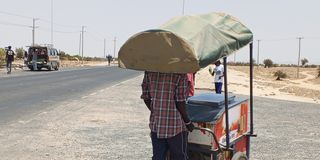
An ice cream vendor in Lodwar town, well shielded from direct sunlight, waits for customers.
Photo credit: Sammy Lutta | Nation
Some of the bottles are reportedly collected from dumping sites by street children before being sold to shopkeepers.
The practice raises questions about the cleanliness of the containers, how they are handled and whether the water is safe for consumption.
Mr Paul Ekai, a Lodwar resident, questioned whether Turkana County's public health department was aware of the practice.
“We don't know if the department of public health in Turkana County government is aware of this trend where street children are selling empty bottles to shopkeepers for repackaging water. Is it legal?” he asks.
The safety of the refilled water could not be established from the information available. The county public health department needs to clarify whether the practice is permitted and what safeguards are in place to protect consumers.
For Mr Ekai, who lives in Kambi Mawe village on the outskirts of Lodwar, the heat has previously meant taking as many as five baths a day. But even after bathing, he says, he begins sweating before he can apply petroleum jelly or put on his clothes.
“I don't have an air conditioner or a fan in my one-bedroomed house, which is poorly ventilated. I always feel uncomfortable watching the 9pm news inside the house. With a bare chest and shorts, I sit outside where it is cool,” he says.
At bedtime, he sets up mosquito nets outdoors, one for his two sons and another for himself and his wife. He also keeps drinking water nearby.
Turkana County Chief Officer for Medical Services Dr Gilchrist Lokoel has issued guidance for residents experiencing symptoms of heat cramps or heat exhaustion.
“Spray yourself with cool water and then sit in front of a fan, move into a shade or move into an air-conditioned car or house, take a cool shower or bath, drink water and no alcohol or caffeine, take off any extra clothing you may be wearing or put a cold pack or cool cloth on your neck or armpit,” he says.
A resident of Lodwar sprinkles water on an improvised container kept in the shade to keep drinking water cold, as a coping strategy during periods of extreme heat.
Photo credit: Sammy Lutta | Nation
Dr Lokoel warns that if the excessive heat persists, workplace productivity could decline and residents could abandon evening strolls and other outdoor activities. He also warns of possible mental health effects and increases in heatstroke and kidney and bladder stone cases.
The warnings come as residents continue to endure hot homes and offices, limited water supplies and unreliable electricity, leaving many with few affordable ways to find relief.
County Director of Kenya Meteorological Services Francis Muinda says Lodwar experiences extreme temperatures partly because it lies about 500 metres above mean sea level.
“The lower you go towards the sea level, the hotter it becomes,” he says.
However, Mr Muinda says the weather outlook for November 3 to 9 indicates that Turkana County is likely to experience wet conditions in several areas, potentially offering some relief.