Newly constructed rural roads are transforming remote villages and trading centres along the Kenya-Ethiopia border, easing years of isolation caused by poor infrastructure in Kibish Sub-County.
The vast frontier sub-county, which also borders South Sudan, has for years struggled with poor and dangerous road networks that cut off communities from markets, healthcare, security services and emergency response, especially during heavy rains.
But residents now say the improved road network is enhancing access to markets, healthcare and schools, while boosting trade and strengthening emergency response services in previously hard-to-reach areas.
Among the key projects is the upgrading of the Napak Hill road along the porous Kenya-Ethiopia border, a route long considered dangerous because of its steep mountainous terrain.
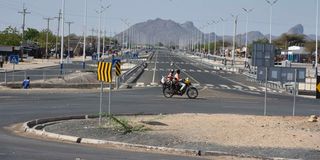
A view of the roads in Lokichar town in Turkana County, on the Lodwar-Lokichar-Kainuk-Kapenguria-Kitale-Eldoret road on February 16, 2026.
Photo credit: Jared Nyataya | Nation Media Group
Residents recall an incident in April 2020, when a police lorry, then the main means of transport for many, lost control and overturned while navigating the road, underlining the risks faced by locals using the route.
Mr John Ekalale, a resident of Lokamarinyang, said the poor state of the hill road had disrupted access to critical supplies, with most motorists avoiding the route because of the high risk of accidents.
“The few vehicles we see on the road are mostly for security personnel, local contractors and county government officers on serious missions. If we must travel, we either use police vehicles or risk our lives being transported alongside goods and building materials,” said Mr Ekalale.
According to Turkana County Chief Officer for Roads and Transport Mark Achila, the county prioritised construction of the road because of its strategic importance in cross-border trade, peace-building and humanitarian operations.
A scenic view of the road leading to Lodwar town in the semi-arid Turkana County, on the Lodwar-Lokichar-Kainuk-Kapenguria-Kitale-Eldoret road on February 16, 2026.
Photo credit: Jared Nyataya | Nation Media Group
The road stretches along the Kaikor Junction-Karubangorok–Kotome Bridge-Napak A-Lowasa route, whose poor condition is often worsened by flash floods.
Mr Achila said the works include installation of rigid pavements, twin-piped culverts and two drifts to improve accessibility and durability.
“The road will boost international trade by easing transportation of goods and services from Kaikor, Lokitaung, Kakuma and Lodwar to border villages, while also facilitating security patrols along the border,” he said.
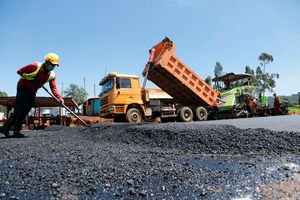
The county government is also constructing the 20-kilometre Kalokok-Lororonyit road at a cost of Sh3.4 million through the Ward Development Fund.
A view of the roads in Lokichar town in Turkana County, on the Lodwar-Lokichar-Kainuk-Kapenguria-Kitale-Eldoret road on February 16, 2026.
Photo credit: Jared Nyataya | Nation Media Group
Project supervisor Mr John Mark Eregae said the works involve bush clearing and grading and, once completed, the road will improve transport and trading activities in Loronyonyit, Lokitela, Kalokok and Koyasa areas.
“The road also serves as an alternative shorter route to Kibish Centre and will be a strategic security access road facilitating rapid response by security agencies during militia attacks and emergency operations,” said Mr Eregae.
Through the Roads Levy Maintenance Fund, a 45-kilometre Kaikor-Napak road has also been constructed to facilitate cross-border trade between Kenya and Ethiopia.
Mr Achila said the projects are part of ongoing county efforts to expand and maintain road networks in Kibish Sub-County by making them motorable throughout the year.
Signage on a road in Moyale near the Kenya-Ethiopia border taken on March 14 2018.
Photo credit: File | Nation Media Group
“Poor road networks in the larger Kibish Sub-County have been exacerbating the isolation of rural communities and hindering emergency services and trade,” he said.
However, he noted that flash floods during heavy rains continue to destroy key bridges, erode embankments and damage sections of roads, disrupting transport and connectivity.
National Police Reservist Philip Lobuin said poor roads had for years hampered security operations whenever cattle rustlers from neighbouring Ethiopia and South Sudan attacked border villages.
“With improved road networks, police vehicles will easily traverse the border for successful livestock recovery missions. Some of the routes at Napak and Kibish that militiamen relied on to escape coordinated recovery operations have now been opened up,” said Mr Lobuin.