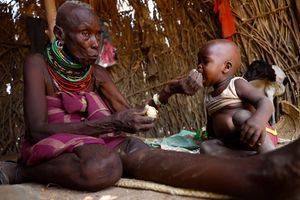
More than 46,000 vulnerable learners went without school meals last year after a Sh4.8 billion funding gap crippled the government's feeding programme, threatening school attendance in some of the country's poorest regions.
A performance report by the State Department for Basic Education shows that the National Council for Nomadic Education in Kenya (NACONEK) fed 2.65 million learners against a target of 2.7 million under the School Health, Nutrition and Meals Programme, leaving 46,225 children without the meals.
The revelation comes on the back of repeated warnings by the Ministry of Education that inadequate funding would leave thousands of vulnerable children, particularly in arid and semi-arid counties, at risk of dropping out of school due to hunger.
The programme requires Sh7.8 billion annually to feed learners throughout the academic calendar but received only Sh3 billion in the financial year ending June 2026, leaving a funding deficit of Sh4.8 billion.
"There was not enough money to meet the target for all the learners and the school calendar days," Basic Education Principal Secretary John Ololtuaa told the National Assembly Education Committee while presenting the ministry's performance report.
Basic Education Principal Secretary John Ololtuaa.
Photo credit: File | Nation Media Group
The funding gap came at a time when food insecurity was worsening across the country, with the United Nations estimating more than two million Kenyans were facing acute hunger, with pastoral communities in the North Eastern region among the worst hit.
Successive failed rainy seasons have left thousands of livestock dead, devastated livelihoods and deepened household food insecurity across the Horn of Africa.
The World Health Organization (WHO) also warned that worsening food insecurity was fuelling malnutrition, increasing disease outbreaks and placing additional pressure on health systems.
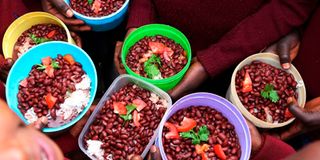
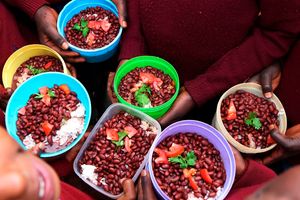
School meals are more than a welfare intervention as they improve attendance, retention and concentration among learners from food-insecure households.
A 2023 performance audit found that attendance improves significantly on days when meals are provided, and drops when they are not.
For many children in marginalised regions, the meal offered at school is often the only reliable source of nutrition.
However, chronic underfunding has weakened the programme’s effectiveness with the Office of the Auditor-General Kenya establishing that over a five-year period, only Sh7.7 billion was approved against a request of Sh17.32 billion.
The latest report by the State Department of Basic Education also paints a picture of a basic education sector struggling to implement several key programmes because of budget constraints, and delayed release of funds.
For instance, the ministry failed to sensitise any of the 9,604 junior school teachers targeted for career guidance due to inadequate funding. Likewise, none of the planned computing packages for 300 public junior schools was provided due to lack a budget for the programme.
Infrastructure projects also stalled, with none of the targeted 300 science labs for public junior schools constructed or equipped and no progress made on planned setting up of 900 sanitation facilities in secondary schools over inadequate funding.
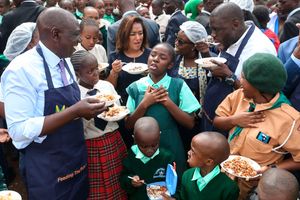
Learners at Logumgum Primary School in Baringo County taking their meals on May 17, 2024.
Photo credit: Photo| Florah Koech
The report further shows that none of the 9,604 senior school teachers earmarked for career guidance training received the training due to delayed exchequer releases.
The failure to expand sanitation facilities comes amid growing concerns over hygiene standards in public schools.
According to a recent report by the National Gender and Equality Commission (NGEC), the average pupil-to-toilet ratio stands at 43:1 for boys and 32:1 for girls across 19 surveyed counties, significantly above the national standards of 25:1 for boys and 20:1 for girls.
The commission warns that inadequate sanitation facilities expose learners to preventable health risks and contribute to menstrual-related absenteeism among girls, undermining learning outcomes.
School feeding also suffered a budget cut, with its allocation reduced from Sh3.6 billion in the 2024/25 financial year to Sh3 billion in 2025/26, even as demand for the programme continued to rise.