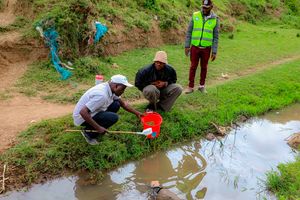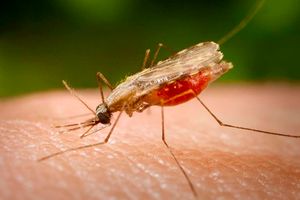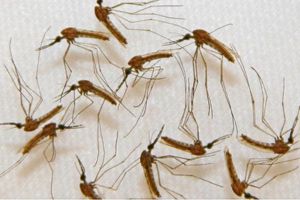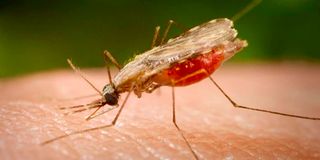
Anopheles mosquito, the main vector for malaria. In Kenya, malaria transmission is highest in two main regions: Lake Basin and the Coast.

Millicent Mandera, a teacher, had always been curious about her blood group. When she went on recess this April, she visited a health facility to find out.
Once there, the clinician suggested that since she was already in hospital, they could do a routine blood test alongside checking her blood group. She agreed, though reluctantly.
"I was not sick; I did not have any symptoms that could make me suspect anything," she told Nation in an interview.
The blood test took about two hours. When the results came back, she was diagnosed with malaria.
"How could that be?" she said.
Millicent was billed Sh9,000 under the Social Health Authority and given medicine to take home. She did not take it, believing she was healthy. In hindsight, she now accepts she had malaria, only without any symptoms.
She is one of many Kenyans who carry malaria infections without ever knowing it.
The latest Economic Survey released by the Kenya National Bureau of Statistics last Wednesday shows that malaria cases in the country almost quadrupled last year. The data shows cases rose from about 3.8 million in 2024 to 14.3 million in 2025.
This sharply contradicts what the Health ministry said during the World Malaria Day commemoration on April 25; that the country had made great strides in reducing the malaria burden over the past decade, with a 31 per cent reduction in incidences recorded in the last three years.
A source at the Health ministry, who asked not to be named, said malaria cases had been declining over time due to strengthened interventions in case management and the use of early warning systems. Their data shows 4.2 million cases in the Financial Year 2024/2025, down from 4.7 million in Financial Year 2023/2024.
"In endemic areas, apart from Turkana County, malaria incidence has reduced over time," the source said.
A representative from KNBS told Nation that the data in the survey must be validated by the relevant ministry, in this case, the Ministry of Health. She also clarified that the figures represent individual malaria cases recorded through the Kenya Health Information System (KHIS), not the total number of people infected.
"We think the high numbers are because of increased reporting by facilities into KHIS because of sensitisation," she said.
Last year's World Malaria Report found that in 2024, total malaria funding covered only 42 per cent of what was needed to stay on track toward the global target of reducing cases and deaths by at least 75 per cent by 2025, compared to 2015 levels.
"Sudden and drastic cuts to foreign aid in 2025 have also compounded chronic underinvestment in health systems in many countries. The consequence has been severe disruption in services, shortages of medicines and increased out-of-pocket payments, elevating the risk of malaria morbidity and mortality," the report noted.
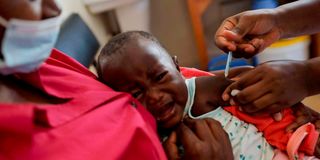
A nurse administers a malaria vaccine to an infant at Lumumba Sub-County Hospital in Kisumu.
Data from the Africa Centres for Disease Control and Infection shows that general Official Development Assistance for health fell by an estimated USD 31.1 billion (about Ksh4 trillion) in 2025, with further reductions expected in 2026.
In Homa Bay County, one of Kenya's malaria-endemic regions, the situation is already being felt on the ground. Philip Mbom, the County Malaria Coordinator, told Nation that they have noticed a rise in cases at their facilities.
"Last year, we had an increase in cases and we are already seeing a spike even in 2026, and we worry the numbers could be high should no intervention be put in place," he said.
Patients in the county are presenting with high fevers, generalised malaise, headaches, joint pains and vomiting. In severe cases, some children are experiencing convulsions.
Mbom points to several converging factors. Climate change has extended the rainy season beyond what was expected, creating more stagnant water and, with it, more mosquito breeding sites. At the same time, key interventions have wound down. The last Indoor Residual Spraying (IRS) campaign in the county was carried out in 2023.
"That was a high-intensity intervention. It was very effective. But because of the 2020 data, WHO advised that because our cases were already controlled, resources should go to higher-burden areas. Because of that, we've seen cases coming back," he said.
That same year, Homa Bay carried out a mass net distribution targeting the entire population. Since then, there has been no repeat campaign. Mbom notes that the insecticide in mosquito nets lasts about 18 months, meaning the nets currently in use are acting only as a physical barrier, with the insecticide long worn out.
"We are planning to distribute nets later this year," he said.
Early in the year, the county also experienced stock-outs of mosquito nets meant for mothers and children, a gap he attributes to cuts in donor aid funding. A social behaviour change campaign previously supported by the United States Government through the Presidential Malaria Initiative has also ended.
"We are having issues because the interventions that we had, like teaching people on usage of mosquito nets, are no longer happening. The people needed constant reminders," he said. "Our people are not getting the right message."
To fill the gap, Homa Bay County is deploying Community Health Promoters (CHPs) who have been trained to do testing and treatment at the household level.
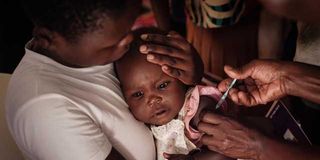
A child gets malaria jab at Kimogoi Dispensary in Vihiga County in 2023.
"Treatment is part of prevention. For malaria to be transmitted, the mosquito picks up the parasite from a positive patient. When you treat the patient, you are also controlling transmission," Mbom explained.
A further complication is asymptomatic infection. The county conducted a survey and found that many people, particularly school-going children, carry the parasite without showing any signs of illness.
"We are having a challenge because we are having several people carrying this parasite without showing the signs and symptoms. So these are people who are harbouring the parasite," he said.
Prof Walter Otieno, a paediatrician and child health specialist who played a key role in malaria vaccine development studies, told Nation that while he has not personally seen an increase in malaria cases among his patients, he advises parents in endemic areas to vaccinate their children and ensure they sleep under insecticide-treated mosquito nets, particularly in the evenings when mosquitoes are most active.
"Malaria transmission depends on temperature and rainfall, and in areas where there is deforestation, there will likely be a spike in cases," he said.
Like Mbom, he recommends Indoor Residual Spraying in areas recording a rise in cases. He also advises people to screen their windows and doors, clear bushes around their homes and drain any stagnant water.
Otieno explained that in areas of very high transmission, asymptomatic infections are common because of repeated exposure over time.
"We say that they have developed concomitant immunity. This means that you get low parasite levels, you have an infection, it could even be persistent, but you don't develop severe disease. This is due to repeated exposure, so that your body is able to control the infection, but not eliminate it," he said.
He urged people in those regions not to assume that any fever is automatically malaria, but to get tested and let a health worker prescribe the appropriate antimalarials as recommended by the Health ministry.
Follow ourWhatsApp channel for breaking news updates and more stories like this.